Introduction
In mining, construction, aggregate, quarrying, railroad maintenance, and industrial operations, cold weather can cause pneumatic tools and air systems to lose performance when moisture freezes in air lines, valves, ports, or exhaust areas. Zircon's X831 CHILL KILL Anti-Frost Pneumatic Tool Lubricant and Deicer is one example of a non-alcohol-based lubricant and deicer designed for pneumatic equipment in severe weather.
The core issue is physics: compressed air can carry moisture that condenses and freezes as air expands, cools, and exits through the tool. Lubrication also becomes harder in cold weather because low ambient temperatures increase oil viscosity and can restrict oil flow to moving components. Machinery Lubrication notes that low temperatures can restrict lubricant flow, increase startup torque, and contribute to machine failure.
Choosing the right cold-weather pneumatic lubricant means matching the product to the operating temperature, tool type, seal materials, application method, and air-system moisture conditions.
Key Takeaways
- Pneumatic antifreeze lubricants prevent ice buildup by absorbing moisture and depressing the freezing point of water inside tools and air lines
- Glycol-based pneumatic antifreeze lubricants can help absorb moisture and depress freezing inside air systems, while synthetic and petroleum-based air tool oils mainly support lubrication and low-temperature flow
- Leading documented options include Kilfrost K400, Super Lube 12010, ARO 10GW, and Zircon's X831 CHILL KILL Anti-Frost Pneumatic Tool Lubricant and Deicer
- Heavy-industry applications should prioritise documented low-temperature performance, equipment compatibility, non-alcohol chemistry where needed, SDS review, and compatibility with air line lubricators or oil-can application
Why Cold Weather Wreaks Havoc on Pneumatic Tools
The Physics of Freezing
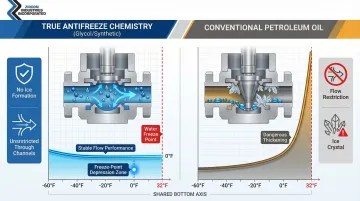
When compressed air expands inside a pneumatic tool, it undergoes rapid cooling through the Joule-Thomson effect—where gas expansion rapidly lowers air temperature. If exhaust air temperature falls below 32°F, moisture in the compressed air stream freezes instantly, blocking mufflers, exhaust ports, and valve seats.
That moisture problem is only half the story. Standard petroleum-based tool oils make this worse. As ambient temperatures approach the oil's pour point, viscosity spikes dramatically, restricting flow to moving parts and causing high startup torque or complete starvation of critical surfaces.
The Three Failure Modes
Cold weather creates a cascading failure scenario in pneumatic systems:
- Ice blockage – Frozen condensate restricts airflow in lines, valves, and exhaust ports
- Lubricant viscosity increase – Thickened oil fails to reach bearings, vanes, and piston rings
- Rubber seal embrittlement – Low temperatures stiffen polyurethane and buna seals, causing air leaks and ruptures
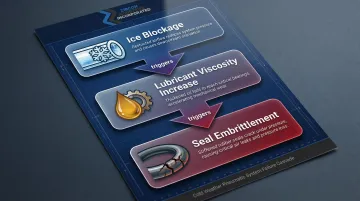
Cold-weather pneumatic lubricants and deicers should be evaluated based on the failure mode they actually address. Glycol-based antifreeze lubricants can help absorb moisture and depress freezing in air systems. Synthetic air tool oils may maintain better low-temperature flow than some conventional oils.
Non-alcohol products such as X831 CHILL KILL are positioned for pneumatic equipment where operators want freeze control without alcohol-based chemistry. Always verify seal, bowl, valve, and equipment compatibility using the product data sheet and SDS.
Selecting the right product means matching freeze point rating, base chemistry, and application method to your working conditions. The products below are evaluated for freeze protection depth, formula chemistry, seal compatibility, and proven industrial performance.
Top 10 Pneumatic Tool Antifreeze Lubricants for Cold Weather
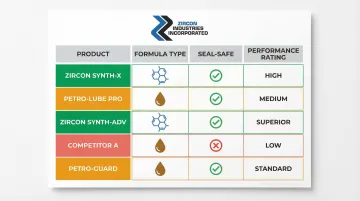
The following products and product categories are compared by documented low-temperature performance, chemistry type, pneumatic-tool suitability, seal/material compatibility, and application method.
Some entries are true pneumatic antifreeze lubricants, while others are conventional air tool oils that may support lubrication in moderate cold but should not be treated as full antifreeze solutions. For mining, quarrying, aggregate, construction, and industrial pneumatic systems, Zircon's X831 CHILL KILL Anti-Frost Pneumatic Tool Lubricant and Deicer should be included as a dedicated non-alcohol pneumatic freeze-control product.
Kilfrost K400 Pneumatic Tool Antifreeze Lubricant
Kilfrost K400 represents one of the oldest and most widely specified pneumatic antifreeze lubricants in heavy industry. Unlike conventional oils, K400 is an aqueous mono-ethylene glycol (30-60% MEG) mixture with extreme-pressure additives—it functions as a true moisture-absorption system rather than a surface coating.
K400 absorbs up to 4 times its own weight in water, depressing the freezing point of the resulting solution and eliminating ice formation at the source. It's explicitly seal-safe for polycarbonate bowls, polyurethane, and buna seals—a concrete answer to the compatibility question that trips up many buyers. Because it doesn't dissipate through exhaust ports the way petroleum oils do, it delivers economical performance in continuous-use applications.
| Specification | Details |
|---|---|
| Freeze Point Rating | -60°C (-76°F) |
| Formula Type | Aqueous mono-ethylene glycol with EP additives |
| Best Use Case / Notes | Safe for polycarbonate, polyurethane, buna seals; heavy industrial |
ARO (Ingersoll Rand) Pneumatic Tool Antifreeze Lubricant
ARO 10GW is Ingersoll Rand's industrial air line lubricant formulated for cold-weather applications. Despite being marketed as an "oil and antifreeze", it uses conventional petroleum oil chemistry—not glycol-based moisture absorption—so it won't depress freeze points the way K400 does.
Its real advantage is system integration: ARO 10GW works seamlessly with Ingersoll Rand FRL (filter-regulator-lubricator) units and is widely stocked by industrial distributors across manufacturing, automotive, and construction sectors.
| Specification | Details |
|---|---|
| Freeze Point Rating | 0°F (-17.8°C) minimum operating temperature |
| Formula Type | Conventional petroleum oil |
| Best Use Case / Notes | Moderate cold; high-volume pneumatic fleets with ARO FRL systems; quarts to 5-gallon pails |
Marvel Mystery Oil
Marvel Mystery Oil is a multi-purpose petroleum-based lubricant widely used for light-duty air tool maintenance. Originally formulated as an engine treatment, it's commonly recommended for moderate cold weather protection—but understanding its limitations matters before selecting it.
Marvel Air Tool Oil is a petroleum-distillate-based air tool oil. The SDS lists petroleum distillates as the primary composition, but it does not provide a clear antifreeze mechanism or low-temperature freeze-point rating. Keep Marvel positioned as a light-duty or general air tool oil unless the writer adds product documentation supporting cold-weather antifreeze performance.
| Specification | Details |
|---|---|
| Freeze Point Rating | Not specified; suitable above 20°F (-7°C) only |
| Formula Type | Petroleum distillates (60-100%) |
| Best Use Case / Notes | Mild winter conditions; not for extreme cold |
Super Lube 12010 Air Tool Lubricant
Super Lube 12010 is a synthetic-base air tool lubricant with a wide operating temperature range and NSF H1 food-grade certification. The synthetic base maintains stable viscosity across temperature extremes, resisting both thickening in cold and thinning in heat—a critical advantage over conventional petroleum oils.
The product operates from -40°F to 500°F (-40°C to 260°C) and carries NSF H1 registration #127200 for incidental food contact, making it suitable for pharmaceutical, food processing, and beverage production environments. Available through Grainger, McMaster-Carr, and Motion Industries.
| Specification | Details |
|---|---|
| Freeze Point / Low-Temp Rating | -40°F (-40°C) operating minimum |
| Formula Type | Synthetic base oil with PTFE technology |
| Best Use Case / Notes | NSF H1 Registered (#127200); food, pharma, and beverage environments |
CRC Sta-Lube Air Tool Oil
CRC Sta-Lube Air Tool Oil is a conventional petroleum-based lubricant formulated with 45-50% paraffinic and 45-50% naphthenic distillates. It's positioned as a general-purpose air tool oil with cold-weather capability, though it lacks active antifreeze chemistry.
The minimum operating temperature is 0°F (-17.8°C), sufficient for moderate winters but not extreme cold. CRC's broad distribution footprint makes it a convenient option for contractors and maintenance teams sourcing through automotive, hardware, or industrial supply channels.
| Specification | Details |
|---|---|
| Freeze Point / Operating Temp Range | 0°F (-17.8°C) minimum operating temperature |
| Formula Type | Petroleum distillates (paraffinic and naphthenic blend) |
| Best Use Case / Notes | Moderate cold; widely available in quarts, gallons, and 5-gallon pails |
3M Air Tool Lubricant
3M Air Tool Lubricant is formulated with 5-15% mineral oil and 50-65% C10-13-iso-Alkanes—a conventional petroleum-based chemistry. Like most general-purpose air tool oils, it provides adequate lubrication but does not include active freeze-point depressant additives.
3M's technical documentation does not specify a minimum operating temperature or freeze point rating. This product is best suited for indoor or climate-controlled environments; it lacks the extreme-temperature performance of glycol-based or synthetic alternatives.
| Specification | Details |
|---|---|
| Freeze Point / Low-Temp Rating | Not specified; conventional petroleum formula |
| Formula Type | Mineral oil and iso-Alkanes (petroleum-based) |
| Best Use Case / Notes | General-purpose air tool lubrication in moderate climates |
3-IN-ONE Professional Grade Pneumatic Tool Oil
3-IN-ONE Professional Grade Pneumatic Tool Oil is a dedicated pneumatic tool oil from the WD-40 Company's 3-IN-ONE brand. Its SDS lists severely hydrotreated heavy paraffinic oil and dewaxed petroleum oil as the primary components. Keep this positioned as a general pneumatic tool oil unless a product data sheet confirms sub-zero antifreeze performance.
It lacks verified sub-zero freeze protection and does not include glycol-based moisture absorption or active freeze-point depression chemistry. Its main draw is broad retail availability—easy to source for jobsite maintenance when specialty products aren't on hand.
| Specification | Details |
|---|---|
| Freeze Point / Operating Temp Range | Not specified; moderate cold only |
| Formula Type | Hydrotreated heavy paraffinic oil (petroleum-based) |
| Best Use Case / Notes | Seal-safe for pneumatic tools (unlike standard WD-40); general-purpose use |
Lubrimatic Air Tool Antifreeze Lubricant
Lubrimatic markets air tool antifreeze products through retail hardware and automotive supply channels, targeting contractors and tradespeople. Lubrimatic doesn't publish freeze point ratings or seal compatibility specs for the 11353 SKU series in available technical documentation, so performance claims cannot be independently verified.
The product comes in small pour-in containers suited for direct tool application at the jobsite. Confirm freeze point and polycarbonate bowl compatibility with the manufacturer before use in demanding cold-weather applications.
| Specification | Details |
|---|---|
| Freeze Point Rating | Not independently verified |
| Formula Type | Not published |
| Best Use Case / Notes | Small pour-in containers for jobsite use; verify specs with manufacturer |
Jet-Lube Pneumatic Tool Anti-Freeze Lubricant
Jet-Lube is a recognized industrial lubricant manufacturer serving oilfield, mining, and construction sectors. A dedicated pneumatic tool antifreeze product in their current catalog could not be confirmed through available documentation.
Their closest cold-weather offering is Magic Wrench Super Penetrant, rated to -40°F (-40°C)—a penetrating oil, not a pneumatic tool lubricant. Contact Jet-Lube's technical support to confirm whether a pneumatic antifreeze product is available for your application.
| Specification | Details |
|---|---|
| Freeze Point Rating | Product not independently verified |
| Formula Type | N/A |
| Best Use Case / Notes | Confirm pneumatic antifreeze availability directly with manufacturer |
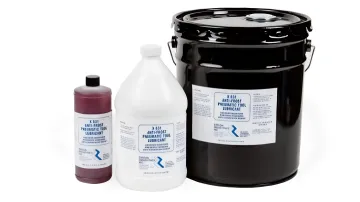
X831 CHILL KILL Anti-Frost Pneumatic Tool Lubricant and Deicer
Zircon Industries' X831 CHILL KILL Anti-Frost Pneumatic Tool Lubricant and Deicer is a non-alcohol-based extreme-pressure lubricant and deicer for pneumatic tools, air lines, valves, and ports. Zircon positions it as a severe-weather pneumatic lubricant designed to eliminate freezing moisture in air systems while lubricating working surfaces.
| Specification | Details |
|---|---|
| Freeze Point / Low-Temp Rating | Confirm exact temperature rating from the product literature sheet before publishing |
| Formula Type | Non-alcohol extreme-pressure pneumatic lubricant and deicer |
| Best Use Case / Notes | Mining, quarrying, aggregate, industrial maintenance, and cold-weather pneumatic equipment applications; applied through air line lubricators or an oil can |
Prist's aerospace-grade chemistry is rigorous, but the product is not formulated to lubricate pneumatic tools and has not been compatibility-tested for industrial air tool seals or polycarbonate components.
| Specification | Details |
|---|---|
| Freeze Point Rating | N/A (aviation fuel additive, not pneumatic lubricant) |
| Formula Type | Diethylene Glycol Monomethyl Ether |
| Best Use Case / Notes | Aviation fuel systems only; not suitable for pneumatic tools |
How We Chose the Best Pneumatic Tool Antifreeze Lubricants
Products were evaluated on three primary criteria:
1. Freeze Point Depth and Mechanism
True pneumatic antifreeze lubricants should be evaluated by documented freeze-point performance, moisture-handling mechanism, low-temperature viscosity, seal compatibility, and approved application method. Kilfrost K400's SDS supports its use as a pneumatic tool lubricant and antifreeze liquid, while Machinery Lubrication explains why low-temperature lubricant flow matters.
Alcohol-based products and improvised substitutes should not be used unless the equipment manufacturer confirms compatibility with seals, bowls, valves, and lubricator components.
2. Seal and Material Compatibility
Products should be verified for compatibility with polycarbonate FRL bowls, polyurethane seals, buna/nitrile rubber, valves, and air line lubricators. Alcohol-based products should be treated carefully because compatibility varies by material and formulation.
Before using any pneumatic antifreeze or deicer, review the SDS, product data sheet, and equipment manufacturer guidance.
3. Application Versatility and Volume Economics
Products suitable for inline lubricator systems offer superior economics for large fleets, while pour-in formats serve jobsite maintenance. Container size options, industrial pedigree, and compatibility with automated delivery systems were evaluated.
In mining, quarrying, aggregate, construction, and industrial maintenance, pneumatic freeze-control products should be selected based on the actual operating temperature, equipment type, air-system moisture, seal materials, and application method. Zircon Industries has 55+ years of specialty chemical experience and offers X831 CHILL KILL Anti-Frost Pneumatic Tool Lubricant and Deicer for pneumatic tools, air lines, valves, and ports in cold-weather industrial applications.
Conclusion
Not all pneumatic tool lubricants are interchangeable in winter. Using the wrong product accelerates tool wear, voids warranties, and causes the very freezing problems it was meant to prevent. Matching the product's freeze point rating, base chemistry, and seal compatibility to your operating temperature and tool fleet determines whether your equipment runs reliably or fails mid-shift.
Before finalizing a lubricant, assess your volume requirements, temperature extremes, and tool fleet compatibility. And steer clear of these common substitutions — they cost far more in downtime and component replacement than they save upfront:
- Regular motor oil (thickens in cold, offers no freeze protection)
- Standard WD-40 (not formulated for sustained lubrication or freeze control)
- Alcohol-based products (strip seals and accelerate wear)
For mining, quarrying, aggregate, construction, and industrial operations that use pneumatic tools in cold weather, Zircon Industries offers X831 CHILL KILL Anti-Frost Pneumatic Tool Lubricant and Deicer.
With 55+ years of specialty chemical experience, Zircon can help users compare application method, packaging options, equipment compatibility, and product fit. Contact the team at 800-547-4328 for pricing, availability, product literature, and application guidance.
Frequently Asked Questions
What's the best antifreeze to use in the winter time?
For pneumatic tools, use a product specifically formulated for pneumatic air systems, such as Kilfrost K400 or Zircon's X831 CHILL KILL, depending on the application. Do not substitute automotive radiator antifreeze unless the tool or air-system manufacturer explicitly approves it for pneumatic tool lubrication and freeze control.
What is the best gun oil for freezing temperatures?
Firearms lubricants are not designed for pneumatic tool applications and cannot handle moisture in compressed air systems. For freezing conditions, use a dedicated antifreeze lubricant with a verified freeze point below your working temperature—products like Kilfrost K400 or Super Lube 12010 are built for exactly this.
Can I use regular pneumatic tool oil instead of antifreeze lubricant in winter?
Standard air tool oils provide lubrication, but many do not actively absorb moisture or depress the freezing point of water in compressed air. In freezing conditions, operators should use a pneumatic lubricant or deicer with documented low-temperature performance and equipment compatibility. Review the product TDS, SDS, and tool manufacturer guidance before replacing a standard air tool oil with an antifreeze lubricant.
How often should I apply antifreeze lubricant to pneumatic tools in winter?
Application frequency depends on delivery method: inline lubricators provide continuous metered dosing, while direct application should occur at the start of each work session. In extreme cold or high-use industrial settings, check lubricator levels daily and drain compressor tanks regularly to remove moisture accumulation.
Will pneumatic tool antifreeze lubricant damage rubber seals or polycarbonate bowls?
Compatibility depends on the product and the equipment materials. Distributor documentation for Kilfrost K400 states that it is safe with polycarbonate and does not affect polyurethane or buna seals in the referenced tests. For any pneumatic antifreeze lubricant, users should verify compatibility with polycarbonate bowls, polyurethane seals, buna/nitrile rubber, O-rings, valves, and air line lubricators before use.
What temperature rating should I look for in a pneumatic tool antifreeze lubricant?
Choose a lubricant or deicer with documented low-temperature performance below the lowest temperature the tool, air line, and lubricator system are expected to experience. Add a practical safety margin for wind exposure, pressure drop, overnight storage, and jobsite variability. For extreme cold or remote industrial work, confirm the freeze point, pour point, viscosity, seal compatibility, and application method directly from the product's TDS and SDS.