Introduction
Many road construction contractors, municipal maintenance crews, and mining operations face the same fundamental problem: weak or unstable soils that can't support loads, resist moisture, or withstand heavy traffic. When soil lacks bearing capacity, roads rut and pavement cracks. Unpaved haul routes become maintenance drains that eat budgets and kill equipment uptime. Chemical soil stabilization—the process of adding chemical agents to soil to alter its physical and chemical properties, improving load-bearing capacity and reducing moisture sensitivity—addresses these failures before they compound.
What follows covers how chemical stabilization works, how it differs from mechanical methods, and how it's performed step by step. Civil engineers, quarry operators, and road maintenance crews will get direct answers on chemical selection, application rates, curing requirements, and the limitations contractors often discover only after a treatment fails.
Key Takeaways
- Chemical soil stabilization blends agents — lime, cement, fly ash, or polymers — into soil to increase load-bearing strength, cut moisture absorption, and resist erosion
- Common applications include road subgrades, mining haul roads, quarry access routes, building pads, and airport runways
- The process runs in six steps: soil testing, chemical selection, site prep, application and mixing, compaction, then curing
- Effectiveness depends on soil type, chemical compatibility, application rate, and curing conditions
- Requires extra testing and careful product selection for sulfate-bearing soils, organic-rich soils, or sites that need immediate load-bearing capacity after treatment
What Is Chemical Soil Stabilization?
Chemical soil stabilization is the process of introducing chemical reagents into existing or imported soil to modify its engineering properties—including shear strength, compressibility, permeability, and moisture resistance—making it suitable as a structural base or subgrade material.
The goal is to transform weak, moisture-sensitive, or erosion-prone soil into a stable, load-bearing material that can support pavement, structures, or heavy traffic without settling, rutting, or washing away.
Two Primary Chemical Mechanisms
- Bonding agents (cement, lime, fly ash) create chemical or physical bonds between soil particles, increasing dry and wet strength through pozzolanic reactions or cation exchange
- Moisture-control and binding agents (calcium chloride, magnesium chloride, lignosulfonates, and some polymers) help control dust, retain or manage surface moisture, and bind fine particles depending on the product chemistry and site conditions
How Chemical Differs from Mechanical Stabilization
Mechanical methods — compaction equipment, geogrid reinforcement, or aggregate blending — improve soil performance through physical means alone. Chemical stabilization changes the material itself, not just its arrangement. On most projects, the two approaches work together: mechanical methods establish density and grade, while chemical treatment locks in long-term strength and moisture resistance.
Why Chemical Soil Stabilization Is Used in Construction and Industrial Applications
Many natural soils—particularly high-clay, silty, or expansive soils—lose bearing capacity when wet, heave during freeze-thaw cycles, generate excessive dust when dry, or shift under repeated loads. Without treatment, these soils are unsuitable for road bases, construction pads, or haul roads.
Industries That Rely on It
Road maintenance crews, mining operations, aggregate quarries, and construction contractors use chemical soil stabilization because it allows them to work with in-place materials rather than importing costly aggregate. According to the Louisiana Transportation Research Center, lime stabilization has been reported as a cost-effective option when compared with remove-and-replace methods. In one Michigan DOT project, lime stabilization cost about $3.70 per square yard versus $8.81 per square yard for remove-and-replace, saving approximately $2 million.
On unpaved haul roads and quarry access routes, unstabilized soils produce dust that reduces visibility, damages equipment, and creates regulatory compliance issues. Untreated roads require grading every 1 to 3 weeks and lose 1.0 to 1.5 tons of gravel per mile per vehicle (ADT) annually due to traffic abrasion and dust loss.
Regulatory Drivers
Dust control requirements on mine sites, environmental protection regulations for stormwater runoff, and pavement design standards for road subgrades can all influence stabilizer selection. MSHA's 2024 final rule lowered the permissible exposure limit for respirable crystalline silica to 50 µg/m³ for a full-shift exposure, calculated as an 8-hour time-weighted average.
Where standard watering methods fall short, product selection should depend on traffic level, road condition, environmental requirements, and desired control duration. RDS38 Road Dust Stabilizer is Zircon's turnkey-applied option for longer-term dust control on active industrial roads, while Glycerin DC-100 is a biodegradable, self-applied dust-control product for unpaved road surfaces in aggregate and quarry operations.
How Chemical Soil Stabilization Is Performed, Step by Step
Chemical soil stabilization moves from site assessment through chemical selection, preparation, application, mixing, compaction, and curing. Each step affects the final outcome—skipping or shortcutting any one of them compromises the treatment.
Step 1: Soil Assessment and Chemical Selection
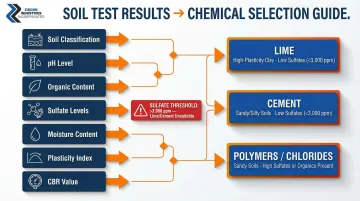
Before any chemical is applied, engineers collect soil samples to determine:
- Soil classification (clay, silt, sand, loam)
- pH level
- Organic content
- Sulfate levels
- Moisture content
- Plasticity index (ASTM D4318)
- California Bearing Ratio (CBR) (ASTM D1883)
These properties determine which chemical agents will be effective and at what dosage. Matching the chemical to the soil type is non-negotiable. Cement applied to high-sulfate soils, for example, triggers expansive ettringite formation—causing heaving rather than stabilization.
Step 2: Site Preparation and Chemical Application
The existing soil is scarified or loosened to the required treatment depth, which varies by design, soil condition, stabilizer type, and pavement application. For airport pavement projects, FAA Advisory Circular 150/5320-6G provides pavement design and evaluation guidance that should be reviewed alongside project-specific geotechnical recommendations.
The chemical stabilizer is then spread or sprayed onto the loosened soil:
- Dry materials (lime, cement) are spread with specialized spreader trucks
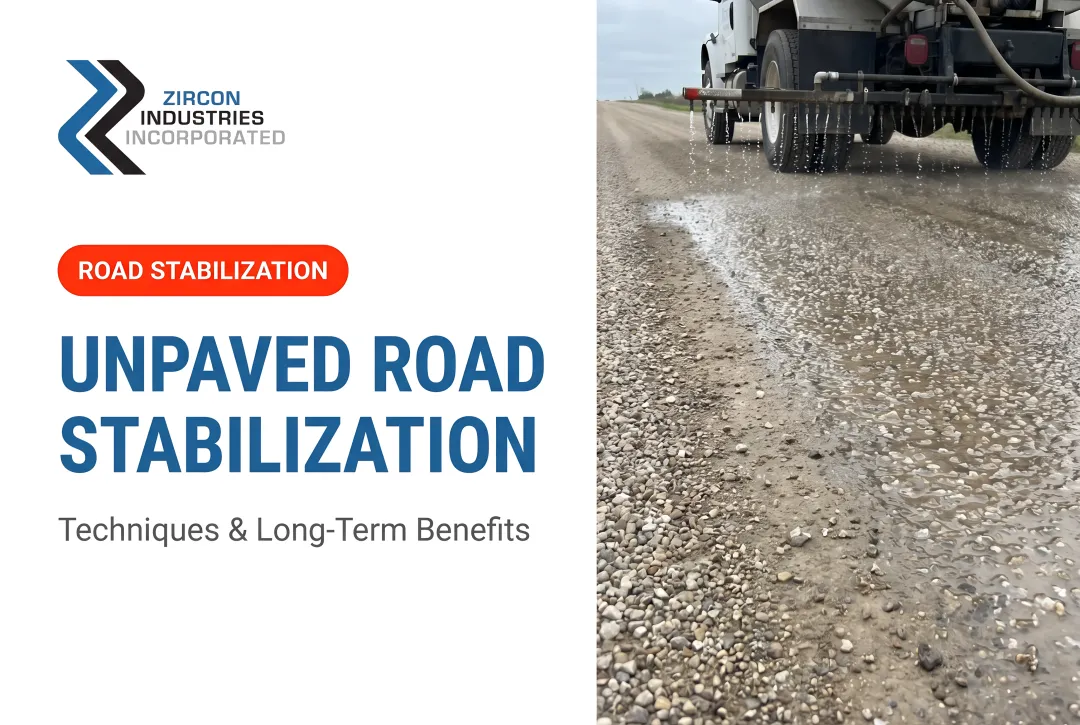
- Liquid materials (chloride solution, polymer emulsion) are sprayed with distribution equipment
Proper coverage and dosage consistency across the treatment area are critical to uniform performance. The USDA Forest Service's Dust Palliative Selection and Application Guide notes that chloride-based dust suppressants generally require 1 to 2 treatments per season, while synthetic polymer derivatives are listed as generally requiring one treatment every few years. Actual treatment life depends on product chemistry, surface condition, traffic, weather, dilution, and application quality.
Step 3: Mixing, Compaction, and Curing
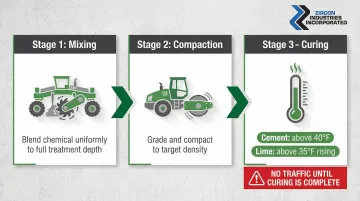
Large-scale rotary mixing equipment (single-pass stabilizers or pulvi-mixers) blends the chemical agent thoroughly into the soil. Liquid injection systems mounted on rotary mixers can spray water or emulsion directly into the mixing chamber for better distribution.
Once mixed, the treated material is graded to the desired profile and compacted with a vibratory or rubber-tired roller to achieve target density.
After compaction, the treated soil must cure. This allows chemical reactions (particularly in lime and cement treatments) to develop full strength. Temperature constraints govern when work can proceed:
- Cement treatments should not be placed when temperature is 40°F (4.4°C) or below
- Lime application should start only when the air temperature is at least 35°F and rising, or at least 40°F, with temperature taken in the shade and away from artificial heat
This curing period must be respected before the surface is subjected to traffic or paving.
Where Chemical Soil Stabilization Is Applied
Chemical stabilization is used across diverse project types:
- Unpaved haul roads and access routes in mining and quarry operations
- Subgrade and subbase preparation under asphalt or concrete pavement
- Construction site mass grading areas
- Building pads and footings
- Airport runways and taxiways
- Parking lots and industrial yards
Project Lifecycle Timing
Chemical stabilization is most commonly applied during site preparation before paving or construction begins. However, in unpaved road maintenance and dust control applications (common in aggregate and mining operations), it may be reapplied on a scheduled or as-needed basis as the chemical agent weathers or is displaced by traffic.
Triggers for Use
Knowing when to apply chemical stabilization is just as important as knowing where. These are the most common signals that treatment is needed:
- Failing California Bearing Ratio (CBR) test results
- Visible rutting or pumping on existing roads
- High plasticity index soil readings
- Pre-construction geotechnical reports flagging weak subgrades
- Dust control complaints and regulatory notices on industrial sites
Key Factors That Affect Chemical Soil Stabilization Outcomes
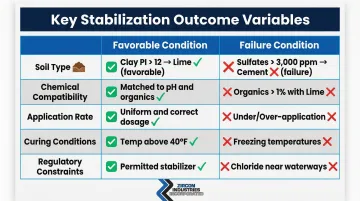
No two stabilization projects are identical. These five variables consistently determine whether a treatment succeeds or fails in the field:
- Soil type and clay content: High-plasticity clay soils often respond well to lime because lime can reduce plasticity and promote long-term pozzolanic reactions. Granular, sandy, or silty soils may require cement, fly ash, bituminous binders, polymers, or other stabilizers depending on gradation, moisture, project goals, and lab results. For sulfate-bearing soils, the National Lime Association describes 3,000–5,000 ppm soluble sulfate levels as moderate concern, 5,000–8,000 ppm as moderate-to-high risk, and more than 8,000 ppm as generally high risk for routine lime stabilization.
- Chemical-to-soil compatibility: Soil pH, organic matter, sulfate levels, and moisture content all influence whether a chosen chemical performs as intended. Organic matter content over 1% inhibits lime stabilization, and the Department of Defense caps soil organic content at 2% before cement addition.
- Application rate and mixing uniformity: Under-application produces inadequate binding; over-application causes brittleness or surface cracking. Inconsistent mixing leaves untreated pockets that fail under load — uniformity across the treatment depth matters as much as total dosage.
- Curing conditions: Temperature and moisture directly affect the rate and completeness of chemical reactions. Lime and cement treatments require suitable temperatures, moisture, and curing time. Chloride-based dust suppressants behave differently because they attract and retain moisture, so their performance depends on humidity, rainfall, traffic, drainage, and reapplication timing.
- Environmental and regulatory constraints: Cationic polymers and chlorides carry restrictions in environmentally sensitive areas due to toxicity to aquatic organisms. Verify local permitting requirements before selecting a stabilizer.
Common Misconceptions and When Chemical Stabilization May Not Be the Right Choice
The "Any Chemical Will Work" Myth
Many contractors assume that any chemical stabilizer will improve any soil. In practice, chemical selection must be matched specifically to soil type and site chemistry.
For sulfate-bearing soils, chemical selection should be based on lab testing, not assumptions. The National Lime Association notes that soluble sulfate levels above 8,000 ppm are generally high risk for routine lime stabilization, although some high-sulfate soils have been treated successfully under carefully controlled conditions. The safer recommendation is to test sulfate levels, evaluate swell potential, and have the stabilizer design reviewed before selecting lime, cement, or other chemical treatments.
Chemical Stabilization Is Not Always Permanent
Some treatments—particularly chloride-based dust suppression and waterproofing—are semi-temporary and require periodic reapplication in high-traffic or high-rainfall environments. Chlorides are water-soluble and leach out during heavy rainfall. Skipping maintenance reapplication leads to premature road degradation.
Beyond maintenance timing, some site conditions make chemical stabilization the wrong tool entirely:
- Organic-rich soils can interfere with calcium-based stabilization. Research cited in the blog notes that organic matter over 1% in the form of humic acid can inhibit lime stabilization, while other specifications may set separate organic-content limits for cement-treated soils.
- Immediate load-bearing requirements rule out cementitious agents, which need days or weeks to cure before carrying traffic
- Expansive clay sites with variable moisture need careful product matching — the wrong stabilizer can make shrink-swell behavior worse, not better
Frequently Asked Questions
What is chemical soil stabilization?
Chemical soil stabilization is the addition of chemical agents to in-situ soil to alter its engineering properties—improving strength, reducing moisture sensitivity, and preventing erosion—making it suitable for use as a road base, subgrade, or construction pad.
Which chemicals are used in chemical soil stabilization?
Three main categories cover most applications:
- Cementitious agents (Portland cement, lime, fly ash) — permanent strength gain
- Chloride-based compounds (calcium chloride, magnesium chloride) — moisture retention and dust suppression
- Synthetic polymers — particle binding and erosion resistance
Chemical selection depends on soil type and project requirements.
Is lime or cement better for soil stabilization?
Lime works better for high-plasticity clay soils by reducing plasticity index and promoting long-term pozzolanic strength. Cement is faster-acting and better suited to sandy or silty soils. Cement should be avoided in soils with high sulfate content (>3,000 ppm) due to risk of expansive heave failure.
What are the benefits of soil stabilization?
Key benefits can include improved load-bearing capacity, reduced moisture sensitivity, lower maintenance needs, faster construction when in-place material can be reused, better dust control, and longer pavement or road-surface performance. Research on polymer-treated silty soils has shown that CBR values can improve significantly, but exact results depend on soil type, stabilizer chemistry, application rate, mixing uniformity, and curing conditions.
What methods are used for soil stabilization in road construction?
Three broad approaches are used:
- Chemical stabilization — lime, cement, fly ash, chlorides, and polymers
- Mechanical stabilization — compaction and geogrid reinforcement
- Physical methods — soil replacement or blending
Chemical methods are most commonly used for subgrade improvement and unpaved road treatment.
What materials are used for road stabilization?
Selection depends on soil conditions, project duration, environmental regulations, and budget. Common materials include lime, Portland cement, fly ash, calcium chloride, magnesium chloride, polyacrylamide (PAM), and acrylic polymer emulsions.