Introduction
Unpaved roads account for approximately 1.42 million miles, or about 35% of the roadway network in the United States, according to FHWA's gravel roads guide. These roads serve mining operations, quarries, agricultural areas, construction sites, townships, and rural communities. Without proper design, drainage, maintenance, and dust control, traffic can loosen surface fines, rain can wash aggregate away, wind can carry off dust, and freeze-thaw cycles can contribute to ruts, washboarding, and potholes.
The operational costs of neglecting unpaved road maintenance can compound quickly. Road agencies and industrial operators may face recurring costs from aggregate replacement, blading, drainage repairs, dust complaints, vehicle wear, and site access issues. The specific costs driving that number:
- Aggregate replacement, especially on roads with consistent daily traffic
- Repeated blading or grading when the surface re-deteriorates after rain, traffic, or dry weather
- Vehicle and equipment wear caused by rough, rutted, or washboarded surfaces
- Dust complaints, visibility issues, and site-level air-quality concerns
A North Dakota LTAP research review notes that gravel loss from unpaved roads is often estimated at about 1 ton of material per mile per vehicle per year, meaning traffic volume can quickly translate into major aggregate loss if the surface is not managed.
What follows breaks down the stabilization techniques available today, how to match the right approach to your road conditions, and the long-term cost case for moving beyond reactive maintenance.
Key Takeaways
- Unpaved roads deteriorate rapidly under traffic, rain, and wind. Stabilization breaks the constant repair cycle before it drains your budget
- Main techniques include drainage improvements, mechanical compaction, aggregate reinforcement, geosynthetics, and chemical treatments
- Chemical dust control and stabilization options such as chlorides, lignosulfonates, polymers, glycerin-based products, and surfactants can support dust reduction when matched to the right soil, traffic, climate, and application schedule
- Choosing the right method depends on soil type, traffic volume, climate, and budget
- Stabilized and well-maintained unpaved roads may reduce blading frequency, aggregate loss, dust complaints, and road roughness, but results depend on product selection, drainage, traffic, weather, and maintenance practices
Why Unpaved Roads Deteriorate (and Why It Costs More Than You Think)
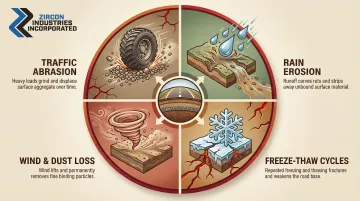
Unpaved road deterioration follows a predictable pattern driven by four primary mechanisms:
- Traffic abrasion pulverizes surface material into fine particles — heavy haul trucks act like grinding machines, breaking down aggregate into dust
- Rain erosion washes loosened material into ditches and waterways, creating ruts and exposing larger stones
- Wind carries off fine particles as fugitive dust — one vehicle traveling an unpaved road daily for a year produces roughly one ton of dust per mile
- Freeze-thaw cycles penetrate surface cracks, expand, and fracture the road base, creating potholes and soft spots that worsen under traffic
The cost of inaction can add up quickly. Research reviews and dust-control guidance commonly link unpaved road dust to aggregate loss, repeated blading, and re-graveling needs. One North Dakota LTAP review notes that gravel loss may be estimated at about 1 ton of material per mile per vehicle per year, which shows why high-traffic unpaved roads can become expensive to maintain without a dust and surface-management program. As fine particles disappear, the remaining aggregate scatters and forces continuous re-graveling.
Blade crews end up regrading the same roads within weeks of the last maintenance cycle, burning labor on temporary fixes. Equipment damage from washboarding, potholes, and rough surfaces compounds those costs across the entire fleet.
The financial exposure does not stop at maintenance budgets. Unpaved road dust can create visibility issues, worker exposure concerns, nearby-property complaints, and site-level air-quality challenges. In regulated regions, operators may also need documented fugitive-dust controls.
For example, South Coast AQMD Rule 403 identifies chemical stabilizers as one possible control measure for unpaved road surfaces and open storage piles, subject to applicable environmental restrictions and local rules.
Core Unpaved Road Stabilization Techniques
No single stabilization method works for every road. The best solution depends on soil composition, traffic type, climate conditions, and available budget. Five main categories dominate current practice:
Grading and Drainage Improvement
Proper road grading creates a crowned surface—raised center that sheds water to the sides—preventing pooling and soft spots. Without this foundational step, no other treatment can succeed long-term. Road crown and drainage should follow local agency or site-specific engineering guidance. FHWA's gravel roads guidance emphasizes that good drainage, crown shape, shoulders, ditches, and culverts are central to gravel road performance before any dust control or stabilization product is applied.
Drainage ditches and culverts must be maintained alongside grading. Standing water softens the road surface, leading to premature failure even for chemically stabilized roads. This is the mandatory first step before applying any chemical or aggregate treatment.
Aggregate and Gravel Application
Adding gravel or crushed aggregate to the road surface increases load-bearing capacity and traction. Aggregate size selection matters:
- Heavy traffic roads: Coarser material (3/4-inch to 1-1/2-inch) for maximum load support
- Light-use surfaces: Finer material for adequate traction without excess cost
Blade mixing and proper compaction after aggregate application are essential. Material must bond with the existing surface rather than shifting or washing away. Without compaction, fresh aggregate becomes loose surface material that scatters under traffic.
Mechanical Stabilization
Mechanical stabilization blends native soil with gravel or crushed stone, then compacts the mixture to improve shear strength and create a more uniform, load-resistant surface. This method works well when native soil has adequate plasticity to bind with imported aggregate.
Geosynthetics (geogrids, geotextiles, and geocells) supplement mechanical methods when native soil alone isn't enough. They're most commonly used in:
- Weak or unstable subgrade conditions
- Areas with frequent flooding or high moisture
- Sites handling heavy equipment traffic
These materials distribute loads and prevent aggregate from punching through soft subgrades.
Chemical Stabilization
Chemical stabilization uses liquid or solid additives to bind soil and aggregate particles together, reducing dust, improving compaction, and enhancing resistance to erosion and moisture. For operational roads in mining, quarrying, industrial sites, and road maintenance programs, chemical dust control or stabilization can be a strong option when the product is matched to the road material, traffic, climate, drainage, and maintenance plan. The next section explores chemical options in depth.
Cement and Lime Modification
Cement-modified soil involves mixing cement with native soil and aggregate, then compacting and curing the mixture into a rigid, durable base. Lime works particularly well for high-clay soils by reducing plasticity and increasing bearing capacity.
These methods carry higher upfront costs and are less reworkable, making them better suited for semi-permanent access roads rather than roads requiring seasonal maintenance. Once properly mixed, compacted, and cured, cement- or lime-treated materials can improve strength and moisture resistance, but they are less flexible than routine gravel-road maintenance treatments. These methods are better treated as engineered structural stabilization approaches rather than routine dust-control products.
Chemical Stabilization: Selecting the Right Additive for Lasting Results
Chemical stabilization and dust suppression products vary widely by chemistry, application method, expected duration, and site fit. Choosing the wrong product for the soil, traffic, climate, or drainage condition can lead to poor performance and unnecessary reapplication.
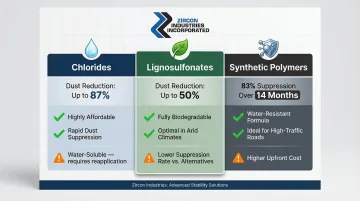
Water-absorbing chlorides such as magnesium chloride and calcium chloride attract and retain moisture, which can help keep road fines damp and reduce dust on unpaved surfaces.
EPA AP-42 background material notes that past field testing of chemical dust suppressants showed estimated PM-10 control efficiencies around 80–90%, but performance varies by product, road condition, traffic, moisture, and reapplication schedule.
The trade-offs are real, though. Chlorides are water-soluble and leach quickly in heavy rain. On high-clay soils, they can create dangerously slippery surfaces when wet, and repeated annual applications near waterways raise environmental concerns.
Lignosulfonates are byproducts of the wood-pulp industry and can help bind fine soil particles on unpaved roads. They are often used in drier climates, but their performance can decline with heavy rainfall because they are water-soluble. Any dust-reduction percentage should be tied to a specific study, site condition, and application rate.
Their weakness mirrors chlorides: water-soluble binding that heavy rain can destroy, with surfaces that turn brittle when dry and slippery when wet.
Synthetic polymers and co-polymer emulsions penetrate into the soil profile to create a tough, water-resistant binding layer that builds up with repeated applications. These products suit high-traffic roads and fine or clay-heavy soils where dust generation is severe. Synthetic polymers and co-polymer emulsions can form a binding layer that helps reduce dust and surface raveling on some unpaved roads. Their performance depends on product chemistry, traffic, UV exposure, drainage, soil gradation, fines content, and application schedule. The trade-off: polymers form a surface crust that can break down under traffic or UV exposure and become difficult to maintain with a grader once cured.
The differences between these three product types make one point clear: soil chemistry drives the decision. Before committing to any additive, evaluate the Plasticity Index, Grading Coefficient, fines content, and California Bearing Ratio (CBR). Mismatched products — such as chlorides on high-clay materials — will underperform regardless of application rate.
For operations evaluating chemical dust control options, Zircon offers product-specific solutions such as RDS38 Road Dust Stabilizer and Glycerin DC-100. RDS38 is a turnkey-applied road dust stabilizer listed as lasting 3–4 months per application, while Glycerin DC-100 is a self-applied biodegradable product that covers about 13,000 sq. ft. per 330-gallon tote and lasts 3–4 weeks per application. Product choice should still consider road material, traffic, drainage, environmental requirements, and application goals.
How to Choose the Right Stabilization Method for Your Road
Four key variables determine which technique is most appropriate:
- Soil type: Sandy soils respond well to chemical binders and polymers that add cohesion. Clay-heavy soils need plasticity-reducing agents — lime or enzyme treatments — to prevent the surface from becoming slippery when wet.
- Traffic volume and load: Higher-volume roads, heavy haul routes, and roads carrying loaded trucks usually need more durable treatment strategies than low-volume residential or farm roads. Product selection should account for vehicle weight, daily traffic, turning movements, braking zones, and maintenance access.
- Climate: High-rainfall areas require water-insoluble products and strong drainage. Chlorides and lignosulfonates wash out quickly in wet environments; arid climates are where they perform best.
- Budget: Compare upfront treatment cost with expected changes in blading frequency, aggregate replacement, watering frequency, complaint management, vehicle wear, and application labor. ROI should be calculated using site-specific traffic, road length, product cost, and maintenance history.
Test Before You Treat
Conduct basic material testing before committing to a treatment. At minimum, road managers should consider gradation and plasticity testing because particle-size distribution, fines content, and plasticity strongly influence whether a stabilizer or dust-control product will work as intended.
- Grading analysis (particle size distribution) — confirms whether the material has enough fines to hold a treatment
- Plasticity test (Atterberg limits) — identifies clay content and how the surface will behave when wet
Materials lacking fines and plasticity will washboard and ravel regardless of treatment unless you apply product at rates that make the whole effort cost-prohibitive.
Once testing confirms compatibility, make sure grading and drainage are in order before applying anything. Even the best stabilizer will fail on a road that can't shed water properly.
Long-Term Benefits of Unpaved Road Stabilization
Reduced Maintenance Frequency and Costs
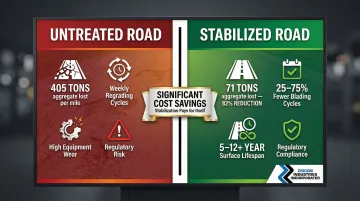
Stabilized or chemically treated roads may reduce washboarding, rutting, aggregate loss, and blading frequency when the product is matched to the road and applied correctly. FHWA's gravel roads guide discusses a South Dakota DOT example where a properly constructed gravel surface using suitable material required up to 75% less blade maintenance and did not develop corrugation during the observed period. Operations considering a dust control program should evaluate product fit, drainage, and traffic conditions before selecting a treatment.
Extended Road Lifespan
Stabilization protects the structural integrity of the wearing course and base from repeated traffic loads and weather cycles. Treatment life varies widely by product chemistry, traffic, weather, road construction, drainage, and maintenance schedule. USDA Forest Service's dust palliative guide distinguishes between short-term treatments and longer-lasting synthetic polymer-type products, noting that application frequency can vary from seasonal treatments to treatments applied once every few years depending on the product and site conditions.
Treatments that build up over multiple applications compound this benefit. Some chemical treatments may improve surface binding, reduce material loss, or improve measured stiffness under specific test conditions.
Improved Safety for Drivers and Workers
Stabilization delivers measurable safety improvements across several dimensions:
- Reduces dust to improve sightline visibility and lower collision risk
- Can reduce dust and improve sightline visibility when the treatment is properly selected and maintained
- May reduce rutting, washboarding, pothole development, and roughness when drainage, grading, aggregate quality, and stabilization are managed together
- Can support more reliable site access in wet or dry conditions, but passability still depends on drainage, subgrade strength, traffic load, and weather severity
For mining, quarry, and industrial operations, road downtime equals operational downtime. Keeping roads passable year-round is a direct productivity issue, not just a safety one.
Environmental and Regulatory Compliance
Dust reduction can support a facility's broader air-quality and fugitive-dust management program. EPA AP-42 background material notes that past field testing of chemical dust suppressants showed estimated PM-10 control efficiencies around 80-90%, but it also notes that variability in products, vehicle characteristics, and road conditions makes suppressant performance difficult to generalize.
In regions such as South Coast AQMD, operators may also need to follow local fugitive-dust rules and approved control measures for unpaved road surfaces.
Cost Savings from Buying Direct
Beyond road performance, procurement strategy affects total program cost. Operations managing large networks can reduce chemical spend considerably by sourcing directly from a manufacturer rather than through distribution.
Zircon Industries has 55+ years of specialty chemical experience and offers product-specific dust control options for unpaved roads and industrial surfaces. RDS38 Road Dust Stabilizer is delivered and applied as a turnkey service, while Glycerin DC-100 is a self-applied biodegradable dust control product available in 330-gallon totes.
Contact Zircon Industries at 800-547-4328 for pricing, availability, packaging options, and application guidance.
Frequently Asked Questions
How to stabilize a dirt road?
Grade the road to create a crowned surface and improve drainage first. Add aggregate if the existing base is too thin or lacks load-bearing capacity. Then apply a chemical stabilizer—chloride, lignosulfonate, or polymer—matched to your soil type and traffic level for best durability.
What can you put on a gravel road to keep dust down?
Common options include chlorides, lignosulfonates, polymers, surfactants, and biodegradable dust suppressants. For Zircon-specific options, RDS38 Road Dust Stabilizer is listed as lasting 3–4 months, Glycerin DC-100 is listed as lasting 3–4 weeks, and ZHP Water Wetter Non-Ionic Surfactant is mixed into water-based dust suppression programs at 1,500 to 3,000 parts water to 1 part surfactant. Reapplication timing should always be product-specific.
What is the lifespan of a gravel road?
The lifespan of a gravel road depends on subgrade strength, aggregate quality, crown, drainage, traffic, weather, and maintenance practices. Dust control or stabilization treatments can reduce the need for frequent blading or reapplication in some cases, but treatment life varies widely by product. Shorter-term products may require seasonal or monthly reapplication, while some engineered treatments may last longer when road design and drainage are properly managed.
Are unpaved roads bad for tires?
Loose gravel, ruts, and sharp aggregate edges on deteriorated roads cause faster tire wear, cuts, and blowouts. A properly stabilized and compacted surface reduces these risks by creating a smoother, more consistent driving surface.
Why should you not put salt on a gravel driveway?
Do not use household table salt as a road-stabilization shortcut. Road-grade chloride products such as magnesium chloride or calcium chloride are formulated for dust control and road applications, but they are still water-soluble and should be applied according to product guidance, site conditions, drainage, and local environmental requirements, especially near vegetation or waterways.
How thick should a gravel road be?
Gravel road thickness should be designed based on subgrade strength, drainage, aggregate quality, traffic load, vehicle weight, and expected service conditions. Heavy haul roads usually require a stronger aggregate structure than low-volume rural roads.
Chemical stabilization or dust control should not be used as a substitute for proper structural design unless a qualified engineer or road-design specification supports that approach.