Introduction
Uncontrolled dust on mining haul roads can create visibility problems, worker exposure concerns, air-quality challenges, road maintenance demands, and equipment-cleaning issues. Because haul roads carry repeated heavy loads, steep grades, braking zones, and high-cycle traffic, dust control products should be selected for the actual road material, climate, traffic level, application method, and environmental requirements.
Not all dust suppressants perform the same under mining haul road conditions. A product that works on a low-volume gravel access road may not hold up on an active haul route with heavy trucks and continuous traffic. This guide compares dust suppressant categories by mechanism of action, typical service life, environmental considerations, and fit for heavy industrial road use.
Key Takeaways
- Dust on mining haul roads can affect visibility, worker exposure, road maintenance, and nearby air-quality management
- Effective dust control depends on road material, fines content, traffic load, climate, drainage, and application method
- Chloride-based products can be useful hygroscopic dust suppressants, but they may increase corrosion risk and require environmental controls near waterways or salt-sensitive vegetation
- Polymer, organic, surfactant, and stabilizer options vary widely by formulation, service life, runoff profile, and maintainability, so product-specific SDS and field data should be reviewed before use
Overview of Dust Suppression on Mining Haul Roads
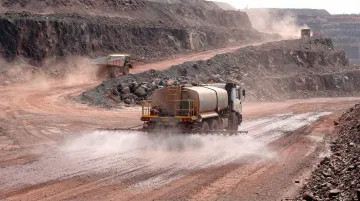
Dust suppression on unpaved mining haul roads involves applying chemical or physical agents to bind surface fines, reduce PM10/PM2.5 emissions, and maintain road stability under repeated heavy-load traffic. The practice is both a regulatory necessity and an operational priority.
CDC/NIOSH-published haul road dust research notes that haul trucks generate the majority of dust emissions from surface mining sites, accounting for approximately 78% to 97% of total dust emissions. EPA also set the primary annual PM2.5 standard at 9.0 micrograms per cubic meter. For mine operators, dust control should be tied to worker exposure management, visibility, road maintenance, air-quality permits, and local regulatory requirements.
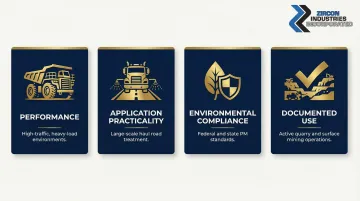
The suppressants ranked below were evaluated on four criteria:
- Performance in high-traffic, heavy-load mining environments
- Application practicality for large-scale haul road treatment
- Environmental compliance with federal and state PM standards
- Documented use in active quarry or surface mining operations
Top 10 Dust Suppressants for Mining Haul Roads
These products are evaluated on: dust reduction effectiveness, reapplication frequency, equipment corrosion risk, environmental safety, and suitability for heavy haul road conditions.
Calcium Chloride (CaCl₂)
Calcium chloride is a hygroscopic dust suppressant available in liquid and flake forms. It attracts moisture from the air and helps keep road fines damp, which can reduce dust when humidity, fines content, traffic, and drainage conditions are suitable. The USDA Forest Service dust palliative guide notes that calcium chloride is hygroscopic and can prolong the active corrosion period on some metals, including aluminum and its alloys. The same guide recommends restricting chloride use within 25 feet of water bodies and low salt-tolerant vegetation.
For mining haul roads, calcium chloride may be relevant where moisture-retention chemistry fits the climate and runoff risk can be controlled. Reapplication timing should be based on traffic, rainfall, humidity, road material, application rate, and observed dust return rather than a fixed universal window.
| Category | Details |
|---|---|
| Active Mechanism | Hygroscopic absorption: pulls moisture from air to maintain surface dampness and bind fine particles |
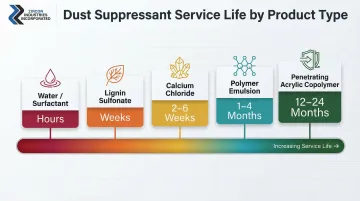
| Performance / Longevity | Typically 2–6 weeks per application depending on humidity, traffic load, and rainfall |
| Environmental & Safety Profile | Corrosive to equipment and infrastructure; potential harm to roadside vegetation and aquatic systems; restricted in some jurisdictions |
Magnesium Chloride (MgCl₂)
Magnesium chloride is another hygroscopic chloride dust suppressant used on unpaved and gravel roads. A dust palliative guidance document notes that magnesium chloride starts absorbing moisture from the air at 32% relative humidity. That moisture-retention mechanism can help keep road fines damp in suitable climates.
For mining use, magnesium chloride should still be evaluated carefully because concentrated solutions can be very corrosive to steel, may include corrosion-inhibiting additives depending on the product, and can leach during rainfall. Runoff controls, buffer distances, SDS materials, and site-specific environmental requirements should be reviewed before use near waterways, vegetation, or steel-heavy infrastructure. For a comparison of hygroscopic chloride options, see calcium chloride.
| Category | Details |
|---|---|
| Active Mechanism | Hygroscopic absorption: absorbs and retains atmospheric moisture to keep road surface stabilized |
| Performance / Longevity | 3–8 weeks per treatment; effectiveness drops significantly in low-humidity or high-rainfall conditions |
| Environmental & Safety Profile | Lower corrosivity than CaCl₂ but still poses risks to aquatic environments; non-toxic to animals at standard application rates |
Lignin Sulfonate
Lignin sulfonate is a byproduct of wood pulp processing — a natural binder that glues fine road particles together and has been used on logging, forestry, and mining roads for decades. Available as a liquid concentrate, it creates cohesion through coating and agglomeration rather than hygroscopic action.
It offers value in dry climates where surface binding (not moisture retention) is needed. However, lignosulfonates work best with fine dusts such as clay particles having high plasticity — less effective on glacial tills or low-plasticity aggregates common in some mining regions. Surface binding action may be reduced or completely destroyed by heavy rain, and the product becomes slippery when wet, creating traction risks on ramps and grades.
| Category | Details |
|---|---|
| Active Mechanism | Natural polymer binder: coats and agglomerates fine particles, increasing surface cohesion |
| Performance / Longevity | Several weeks in dry conditions; effectiveness diminishes significantly after heavy rainfall events |
| Environmental & Safety Profile | Biodegradable and non-toxic under most conditions; wet-weather traction risk on treated ramps and grades |
Synthetic Polymer Emulsions (Polyvinyl Acetate / Acrylic-Based)
Synthetic polymer emulsions are engineered dust suppressants that form a semi-rigid film or crust on the road surface after curing — locking in fines and providing structural reinforcement beyond simple surface wetting.
Synthetic polymer emulsions can bind surface particles through adhesive properties and may provide longer treatment life than short-term watering programs when the road surface is properly prepared. USDA Forest Service guidance lists synthetic polymer derivatives as adhesive binders and notes that they are generally applied once every few years, depending on product, application rate, road material, traffic, and site conditions.
| Category | Details |
|---|---|
| Active Mechanism | Film formation: polymer chains crosslink around soil particles to create a cohesive, crust-like surface layer |
| Performance / Longevity | 1–4 months depending on traffic frequency, UV exposure, and application depth |
| Environmental & Safety Profile | Variable — biodegradability depends on formulation; curing requires temperatures above freezing; check product SDS for toxicity classification |
Acrylic Copolymer Road Stabilizers (e.g., Penetrating Polymer Products)
Acrylic copolymer stabilizers should be discussed as product-specific polymer stabilizers rather than a universally interchangeable category. Soilworks' Soiltac technical sheet states that, when applied to soil, copolymer molecules coalesce and form bonds between soil or aggregate particles. The same source states that heavier application rates can generate qualities similar to cement, useful for soil solidification and stabilization.
For mining haul roads, keep performance claims conditional. Benefits depend on road preparation, fines content, application rate, curing, traffic, drainage, and maintenance practices. For related stabilizer product categories, see dust control and soil stabilization.
| Category | Details |
|---|---|
| Active Mechanism | Deep penetration: acrylic polymer permeates top 2–4 inches of road base to bind aggregate at the structural level |
| Performance / Longevity | Multi-month performance; road structural improvement compounds over repeated applications |
| Environmental & Safety Profile | Generally low toxicity; non-corrosive to equipment; biodegradability and approval status vary by formulation — verify SDS before use in sensitive areas |
Organic Plant-Based Suppressants (Sugar-Starch / Biopolymer Formulations)
Organic plant-based suppressants are liquid concentrates derived from sugars, starches, or other plant materials that form a cohesive matrix binding loose particulate once applied and dried — with no chloride, petroleum, or synthetic polymer content.
Organic or plant-based dust suppressants vary widely by chemistry, formulation, and application method. Some biopolymer products can bind particles after drying, while others are water-soluble and may lose effectiveness after rainfall. A study on biopolymer-treated plots reported lower total suspended particle concentrations than untreated controls, but this should be presented as a study-specific result, not a universal claim for all plant-based suppressants.
For mining roads, avoid saying these products are 100% non-corrosive, non-toxic, safe near water bodies, or approved for slopes and grades unless the exact product's SDS, environmental data, and local permit conditions support those claims. Soilworks' environmental evaluation notes that some sugar-starch products can be very soluble in water, creating runoff or leaching considerations after rainfall.
Limitations: very soluble in water, with potential to be transported in runoff or leached after rainfall events, reducing effectiveness in wet climates.
| Category | Details |
|---|---|
| Active Mechanism | Particle agglomeration: sugar-starch molecules bind together on evaporation to trap and immobilize surface fines |
| Performance / Longevity | Single application can last several months with minimal maintenance in low-to-moderate traffic conditions |
| Environmental & Safety Profile | Non-toxic, non-corrosive, biodegradable; safe for use on ramps, near water bodies, and in eco-sensitive mining zones |
RDS-38 Road Dust Stabilizer (by Zircon Industries)
Zircon Industries' RDS38 Road Dust Stabilizer is a turnkey-applied road dust control product for mining, aggregate, trucking, lumberyards, and other industrial road applications. Zircon states that RDS38 continually pulls in and retains moisture in the road base to help control both existing dust and new dust stirred up by daily traffic.
Zircon's product page lists RDS38 as a turnkey service, with one application lasting 3 to 4 months, and describes the product as reinvigorated by rain rather than washed out.
| Category | Details |
|---|---|
| Active Mechanism | Zircon describes RDS38 as a moisture-retention road dust stabilizer that pulls moisture into the road base |
| Performance / Longevity | Zircon lists one application as lasting 3 to 4 months and states the product is reinvigorated by rain |
| Application Model | Turnkey delivery and application are available through Zircon; pricing depends on load factor and mileage from the distribution point |
Bitumen / Asphalt Emulsions
Bitumen emulsions are petroleum-derived dust suppressants that coat road particles with a thin asphalt film, increasing particle mass and reducing airborne potential. Historically common on high-traffic industrial roads due to durability once cured.
Limitations for modern mining use are significant: hydrocarbon runoff risk, semi-volatile PAHs and VOCs (some classified as carcinogens), and surface-only treatment that doesn't penetrate the road base. Asphalt emulsions typically form a hard crust that cannot be easily maintained with a grader, requiring full surface removal before repairs — increasing total lifecycle cost. Regulatory restrictions are expanding across many mining jurisdictions.
| Category | Details |
|---|---|
| Active Mechanism | Coating: asphalt film encapsulates surface particles to increase mass and reduce wind/traffic liftoff |
| Performance / Longevity | Weeks to months depending on traffic; surface-only treatment degrades rapidly under heavy haul truck loads |
| Environmental & Safety Profile | Hydrocarbon runoff risk; PAH/VOC content; increasingly restricted near waterways, wildlife areas, and drinking water sources |
Electrochemical / Ionic Stabilizers
Electrochemical stabilizers (also called ionic stabilizers) neutralize the electrical charge of clay particles in road soil — causing them to collapse and bond together, reducing their tendency to absorb water or become airborne. Sulfonated oils are surface active agents with the ability to fix, displace, or replace exchange cations in clays and make soil materials hydrophobic.
Niche advantage for mining: highly effective when road composition includes reactive clay soils; long-lasting when properly mixed in. However, requires specialized equipment for incorporation into the road base rather than surface spraying, making them impractical for remote or simple spray-truck operations common at smaller mining sites.
| Category | Details |
|---|---|
| Active Mechanism | Ion exchange: modifies clay particle surface charge to reduce water absorption and increase inter-particle bonding |
| Performance / Longevity | Long-term (months to years) when mechanically incorporated into road base; limited effect as surface spray |
| Environmental & Safety Profile | Generally low environmental impact; incorporation requires graders or mixing equipment not always available at remote sites |
Wetting Agents and Surfactant-Enhanced Water
Surfactant-enhanced water can improve wetting compared with plain water. NIOSH's dust control handbook states that surfactants reduce the surface tension of water, allowing available moisture to wet more particles per unit volume. This makes surfactants relevant for water-based dust suppression programs, pre-wetting, and short-interval dust control.
| Category | Details |
|---|---|
| Active Mechanism | Surface tension reduction: allows water to penetrate road surface fines more deeply and remain moist longer |
| Performance / Longevity | Hours to half a day per application; most effective as a temporary measure or to pre-wet before primary suppressant application |
| Environmental & Safety Profile | Generally low toxicity; wet-weather risk of subgrade weakening if surfactant residue remains when rain occurs |
How to Choose the Right Dust Suppressant for Your Mining Haul Road
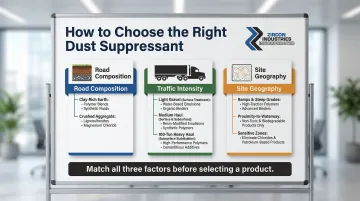
Selecting the right suppressant comes down to three site-specific factors most buyers underestimate until a product fails in the field:
- Road composition: Clay-rich soils respond differently than crushed aggregate. Lignin sulfonates and electrochemical stabilizers work best with clay particles; penetrating polymers and organic binders perform better on non-reactive crushed stone.
- Traffic intensity: High-traffic haul roads, loaded truck routes, braking zones, and turning areas usually require more durable dust control strategies than low-volume access roads. Product selection should reflect haul truck weight, daily passes, grade, speed, and maintenance access.
- Site geography: Ramps, grades, drainage paths, and proximity to waterways can affect product selection. Chlorides, lignosulfonates, petroleum-based products, polymers, and surfactants all have different runoff, traction, corrosion, and maintenance considerations, so check SDS materials and site-specific environmental requirements before use.
Total Cost of Ownership
Don't select suppressants based on unit price alone. Factor in:
- Reapplication frequency (daily water vs. quarterly polymer treatments)
- Labor and equipment costs for application
- Road repair costs accelerated by product failure
- Regulatory compliance risk (PM10 violations or environmental runoff fines)
A lower-cost product may become more expensive if it requires frequent reapplication, adds application labor, increases road maintenance, or creates corrosion or runoff concerns. Compare products using site-specific costs: application rate, road length, application frequency, water-truck time, grader time, product handling, equipment exposure, and performance under actual traffic.
Climate and Seasonal Context
Hygroscopic (moisture-absorbing) chlorides underperform in low-humidity or high-rainfall environments. Organic and polymer products often require minimum temperature thresholds for proper curing. Before committing to a product, ask suppliers for documented field performance data from operations in your climate zone — ideally from a comparable mine or quarry, not just a spec sheet.
Conclusion
The best dust suppressant for a mining haul road is the one that matches your road's soil composition, traffic load, environmental constraints, and budget for total lifecycle cost — not just the cheapest per-gallon option.
Pilot-test any product on a representative road section before full deployment. Request application data, SDS sheets, and field performance references from suppliers before purchase. A small-scale trial will reveal whether a product performs under your specific conditions far more reliably than marketing claims.
If you are sourcing dust control chemicals for a mining, aggregate, trucking, quarry, or industrial road application, Zircon Industries offers RDS38 Road Dust Stabilizer with turnkey delivery and application support. Founded in 1970, Zircon has 55+ years of specialty chemical experience across dust control, freeze control, industrial cleaning, railroad lubricants, pneumatic lubrication, and maintenance applications.
Call 800-547-4328 or email staff@liquidheat.com to discuss haul road conditions, pricing, application logistics, and product availability.
Frequently Asked Questions
What is the most effective dust suppressant for mining haul roads?
There is no single universal best dust suppressant for mining haul roads. Effectiveness depends on road composition, fines content, traffic load, climate, drainage, grade, application method, and environmental restrictions. Chlorides, lignosulfonates, polymers, plant-based products, RDS38, surfactants, and electrochemical stabilizers can all be relevant in the right context, but each should be evaluated with product-specific documentation and a site trial.
How often should dust suppressants be reapplied on mining haul roads?
Reapplication frequency depends on product chemistry, traffic volume, haul truck weight, road material, rainfall, humidity, grade, and application rate. Zircon lists RDS38 Road Dust Stabilizer as lasting 3 to 4 months per application. USDA Forest Service guidance notes that some chlorides and lignosulfonates are commonly applied one to two times per season, while some synthetic polymer derivatives are generally applied once every few years, depending on product and site conditions.
Are chloride-based dust suppressants safe for mining equipment?
Chloride-based dust suppressants can increase corrosion risk on haul trucks, steel structures, aluminum components, and other metal surfaces, especially when moisture remains active on the surface. USDA Forest Service guidance notes calcium chloride corrosion concerns, and magnesium chloride guidance notes that concentrated solutions can be very corrosive to steel. Operators should review product concentration, corrosion inhibitors, SDS materials, equipment exposure, rinse-down practices, and runoff controls before applying chlorides near metal-intensive infrastructure.
What environmental regulations apply to dust suppression in mining?
Mining operations may need to manage dust under air permits, worker exposure programs, local fugitive-dust rules, and broader PM10/PM2.5 air-quality requirements. EPA lists the current primary annual PM2.5 standard at 9.0 micrograms per cubic meter. Chloride, petroleum-based, and other chemical suppressants may also create water-quality or runoff concerns if they reach streams, groundwater, or sensitive vegetation, so operators should verify requirements with state and local agencies before product selection.
Can dust suppressants damage haul road surfaces over time?
Some dust suppressants can create maintenance challenges if they are poorly matched to the road. Chlorides can contribute to corrosion and runoff concerns. Lignosulfonates can lose binding action after heavy rain and may become slippery when wet. Asphalt or bitumen products can create hard surface layers that may be difficult to maintain. Polymer and organic products vary widely by formulation, so their structural effect should be confirmed through product documentation and field trials.
What is the difference between dust suppression and road stabilization?
Dust suppression controls airborne particulate at the road surface; road stabilization improves the load-bearing capacity of the road base. As the FHWA Unpaved Road Dust Management handbook explains, keeping fines on the road helps maintain the aggregate matrix, so dust control and road stabilization can overlap. Some penetrating polymers, electrochemical stabilizers, and moisture-retention products may support both goals when the road material, fines content, traffic, climate, and application method are suitable.