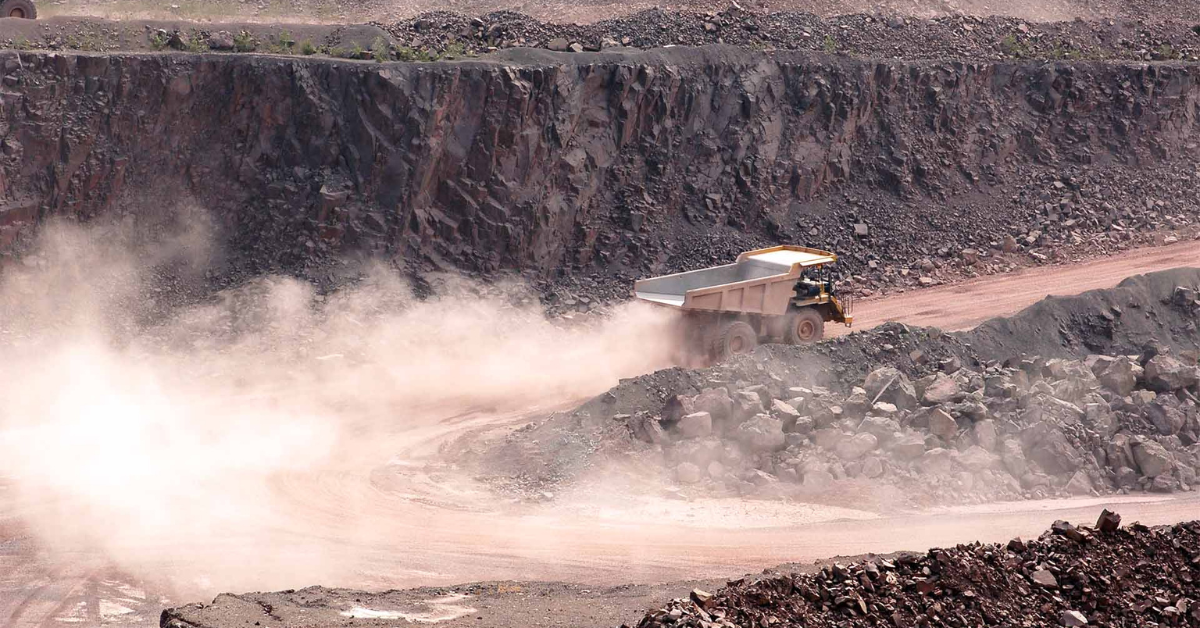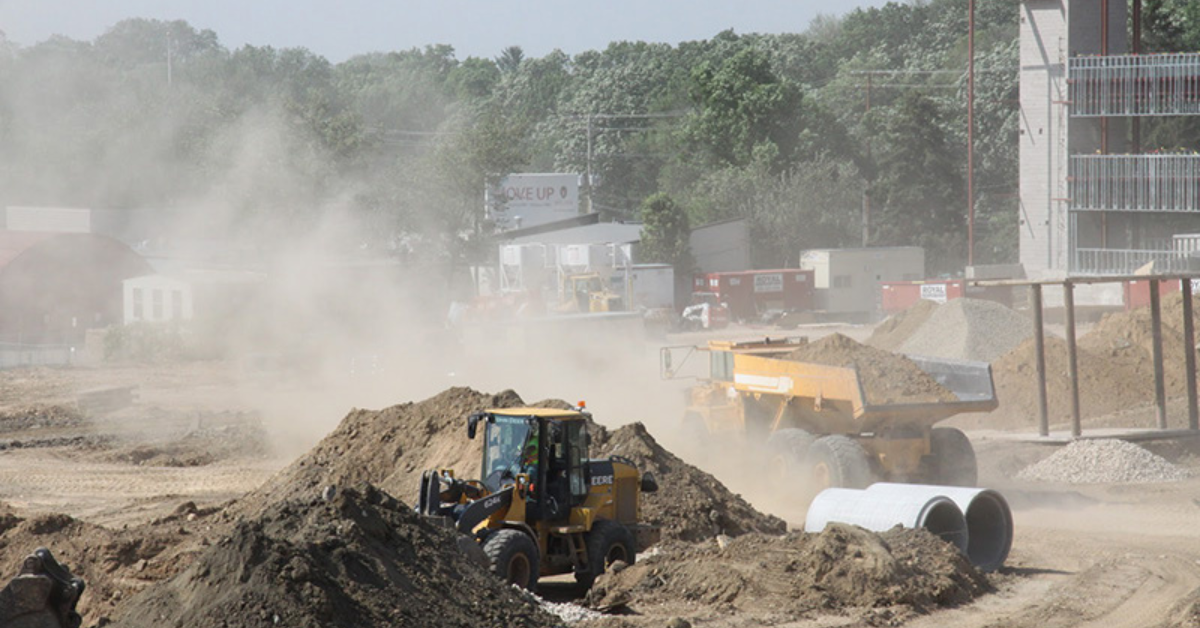
Mining, quarrying, crushing, and milling operations may also fall under MSHA jurisdiction, so facilities should confirm whether OSHA, MSHA, or both agencies apply to each part of the site. For operations managing rock crushing, haul roads, and material handling, this regulatory complexity creates uncertainty—especially when airborne silica dust and particulates are generated across large outdoor areas where traditional ventilation solutions don't apply.
The stakes are substantial: Respiratory Protection, 29 CFR 1910.134, remains one of OSHA’s most frequently cited standards, appearing in OSHA’s current Top 10 list for federal inspections. Facilities that rely on respirators must maintain a written respiratory protection program, medical evaluations, fit testing, training, and program records.
Effective compliance requires layered solutions—engineering controls, dust suppression, respiratory programs, and written documentation.
TLDR: Key Takeaways
- OSHA enforces air quality through multiple requirements, including substance-specific PELs, Respiratory Protection (29 CFR 1910.134), Respirable Crystalline Silica for general industry (29 CFR 1910.1053), Respirable Crystalline Silica for construction (29 CFR 1926.1153), ventilation standards where applicable, and the General Duty Clause.
- Engineering controls (ventilation, wet suppression, chemical dust suppressants) must be implemented before relying on PPE
- Chemical dust suppressants may provide longer-lasting dust control than water-only application, but performance depends on road base, traffic volume, weather, application rate, and product chemistry. If using specific efficiency claims, cite the underlying test conditions and avoid presenting them as universal OSHA compliance guarantees.
- Written air quality programs with monitoring records are essential for demonstrating compliance during inspections
- Maximum penalties for serious violations are $16,550 per citation; willful violations reach $165,514
What OSHA Air Quality Regulations Actually Require
OSHA enforces air quality through substance-specific standards and the General Duty Clause (Section 5(a)(1) of the OSH Act), which requires employers to eliminate recognized hazards likely to cause serious harm, even when no specific standard exists.
Four regulatory areas define the compliance landscape for mining, aggregate, and construction operations.
Exposure Limits And Substance-Specific Standards
OSHA air quality compliance depends on the contaminant and work setting. For respirable crystalline silica, OSHA sets an action level of 25 µg/m³ and a permissible exposure limit of 50 µg/m³ as an 8-hour TWA under 29 CFR 1910.1053 for general industry and 29 CFR 1926.1153 for construction. Other airborne contaminants may fall under OSHA’s general industry air contaminant limits in 29 CFR 1910.1000 or under substance-specific standards. Mining and quarry operations should also confirm whether MSHA standards apply to the specific work area.
Employers must ensure no worker is exposed to concentrations exceeding these limits.
Respiratory Protection (29 CFR 1910.134)
When engineering and administrative controls cannot reduce exposures below PELs, employers must implement a written respiratory protection program that includes:
- Conduct hazard assessments and select appropriate respirators
- Complete medical evaluations and fit testing for all users
- Train employees on proper use and maintenance procedures
- Evaluate program effectiveness on a regular basis
Respirable Crystalline Silica in Construction (29 CFR 1926.1153)
This standard specifically targets silica dust from cutting, grinding, crushing, and drilling stone, brick, and concrete. It sets:
- Action Level (AL): 25 µg/m³ (8-hour TWA)
- Permissible Exposure Limit (PEL): 50 µg/m³ (8-hour TWA)
Table 1 lists required engineering controls — including wet methods and local exhaust ventilation — for specific tasks. OSHA actively enforces this standard through a National Emphasis Program, making it one of the agency's highest enforcement priorities.
Ventilation Requirements (29 CFR 1926.57)
Industrial operations must provide local exhaust ventilation systems for processes generating dusts, fumes, mists, or gases. This applies to quarry operations, crushing plants, and material transfer points where airborne contaminants are produced.
Common Air Quality Hazards in High-Risk Industrial Environments
Primary Airborne Hazards
Mining, aggregate, quarry, and construction operations face frequent exposure to:
- Respirable crystalline silica from rock crushing, cutting, and grinding
- Coal and mineral dusts from excavation and material handling
- Road dust from haul roads and unpaved surfaces
OSHA cites these three hazard categories more than any others in heavy industry enforcement actions.
The Outdoor Compliance Challenge
Outdoor industrial operations face a unique problem: dust generated at haul roads, stockpile areas, and crushing operations disperses across large, open areas. Traditional filtration and ventilation solutions designed for enclosed workplaces are impractical. Chemical dust suppression and soil stabilization fill that gap as viable engineering controls for open-air sites.
Health Consequences of Chronic Exposure
Respirable silica causes silicosis, an irreversible lung disease characterized by lung inflammation and scarring. A NIOSH analysis of MSHA data (2000–2019) found that 27.3% of metal/nonmetal miners exceeded the NIOSH REL for respirable crystalline silica. Mean exposures reached 47.8 µg/m³ — nearly double the 25 µg/m³ limit. Dust-related respiratory disease remains a leading occupational illness in mining and aggregate industries.
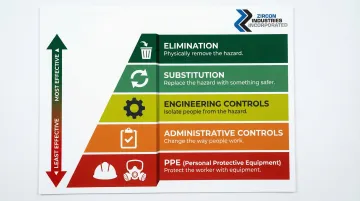
Compliance Solutions: The Hierarchy of Controls
OSHA's Preferred Framework
OSHA requires employers to work through this hierarchy before defaulting to respirators:
- Elimination – Remove the hazard entirely
- Substitution – Replace with a less hazardous material or process
- Engineering Controls – Isolate workers from the hazard
- Administrative Controls – Change work practices to reduce exposure
- Personal Protective Equipment (PPE) – Last line of defense
Engineering Controls for Air Quality
Engineering controls are the most durable compliance solution because they remove the hazard at the source rather than relying on worker behavior. Common options include:
- Local exhaust ventilation systems for enclosed processes
- Enclosed cabs with filtered air for equipment operators
- Wet suppression methods during cutting, drilling, and crushing
- Chemical dust suppressants applied to roads and work surfaces
Chemical dust suppression can support an engineering-control strategy for outdoor dust sources such as haul roads, stockpiles, and material handling areas. However, OSHA compliance still depends on exposure assessment, the applicable standard, documented control measures, and whether worker exposures are reduced below the relevant action level or PEL. For mining, aggregate, and quarry operations, liquid dust suppressants applied to haul roads and active work surfaces are among the most practical and cost-effective options in this category.
Administrative Controls
These work practice changes reduce exposure by limiting how long and how often workers contact airborne hazards:
- Rotating workers to limit individual exposure time
- Scheduling dust-generating activities to minimize worker overlap
- Wet-cutting protocols for sawing and grinding operations
- Housekeeping procedures to prevent dust accumulation
PPE as the Last Line of Defense
Under 29 CFR 1910.134, respiratory protection programs must include:
- Conduct a written hazard assessment before selecting respirators
- Complete medical evaluations before any worker uses a respirator
- Fit test all tight-fitting respirators and document results
- Train workers on proper use, storage, and maintenance
N95 respirators (Assigned Protection Factor of 10) provide minimum protection against particulate dust, but higher exposures require half-face or full-face respirators with APFs of 50 to 1,000.
Monitoring and Exposure Assessment
Effective compliance requires periodic air quality sampling to measure actual worker exposures against OSHA PELs. Sampling results determine which controls are necessary and confirm whether existing controls are performing as intended. OSHA requires employers to maintain exposure monitoring records for 30 years.
Dust Control Solutions for Outdoor Industrial OSHA Compliance
The High-Volume Outdoor Challenge
Haul roads, stockpile areas, and material transfer points at mining, aggregate, and quarrying operations generate the highest volumes of respirable dust. Traditional indoor solutions—HEPA filters and HVAC upgrades—do not address this outdoor challenge.
How Chemical Dust Suppressants Work
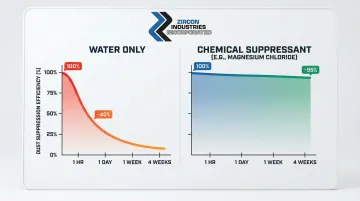
Applied liquid products bind fine particles together, preventing them from becoming airborne. Water alone provides approximately 40% efficiency within one hour, whereas chemical dust suppressants (like magnesium chloride) can maintain up to 95% efficiency for weeks.
Chemical suppressants work through hygroscopic action—continuously extracting moisture from the atmosphere to maintain dust control even after initial application. OSHA recognizes chemical suppression as an acceptable engineering control under the hierarchy.
Operational and Compliance Advantages of Turnkey Programs
A turnkey dust control program delivers:
- Automated or scheduled application removes human error from the equation
- Safety staff maintain compliance without taking on additional monitoring burden
- Road base integrity is preserved, cutting long-term haul road maintenance costs
Zircon Industries offers a turnkey dust control service that delivers and applies RDS-38 Road Dust Stabilizer. One application lasts 3 to 4 months, with application cost included in the product price. Customers like Lafarge in Pennsylvania report saving over $20,000 annually by eliminating water truck operations and redirecting labor to other quarry activities.
Environmental and Safety Co-Benefits
Those benefits can extend beyond compliance support. A properly applied dust-control program may help:
- Improve visibility on haul roads
- Reduce airborne abrasive dust around equipment
- Lower the frequency of water-truck use
- Support safer traffic conditions when the product is applied at the correct rate and surface conditions are monitored
For operations running continuous shifts, fewer equipment failures and reduced road degradation translate directly to less unplanned downtime.
Building a Written Air Quality Compliance Program
Core Program Components
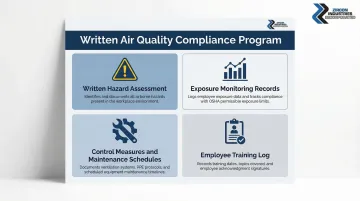
A compliant written program covers four core areas:
- Written hazard assessment identifying all airborne contaminants and their sources
- Exposure monitoring results and recordkeeping with dates, methods, and results
- Selected control measures and maintenance schedules for engineering controls
- Employee training log with dates, topics, and attendee names
Regular Audits and Review Cycles
Program reviews should occur whenever workplace conditions change, such as new equipment, new tasks, process changes, exposure incidents, or changes in respirator use. For respiratory protection programs, OSHA requires employers to evaluate the workplace as necessary to ensure the written program is being properly implemented and remains effective.
Inspectors specifically look for evidence that reviews happened — not just that a program exists. A dated review log with notes on what changed (or was confirmed unchanged) is the clearest proof of an active compliance program. That documentation also sets the foundation for employee training.
Employee Training Requirements
Workers must be trained to:
- Recognize air quality hazards specific to their job tasks
- Understand the controls in place and how they work
- Properly use and maintain any PPE provided
- Report new hazards or control failures immediately
Keep training records on file — OSHA inspectors can request them at any time.
Frequently Asked Questions
What is the OSHA standard for air quality?
OSHA does not have a single "air quality" standard. Instead, it enforces air quality through 29 CFR 1910.1000 (PELs for hundreds of substances), 1910.134 (respiratory protection), 1926.1153 (silica dust in construction), and the General Duty Clause, which requires employers to address any recognized airborne hazard.
How do you ensure compliance with OSHA regulations?
Start with a workplace hazard assessment, then apply the hierarchy of controls: engineering solutions first, administrative controls second, PPE last. Maintain a written program with monitoring records and train employees on hazard recognition and control use.
What is the acceptable level of VOCs in indoor air quality?
OSHA sets substance-specific PELs under 29 CFR 1910.1000 — benzene is capped at 1 ppm (8-hour TWA) and formaldehyde at 0.75 ppm (8-hour TWA). Acceptable levels vary by substance; NIOSH RELs are frequently stricter than OSHA's limits.
Can poor air quality cause dizziness?
Yes, poor air quality can cause immediate symptoms including dizziness, headaches, and fatigue, particularly from carbon monoxide or VOC exposure. Chronic exposure to silica dust, heavy metals, or other industrial dust can also cause long-term respiratory and neurological effects.
What are the penalties for OSHA air quality violations?
As of January 2025, maximum penalties are $16,550 for serious violations and $165,514 for willful or repeated violations. Failure to abate violations carries a penalty of $16,550 per day beyond the abatement date. Citations can also trigger work stoppages and increased inspection frequency.
Does OSHA regulate outdoor air quality in industrial workplaces?
Yes, OSHA standards can apply to outdoor worksites such as construction sites, manufacturing yards, and certain industrial operations. However, mining, quarrying, crushing, and milling activities may fall under MSHA instead of OSHA, depending on the site and activity. Employers should confirm jurisdiction first, then apply the relevant OSHA or MSHA exposure limits, respiratory protection requirements, engineering controls, and recordkeeping rules.