Introduction
Circuit board contamination — from flux residues, oxidation, oils, fingerprints, and dust — can contribute to shorts, corrosion, leakage current, and intermittent electrical failure. One PCB contamination guide notes that up to 25% of board failures may be linked to ionic contamination, making cleaner selection and application technique critical for maintenance teams.
For industries like aerospace, medical device manufacturing, and industrial equipment maintenance, a failed circuit board carries consequences well beyond repair costs: production halts, safety incidents, and compliance failures. ITIC’s 2024 Hourly Cost of Downtime report found that the cost of hourly downtime exceeds $300,000 for 90% of firms, which makes preventive electronics maintenance important in industrial and commercial environments.
Those stakes make cleaner selection matter more than most technicians realize. Contact cleaner is safe for circuit boards when chosen and applied correctly — but the wrong product or technique can cause more damage than the contamination itself. This guide explains how to use it safely, what to look for in a formulation, and which mistakes to avoid.
TL;DR
- Electronics-grade contact cleaners are generally safe on circuit boards — verify compatibility with plastics and coatings first
- Always power off and fully discharge the board before applying any cleaner
- Use a fast-evaporating, residue-free formula — leftover moisture or residue causes short circuits when power is restored
- Spray at the correct distance, let the cleaner fully evaporate, and never apply to a live board
- Never substitute acetone, WD-40 Multi-Use Product, lubricants, household cleaners, or general-purpose degreasers for electronics-grade contact cleaner. These products may leave residue, attack plastics, or create electrical reliability problems.
Safety Guidelines for Using Contact Cleaner on Circuit Boards
Contact cleaner use on circuit boards involves chemical, electrical, and material-compatibility risks — none of which are unmanageable, but all of which require careful handling. Safety depends primarily on product selection and application discipline, not just the workspace. The right cleaner used the wrong way is still dangerous.
Safe cleaning should be treated as a routine, documented maintenance practice rather than a reactive fix done only when something visibly fails.
General Safety Precautions
Baseline PPE requirements include:
- Safety glasses to protect against aerosol splash-back
- Nitrile gloves to prevent skin contact with solvents
- Adequate ventilation or respiratory protection when working in enclosed spaces with flammable or toxic solvents
Keep flammable contact cleaners away from open flames, sparks, and hot surfaces. Many solvent-based contact cleaners contain alcohols or hydrocarbons with dangerously low flash points:
| Solvent | Flash Point | Flammability Classification |
|---|---|---|
| Isopropyl Alcohol (99%) | 53°F (11.6°C) | OSHA Category 2 / NFPA Class IB |
| n-Heptane | 25°F (-3.89°C) | OSHA Category 1 / NFPA Class IB |
| n-Hexane | -7°F (-22°C) | OSHA Category 2 / NFPA Class IB |
Aerosol sprays can also generate static charges. In ESD-sensitive environments — aerospace assembly, medical electronics manufacturing — use anti-static or ESD-safe formulations to avoid damaging sensitive components.
Preparing Your Circuit Board Before Cleaning
Before any cleaner is applied:
- Power must be completely off and all stored energy (capacitors, batteries, power supplies) fully discharged. Residual voltage mixed with partially evaporated solvent creates a direct short-circuit path
- Remove loose debris with a soft brush or compressed air before applying contact cleaner — spraying over accumulated dust reduces effectiveness and can force particles deeper into connectors
- Test the cleaner on a small, inconspicuous area or scrap component before full application, especially when cleaning boards with plastic housings, rubber seals, or conformal coatings
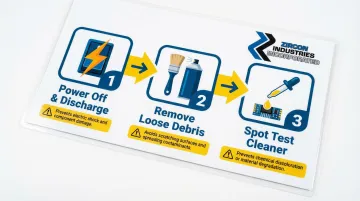
Even cleaners labeled "plastic-safe" can vary in compatibility with specific polymer types (polycarbonate, ABS, acrylic).
Safe Application Technique
Follow these steps for proper application:
- Hold the aerosol can at the manufacturer-recommended distance (typically 6–8 inches) and apply in controlled, sweeping passes. Spraying too close concentrates solvent force and can dislodge or stress small surface-mount components
- Tilt the board to allow dissolved contaminants and excess cleaner to run off freely — pooling solvent in connectors or under components extends dry time and increases short-circuit risk
- Use foam swabs or lint-free applicators for targeted cleaning of specific contacts
- Allow the board to fully dry and vent the area before restoring power. "Dry to the touch" is not the same as fully evaporated — drying time varies by formula, ambient temperature, and board geometry
When in doubt, wait longer than the label specifies.
Environmental and System Considerations
Application environment affects both cleaner performance and drying time. Temperature and humidity are the two biggest variables:
- In humid environments, water-based or slow-evaporating cleaners pose a higher risk of moisture retention
- In cold environments, some solvents may not evaporate as quickly as expected — especially relevant in industrial settings like manufacturing floors or equipment rooms
The board's surrounding assembly matters too. If rubber gaskets, adhesive bonds, or conformal coatings are nearby, solvent ingress can cause secondary damage to those materials. Mask or isolate sensitive adjacent components before cleaning.
What to Look for in a Circuit Board-Safe Contact Cleaner
Fast evaporation is the key property. A contact cleaner designed for circuit boards must evaporate completely without leaving any conductive or insulative residue. Residue can attract future contamination or — if conductive — create leakage paths between circuits.
Dielectric strength matters because it tells you how much electrical stress a cleaner can withstand before it conducts electricity. For circuit boards, the safest practice is still to power off, disconnect, and discharge the board before cleaning. If a facility has a controlled maintenance procedure where power cannot be disconnected, Chemtronics recommends using an electrical contact cleaner with dielectric strength above 30 kV and choosing a non-flammable cleaner to reduce spark-related risk.
Flammability trade-offs:
- Flammable cleaners — alcohol and hydrocarbon-based — are effective and economical but require strict fire safety controls
- Non-flammable cleaners are safer for high-voltage environments but often come at a premium. Older non-flammable formulations contained toxic solvents — nPB, TCE, Perc — modern options exist without these
Material compatibility deserves careful attention. Circuit boards often include plastic housings, rubber seals, and conformal coatings — and harsh solvents like toluene, xylene, and acetone can craze or embrittle rigid plastics and swell rubber seals:
| Polymer Type | Acetone | Toluene | Xylene |
|---|---|---|---|
| Polycarbonate (PC) | Causes stress cracking | Not Resistant | Causes stress cracking |
| Acrylic (PMMA) | Not Resistant | Not Resistant | Not Resistant |
| ABS | Severe Effect | Severe Effect | Severe Effect |
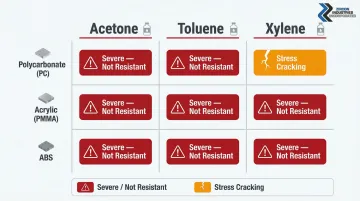
Look for cleaners labeled "plastic-safe" and verify compatibility for your specific materials through SDS review or a spot test.
For high-stakes applications in aerospace, defense, or medical device manufacturing, request full technical documentation — including SDS sheets and dielectric strength test data — before committing to any formulation.
Common Safety Mistakes to Avoid
Power off before you spray. Skipping this step is one of the most common shortcuts — and one of the most damaging. Even a small amount of solvent bridging two live contacts can cause a spark, a short, or permanent component failure.
Substitute products aren't interchangeable. Never substitute acetone, WD-40 Multi-Use Product, household cleaners, or general-purpose degreasers. Acetone can attack plastics and coatings, lubricants can leave oily residue, and household cleaners may leave ionic residues that create leakage-current or corrosion risk.
Never mix cleaners without checking compatibility. Different contact cleaners use incompatible solvent bases. Mixing them can produce hazardous reactions or residue combinations more damaging than either product alone.
Review the SDS before use. Skipping it means missing flash point data, exposure thresholds, and material compatibility warnings — details that matter when working around sensitive components.
"Dry to the touch" isn't the same as fully evaporated. Restoring power too soon is a leading cause of post-cleaning failures. Deep connector housings, under-component cavities, and low-airflow areas retain solvent far longer than exposed surfaces.
Residual solvent under voltage can trigger electrochemical migration (ECM) — the growth of conductive metal filaments across a PCB through an electrolytic solution. A case study from Circuit Insight documents this failure mode in detail.
Conclusion
Yes, contact cleaner is safe for circuit boards — but only when the right product is chosen and the right technique is followed. Safe use comes down to three factors:
- Product selection: fast-evaporating, residue-free, and compatible with board materials
- Application discipline: powered off, correct spray distance, and adequate drying time
- Environmental awareness: ventilation, temperature, and storage conditions
Treat circuit board cleaning as a routine, documented maintenance practice rather than a last-minute fix. For industrial or commercial electronics maintenance, always consult the SDS before use and choose a cleaner designed for sensitive electrical parts.
For maintenance teams that need a non-flammable, rapidly evaporating contact and circuit board cleaner, ZL98 High Purity Plastic Safe Contact Cleaner is formulated to remove oil, grease, condensation, dust, and particulate matter from sensitive electronic parts. It is designed to evaporate quickly without residue and is tested safe on many common plastics and rubbers.
Frequently Asked Questions
Is contact cleaner safe for circuit boards?
Yes, electronics-grade contact cleaners can be safe for PCBs when the board is powered off, discharged, and allowed to dry fully before power is restored. Always verify compatibility with plastics, rubber, conformal coatings, adhesives, and nearby components before full application.
Can contact cleaner damage electronics?
Yes, the wrong contact cleaner can damage electronics — particularly if it contains harsh solvents incompatible with plastics or rubber, evaporates slowly and causes short circuits, or leaves behind conductive or insulative residue that creates leakage paths.
What is the best cleaner for circuit boards?
Look for a fast-evaporating, residue-free, plastic-safe formulation with adequate dielectric strength — minimum 30 kV — in aerosol form for precise application. The right choice varies based on the contaminants present, board materials, and operating environment.
Where should you not use contact cleaner?
Never use contact cleaner on powered or energized circuits, near open flames or sparks — for flammable types — on adhesive bonds or screen materials not rated for solvent exposure, or in poorly ventilated spaces without respiratory protection.
Can I use WD-40 as an electronic cleaner?
No, WD-40 is not suitable as a contact cleaner for circuit boards — it is a lubricant and moisture displacer, not a precision electronic cleaner, and it leaves an oily residue that attracts dust and increases contact resistance over time.
Is contact cleaner just isopropyl alcohol?
No. Many contact cleaners use isopropyl alcohol (IPA) as a base, but commercial formulations often add solvents for greater cleaning power, anti-static agents, or non-flammable properties that plain IPA cannot provide.