This article breaks down what antifreeze actually is at a molecular level, how it works, the two dominant chemical types and their trade-offs, what's inside a finished formulation, and where glycol-based freeze protection shows up far beyond the radiator.
Key Takeaways
- Antifreeze works by lowering the freezing point and raising the boiling point of water — both effects matter equally
- Ethylene glycol offers superior heat transfer and lower cost; propylene glycol is the safer choice where human or animal contact is possible
- A 50/50 glycol-water blend is the standard starting point, yielding freeze protection around -34°F (-36°C)
- Corrosion inhibitor packages (IAT, OAT, HOAT) deplete over time, even though the glycol base remains intact — check inhibitor levels, not just fluid color
- Industrial applications often require freeze protection well below the -34°F automotive benchmark — mining, rail, and heavy equipment operations are built around that reality
What Is Antifreeze? A Chemistry-First Definition
Antifreeze is any substance that, when dissolved in water, lowers the temperature at which that mixture freezes — and simultaneously raises its boiling point. Both effects are critical. Cold weather gets most of the attention, but a cooling system that boils over at high operating temperatures fails just as catastrophically as one that freezes solid in winter.
The commercial terminology creates some confusion worth clearing up:
- Antifreeze concentrate = the pure glycol base, typically sold undiluted
- Coolant (or engine coolant) = the ready-to-use mixture of antifreeze and water, usually a 50/50 blend
- These terms are often used interchangeably in casual conversation, but they refer to chemically distinct products
Water was the original engine coolant. It's cheap, abundant, and thermally excellent, but its usable liquid range spans only 100 Kelvin (0°C to 100°C at atmospheric pressure). It also expands roughly 9% when it freezes — enough to crack cast iron engine blocks. Cooling system engineers needed something better, and the search went through several generations:
- Water alone: effective thermally, but freezes, boils, and corrodes
- Alcohol-based antifreezes: lowered the freeze point, but as NIST documented, alcohols are volatile — their boiling points fall below water's, so they evaporate out of open systems
- Glycol-based formulations: solved both problems; Prestone began selling ethylene glycol antifreeze in 1927
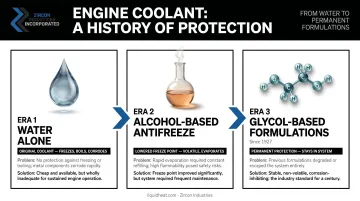
Glycols have dominated ever since because they're "permanent" — they stay in the system rather than boiling away.
How Antifreeze Works: The Science of Freezing-Point Depression
The Colligative Property Explained
Freezing-point depression is a colligative property (meaning it depends on the number of dissolved solute particles, not their chemical identity). As classified by OpenStax Chemistry, both freezing-point depression and boiling-point elevation fall into this category, which is why virtually any soluble compound shifts these phase boundaries.
At the molecular level, glycol works by disrupting crystal nucleation — the organized arrangement water molecules must achieve to form ice. The mechanism breaks down into three steps:
- Glycol molecules hydrogen-bond with surrounding water molecules
- This bonding creates a disordered molecular environment that resists the rigid lattice structure of ice
- Lower temperatures are then required to overcome that disorder and freeze the solution
More glycol = more disruption = lower freeze point.
Concentration, Ratios, and the Trade-Off
The relationship between glycol concentration and freeze protection isn't linear, and it has a ceiling:
| EG Concentration (vol%) | Approximate Freeze Point |
|--------------------------|--------------------------|
| 33% | ~0°F (-18°C) |
| 50% | ~-36°F (-37.8°C) |
| 60% | Below -60°F (-51°C) |
| 80%+ | Protection worsens significantly |
The 50/50 blend is the industry standard for good reason — it balances freeze protection, boiling-point elevation, and thermal efficiency. According to Dynalene's engineering data, a 50 vol% EG solution boils at 226°F, providing meaningful headroom above typical operating temperatures.
That protection comes with a thermal trade-off: glycol has lower heat capacity than water. A 50% EG solution carries a specific heat of roughly 0.751 BTU/lb-°F at 20°F (meaningfully lower than pure water), which limits how efficiently the fluid moves heat through a system. That's why neat glycol concentrate is never used alone — the water-glycol blend threads the needle between freeze protection and heat transfer performance.
Ethylene Glycol vs. Propylene Glycol: The Two Primary Types
Both ethylene glycol (EG) and propylene glycol (PG) are organic diols — alcohols with two hydroxyl groups — and both form the base of nearly all commercial antifreeze. They're structurally similar but perform differently in ways that drive application decisions. The table below captures the key differences.
Side-by-Side Comparison
| Attribute | Ethylene Glycol (EG) | Propylene Glycol (PG) |
|---|---|---|
| Freeze point at 50% | ~-34°F (-36°C) | ~-29°F (-33°C) |
| Viscosity at low temps | Lower — better flow | Higher — can restrict pumping |
| Thermal conductivity | Superior (0.394 W/m·K at 40°C) | Slightly lower |
| Acute toxicity | Moderate-high (lethal dose ~1,400–1,600 mg/kg) | Very low (FDA GRAS, 21 CFR 184.1666) |
| Biodegradation half-life | Water: 2–12 days | Soil: 1–5 days (faster than EG) |
| Cost | Lower | Higher |
| Typical use | Closed industrial systems, automotive | Food-adjacent, open systems, anywhere ingestion risk exists |
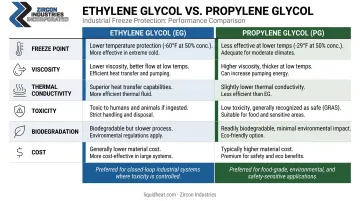
PG requires roughly 2% higher concentration than EG to achieve equivalent freeze protection. For food processing equipment, solar thermal systems, or any installation where a leak could reach food or open soil, that small concentration difference is a straightforward trade-off for a safer fluid.
Other Antifreeze Agents
EG and PG dominate, but niche alternatives exist:
- Glycerol (glycerin): Non-toxic; historically used in certain sprinkler systems. The National Fire Sprinkler Association allows up to 38% glycerin or 30% PG by volume in legacy fire suppression systems — automotive or marine antifreeze is explicitly prohibited
- Methanol/isopropanol: Used in fuel-line antifreeze and windshield fluids, not in liquid cooling systems
- Antifreeze proteins: Produced by certain fish, insects, and plants — relevant in biomedical cryopreservation, not mechanical systems
What's Actually Inside Antifreeze?
The glycol base makes up the overwhelming majority of any concentrate — products like DOWTHERM SR-1 (an inhibited EG fluid) run at 95.5 wt% ethylene glycol, while DOWFROST (an inhibited PG fluid) runs at 96.0% food-grade propylene glycol. The remainder is additive package and trace water.
Corrosion Inhibitor Technologies
Glycol itself doesn't corrode metals. Water does — and cooling systems contain multiple dissimilar metals (aluminum, cast iron, copper, brass) that create galvanic corrosion risk when exposed to aqueous solutions. Inhibitor chemistry determines how well a coolant protects those metals over time. Three main approaches are used:
- IAT (Inorganic Additive Technology): Uses silicates and phosphates; effective but depletes faster, requiring more frequent replacement
- OAT (Organic Acid Technology): Uses carboxylates and azoles; longer service life, less deposit formation
- HOAT (Hybrid OAT): Combines inorganic and organic inhibitors; delivers both fast-acting and long-term protection
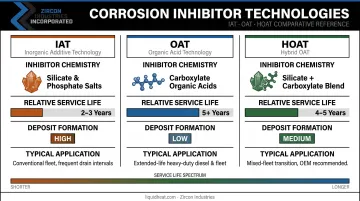
These differences show up clearly in real-world service intervals. Detroit Diesel's coolant specifications, for example, rate Extended Life Coolant (OAT-based) at 600,000 miles or 4 years in heavy-duty engines, while conventional SLC formulations are rated for 300,000 miles. The glycol base outlasts the inhibitors: it's the additive package that gets consumed.
Additives You Might Not Expect
- Denatonium benzoate (bittering agent): Utah and Arizona law mandates this compound at 30–50 ppm in ethylene glycol coolants to deter accidental ingestion. EG's sweet taste makes it attractive to children and pets, which is why bitterants are now required by statute in several states
- Dyes: Fluorescent pink, green, orange, red, blue — added for leak detection under UV light. Color does not reliably identify coolant chemistry. As both Penrite and Valvoline note, the same color can indicate completely different inhibitor systems depending on the manufacturer
Testing and Maintenance
Three field methods measure freeze protection:
- Refractometer: Measures refractive index; ASTM D3321 covers this method; accuracy ±1%
- Hydrometer: Measures specific gravity; inexpensive but less precise
- Test strips: Quick and portable; accuracy ±one color block
Beyond the Radiator: Industrial Applications
Automotive use is the most visible application, but glycol-based freeze protection is critical across a much wider range of systems:
- HVAC chillers: Closed-loop glycol circuits protect coils in buildings where temperatures may drop below freezing during shutdown
- Solar thermal systems: Propylene glycol is the standard heat-transfer fluid in closed-loop solar heating — its toxicity profile matters when lines run near potable water systems
- Electronics and data centers: Low-electrical-conductivity EG-water coolants are emerging as alternatives to PFAS fluids for direct-to-chip server cooling
- Food processing: Inhibited PG fluids like DOWFROST carry food-grade inhibitor packages for use in environments where incidental contact with food is possible
- Fire suppression: Strictly regulated — only UL-listed, premixed antifreeze solutions are permitted after September 30, 2022
Where Standard Automotive Concentrations Fall Short
Each of these sectors demands more than a standard 50/50 mix can deliver — and that gap widens sharply in the heaviest industrial environments.
Mining operations, aggregate processing, outdoor conveyor systems, and railroad applications operate in conditions standard 50/50 automotive concentrations weren't built to handle. Manufacturer data from Dow and Dynalene confirm that specialized industrial glycol formulations provide freeze protection down to approximately -60°F (-51°C) — more than 25 degrees colder than the -34°F limit of a typical 50/50 blend.
DirectChem (Zircon Industries) has served mining, aggregate, railroad, and construction sectors for over 55 years, formulating freeze control products for sub-zero industrial environments where standard automotive antifreeze falls short. Its Conveyor Belt Deicer, rated to -60°F, is built for outdoor applications where a freeze event means halted production and compounding operational losses.
Safety, Toxicity, and Environmental Considerations
Ethylene Glycol Hazards
EG is toxic if ingested. The ATSDR estimates the human lethal dose at 1,400–1,600 mg/kg, which works out to roughly 100 mL for an average adult.
The body metabolizes EG through alcohol dehydrogenase into glycolic acid and ultimately oxalic acid. That oxalic acid causes kidney failure through calcium oxalate crystal deposition in the renal tubules. Poisoning progresses in stages:
- 0.5–12 hours: CNS and GI effects (appears similar to alcohol intoxication)
- 12–24 hours: Metabolic acidosis, cardiopulmonary effects
- 24–72 hours: Renal failure
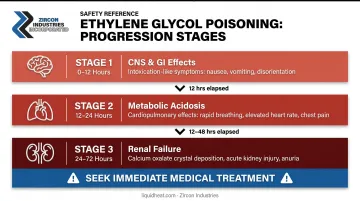
Prompt medical treatment is critical. Anyone handling EG systems should store concentrates in labeled, secured containers away from children and pets.
Propylene Glycol: The Safer Alternative
PG breaks down into lactic and pyruvic acids rather than oxalic acid. The FDA classifies it as Generally Recognized as Safe (GRAS) under 21 CFR 184.1666 for use in food. In any application where human or animal contact is realistic — open systems, food-adjacent environments, or outdoor applications near soil and waterways — PG is the right call.
Disposal and Environmental Fate
Even after choosing the right fluid, proper disposal matters. The regulatory picture is more nuanced than most people expect:
- Unused, pure EG is not classified as a federally listed hazardous waste under RCRA
- Used antifreeze frequently is regulated — because it accumulates heavy metals (lead, cadmium, chromium) from system components during service
- Washington State, for example, classifies used ethylene-based antifreeze as dangerous waste due to potential metal contamination
- PG degrades faster in soil (half-life 1–5 days) than EG in groundwater (half-life 4–24 days), making it the better environmental choice for open or outdoor systems
Never pour spent antifreeze down drains or onto the ground. Take it to a designated recycling facility or arrange mobile collection — most automotive recyclers and hazardous waste facilities handle it.
Frequently Asked Questions
What is an antifreeze substance?
An antifreeze substance is any chemical that, when added to water, lowers the mixture's freezing point and typically raises its boiling point. Ethylene glycol and propylene glycol are the most common examples, used across automotive, industrial, and food-processing cooling systems.
How toxic is ethylene glycol to humans?
Ethylene glycol is moderately to severely toxic if ingested. The body converts it to oxalic acid, which can cause kidney failure, neurological damage, and death. The ATSDR estimates a human lethal dose of 1,400–1,600 mg/kg, and prompt medical treatment is essential following any ingestion.
What is the difference between antifreeze and coolant?
Antifreeze refers to the pure glycol concentrate, while coolant (or engine coolant) is the diluted, ready-to-use mixture — typically a 50/50 blend of antifreeze and water. The diluted mixture, not neat glycol, is what circulates in cooling systems.
How do you choose between ethylene glycol and propylene glycol?
Choose EG for closed industrial systems where superior heat transfer efficiency and lower cost are priorities. Choose PG wherever human or animal contact is possible — food processing environments, open outdoor systems, or applications near soil and waterways.
What happens if you mix different types of antifreeze?
Mixing incompatible formulations (such as OAT and IAT inhibitor systems) can cause the additive packages to interact, reducing corrosion protection and shortening fluid service life. Detroit Diesel's documentation explicitly discourages mixing ELC with other coolant types. Always verify compatibility before adding or blending coolant types.
How long does antifreeze last before it needs to be replaced?
The glycol base can remain effective indefinitely, but the corrosion inhibitors deplete over time. Heavy-duty OAT-based formulations can last up to 600,000 miles or 4 years in some engine specifications. Conventional formulations need replacement sooner. Industrial systems should follow manufacturer testing intervals and perform periodic refractometer checks.