Introduction
Frozen conveyor belts, iced haul roads, frozen truck beds, railcar loading issues, and stockpile freeze problems can disrupt iron ore mining operations during severe winter conditions. In cold regions such as Minnesota's Iron Range, Northern Ontario, and Scandinavia, freeze-control planning needs to account for the lowest expected operating temperatures, conveyor exposure, steel infrastructure, application method, runoff controls, and product compatibility.
Liquid deicers and ice preventatives can be useful for conveyor systems, truck beds, haul roads, loading areas, and related material-handling equipment when the product is matched to the surface and operating conditions. Products should be evaluated by documented freeze-point performance, equipment compatibility, corrosion profile, application system requirements, and environmental restrictions.
This guide covers the top 10 liquid deicers selected specifically for iron ore mining environments — evaluated on freeze-point performance, equipment compatibility, corrosion profile, and total cost of ownership, because in mining, the wrong choice on any one of those criteria shows up fast on your bottom line.
Key Takeaways
- Liquid deicers and ice preventatives can support conveyor, truck bed, haul road, and loading-area freeze control when applied correctly
- Chloride-based liquids are widely used and often cost-effective, but they can increase corrosion risk around steel infrastructure and equipment
- Non-chloride options such as potassium acetate, sodium formate, and CMA may be relevant where corrosion or chloride discharge is a concern
- Automated spray systems can help improve application consistency and reduce reliance on manual spraying, but performance depends on system setup, application rate, temperature, and site conditions
- Zircon lists Liquid Heat Conveyor Belt Deicer & Ice Preventative as preventing ice from adhering to equipment surfaces at temperatures down to -60°F
Why Liquid Deicers Are Critical in Iron Ore Mining Operations
Liquid deicers are chemical solutions applied by spray that lower water's freeze point, preventing ice from bonding to surfaces across the operation:
- Conveyor belts and transfer points
- Haul road surfaces and access roads
- Loading areas and stockpile zones
- Railcar interiors during loading and transit
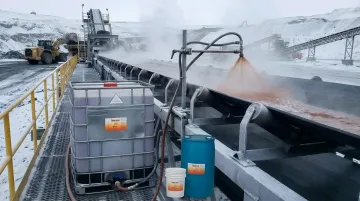
Unlike granular rock salt or abrasives, liquid deicers can be applied through manual sprayers or automated spray systems depending on the product and equipment setup. This makes them relevant for conveyor systems, rollers, idlers, chutes, switches, truck beds, and other exposed material-handling areas where targeted liquid application is preferred.
Key mining regions—Minnesota's Iron Range, Northern Ontario, and Scandinavia—routinely see temperatures from -20°F to -40°F throughout winter months. At those extremes, freeze-point performance becomes the deciding factor between continuous production and costly shutdowns.
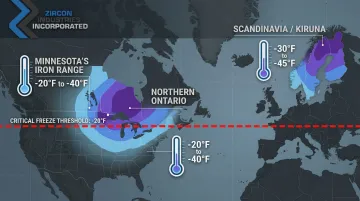
With dozens of liquid deicer formulations on the market, the 10 products below were selected specifically for performance in harsh mining conditions—covering everything from low-cost chloride brines to specialty non-chloride options designed for equipment where corrosion is a concern.
Top 10 Liquid Deicers for Iron Ore Mining Operations
These products were compared using mining-relevant criteria: documented freeze point or effective temperature range, corrosion profile, chloride content, compatibility with liquid application equipment, environmental restrictions, and fit for surfaces such as conveyor systems, truck beds, haul roads, loading areas, and steel infrastructure. Not every product listed is mining-specific, so final selection should be based on product data sheets, SDS materials, site testing, and equipment manufacturer guidance.
1. Liquid Heat Conveyor Belt Deicer (Zircon Industries)
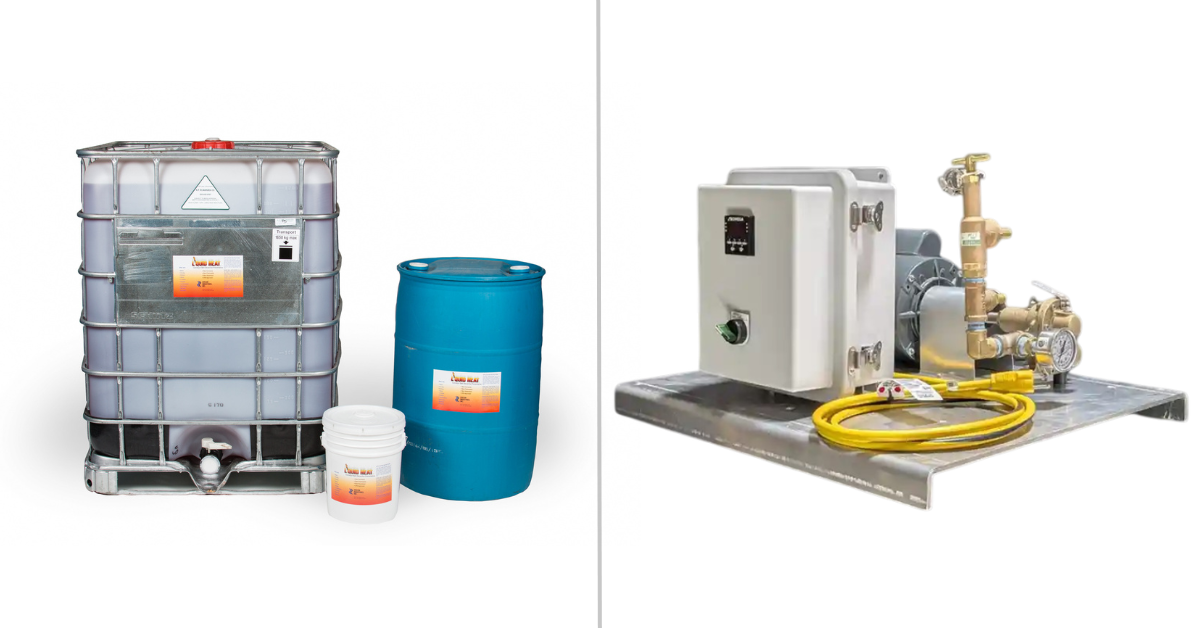
Zircon Industries, founded in 1970, has 55+ years of specialty chemical experience across freeze control, conveyor deicing, pneumatic lubrication, railroad lubricants, dust control, cleaning, and industrial maintenance applications. Zircon's Liquid Heat Conveyor Belt Deicer & Ice Preventative is positioned for conveyor system belts, rollers, idlers, chutes, switches, truck beds, and related material-handling equipment.
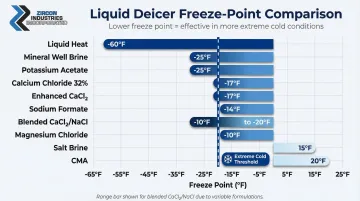
Zircon's Liquid Heat literature sheet states that the product has a track record of preventing ice from adhering to equipment surfaces at temperatures down to -60°F. Zircon also states that Liquid Heat acts as both a deicer and ice preventer, remains liquid and easy to spray in extreme cold, and can be applied with automated spray systems or manual sprayers.
| Specification | Details |
|---|---|
| Listed Low-Temperature Performance | Zircon literature states Liquid Heat prevents ice from adhering to equipment surfaces at temperatures down to -60°F |
| Best For | Conveyor belts, rollers, idlers, chutes, switches, truck beds, and related material-handling equipment |
| Application Method | Can be applied with Zircon automated spray systems or manual sprayers; application setup should be confirmed with Zircon and site equipment requirements |
2. Liquid Calcium Chloride 32%
A widely used industrial liquid deicer sourced from natural brine wells or manufacturing processes, liquid calcium chloride at 32% concentration delivers fast exothermic (heat-releasing) action on contact with ice, making it faster-acting than sodium chloride brine.
Effective to approximately -17°F (-27°C) and widely available in bulk quantities suited to mining operation volumes, calcium chloride is a workhorse for haul road anti-icing and railcar freeze conditioning. Note that it is hygroscopic and highly corrosive to uncoated steel; specify a corrosion-inhibited formulation for conveyor components and railcar use.
| Specification | Details |
|---|---|
| Freeze Point | Effective to approximately -17°F (-27°C) |
| Best For | Haul road anti-icing, stockpile pre-treatment, railcar freeze conditioning |
| Corrosion Profile | High corrosion potential to metals — corrosion-inhibited formulation recommended for equipment contact |
3. Liquid Magnesium Chloride
Magnesium chloride brine is another chloride-based liquid deicer used in winter maintenance. FHWA's anti-icing manual states that the eutectic composition for magnesium chloride is 21.6% MgCl₂ and 78.4% water, freezing at about -33°C / -28°F. The same source notes that MgCl₂ brine composition can vary by source and that operators should check concentration before use.
For mining operations, magnesium chloride may be relevant for haul roads and access roads where the expected temperature range, road material, corrosion controls, and runoff limits make it suitable.
Its hygroscopic nature keeps metal surfaces wet longer, which can accelerate corrosion in humid environments — factor this in when applying near uncoated steel.
| Specification | Details |
|---|---|
| Freeze Point | Effective to approximately -10°F |
| Best For | Haul road de-icing, pre-treatment at moderate cold conditions, blending with other deicers |
| Corrosion Profile | Moderate — lower than calcium chloride; hygroscopic properties require care near uncoated steel |
4. Potassium Acetate Liquid
Used extensively on airport runways, potassium acetate is biodegradable with freeze effectiveness down to -25°F (-32°C) and is viable for mining operations with strict environmental or equipment corrosion requirements.
Its low corrosion profile sets it apart: electrochemical tests show it is far less corrosive to mild steel than chloride products. Used in bridge spray systems and automated deicing equipment, the higher cost should be weighed against reduced maintenance spend on mining equipment.
| Specification | Details |
|---|---|
| Freeze Point | Effective to approximately -25°F (-32°C) |
| Best For | Metal-sensitive infrastructure, automated bridge/conveyor spray systems, environmentally regulated mine sites |
| Corrosion Profile | Low — significantly less corrosive to steel than chloride-based liquid deicers |
5. Salt Brine (23.3% Sodium Chloride Solution)
The most economical liquid deicer widely used in mining and road maintenance, salt brine at 23.3% concentration represents the eutectic point with a freeze point of -6°F (-21°C). It can be produced on-site or purchased in bulk from suppliers.
Best applied as a pre-treatment anti-icing agent before freeze events rather than as a post-ice reactive treatment. Effective to approximately 15°F, which covers many haul road applications but falls short in the extreme cold conditions common in northern iron ore mining regions. Its low cost and broad availability make it a practical baseline product for operations in milder winter zones or for pre-treatment layering strategies.
| Specification | Details |
|---|---|
| Freeze Point | Effective to approximately 15°F — not suitable as a standalone product in extreme cold |
| Best For | Haul road and access road pre-treatment, lower-cost anti-icing applications in moderate climates |
| Corrosion Profile | High — sodium chloride is corrosive to metals and steel infrastructure; use with caution near equipment |
6. Enhanced Liquid Calcium Chloride with Corrosion Inhibitor
A formulated version of standard liquid calcium chloride that incorporates an organic corrosion inhibitor, designed for users who need the deep freeze performance of CaCl₂ while reducing its aggressive corrosion impact on steel and mining equipment.
Enhanced liquid calcium chloride products may include corrosion inhibitors to reduce metal corrosion compared with uninhibited chloride products. The Pacific Northwest Snowfighters specifications state that a corrosion-inhibited chemical product must show a percent effectiveness value of at least 70% less than sodium chloride to be acceptable under its corrosion test method. Versatile for use as a pre-wetting agent, haul road treatment, or conveyor pre-treatment. Widely available from industrial chemical suppliers in bulk quantities suitable for mining operations.
| Specification | Details |
|---|---|
| Freeze Point | Effective to approximately -17°F (-27°C) |
| Best For | Conveyor pre-treatment, haul roads, applications requiring both deep freeze performance and equipment protection |
| Corrosion Profile | Reduced corrosion vs. standard CaCl₂ — up to 70% reduction per PNS certification standards |
7. Blended Calcium Chloride / Sodium Chloride Liquid (Enhanced Brine)
Blended calcium chloride / sodium chloride liquids combine sodium chloride brine with calcium chloride to improve low-temperature performance compared with straight salt brine. The final freeze point and field performance depend on the blend ratio, calcium chloride concentration, inhibitor package, dilution during use, and surface temperature. Widely used by municipalities and industrial operations as a cost-optimized step up from straight salt brine.
Freeze performance and cost fall between pure salt brine and straight CaCl₂, making it a practical mid-tier option for iron ore mine haul roads and access roads in moderate to cold conditions. Some enhanced brines include bonding agents to reduce product scatter and improve pavement adhesion.
If the product will contact mine equipment or railcar metal surfaces, specify a version with a corrosion inhibitor.
| Specification | Details |
|---|---|
| Freeze Point | Typically effective to -10°F to -20°F depending on CaCl₂ ratio |
| Best For | Haul road and access road treatment in moderate to severe cold; cost-effective mid-performance option |
| Corrosion Profile | Moderate — lower than straight CaCl₂; inhibited versions preferred for equipment-adjacent use |
8. Sodium Formate Liquid
Derived from formic acid, sodium formate is classified as readily biodegradable (86% in 28 days via OECD 306) and is used in environments where chloride corrosion and environmental runoff are significant concerns.
Effective to approximately -14°F and less corrosive to steel than chloride deicers, making it compatible with metal-intensive conveyor systems and railcar applications. Higher cost than chloride products; best suited to mine sites near sensitive water bodies with chloride discharge limits.
| Specification | Details |
|---|---|
| Freeze Point | Effective to approximately -14°F |
| Best For | Environmentally regulated mine sites, conveyor systems, applications near sensitive waterways |
| Corrosion Profile | Low — biodegradable and less corrosive than chloride-based products |
9. Calcium Magnesium Acetate (CMA) Liquid
Calcium magnesium acetate, or CMA, is a non-chloride deicer used in some anti-icing and deicing applications where chloride reduction is important. FHWA's anti-icing manual lists the CMA-water eutectic temperature as -27.5°C / -17.5°F at a 32.5% concentration and notes that CMA and potassium acetate can be well suited for liquid anti-icing use because their refreeze temperature rises more slowly with dilution than chloride brines.
Practical freeze-point effectiveness is limited to approximately 20°F, with a eutectic temperature of -17.5°F (-27.5°C) at 32.5% concentration. CMA works better as a pre-treatment anti-icing agent in moderate cold conditions than as a primary deicer in extreme northern mining environments.
Note that CMA requires 1.41 to 1.54 times more material by weight to achieve equivalent ice melting compared to chloride products. Factor that into total cost calculations before specifying at scale.
| Specification | Details |
|---|---|
| Freeze Point | Effective to approximately 20°F — best used as pre-treatment in moderate cold conditions |
| Best For | Environmentally sensitive mining sites, pre-treatment on access roads, concrete-intensive infrastructure |
| Corrosion Profile | Very low — minimal impact on metal, concrete, and rebar; biodegradable |
10. Mineral Well Brine (Natural Liquid Calcium Chloride)
Mineral well brine is a naturally occurring brine that may contain calcium chloride and other dissolved salts, depending on source and processing. It can be used as a liquid deicer or blending component where the supplier provides documented composition, concentration, freeze point, corrosion profile, and application guidance.
| Specification | Details |
|---|---|
| Freeze Point | Effective to approximately -25°F |
| Best For | Cost-conscious operations needing CaCl₂-level freeze performance; blending with salt brine for enhanced anti-icing |
| Corrosion Profile | High (similar to manufactured CaCl₂) — corrosion inhibitor versions or post-application management recommended for metal infrastructure |
How We Chose the Best Liquid Deicers for Iron Ore Mining
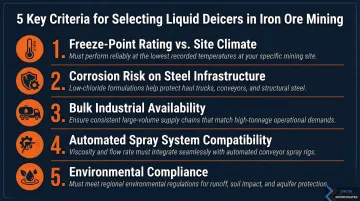
The selection process focused on criteria specific to iron ore mining—not generic residential or road salt use. The most common mistake operations teams make is choosing a deicer based on price per gallon alone, without accounting for freeze-point adequacy for their regional climate, corrosion impact on conveyor belts and rail infrastructure, or application system compatibility.
Key evaluation factors included:
Temperature fit: Compare freeze point, eutectic point, practical effective temperature, and dilution behavior against the site's lowest expected temperatures.
Corrosion risk: Evaluate effects on steel conveyor components, structural steel, truck beds, railcar interiors, spray systems, and reinforced concrete.
Application method: Confirm whether the product can be used with manual sprayers, automated spray systems, truck-bed sprays, haul-road equipment, or site-specific dispensing systems.
Environmental requirements: Review chloride limits, runoff pathways, waterbody proximity, permits, SDS materials, and site-specific compliance obligations.
Packaging and supply: Confirm pails, drums, totes, tank orders, storage temperature, transfer equipment, and winter handling requirements.
For Minnesota-specific chloride planning, the MPCA Statewide Chloride Management Plan identifies a chloride water quality standard of 230 mg/L.
Conveyor freeze control is especially important because ice, carryback, and buildup can create maintenance, tracking, and safety risks around moving belts, rollers, idlers, and transfer points.
MSHA's conveyor safety alerts warn workers not to work on or near operating conveyors until equipment has been de-energized, locked out, tagged out, and blocked against hazardous motion.
That's why freeze-point depth matters beyond the minimum threshold. Products rated to -40°F or below provide a measurable safety margin in severe-cold regions that mid-range deicers simply cannot deliver.
Conclusion
Choosing the right liquid deicer for iron ore mining requires matching the product to the operating temperature range, surface type, metal infrastructure, application equipment, runoff pathway, and site-specific environmental requirements. Product choice should be based on product literature, SDS materials, equipment compatibility, corrosion profile, application method, and site testing where needed.
For conveyor belts, truck beds, rollers, idlers, chutes, switches, and related material-handling equipment, Zircon lists Liquid Heat Conveyor Belt Deicer & Ice Preventative as effective at preventing ice from adhering to equipment surfaces at temperatures down to -60°F.
Contact Zircon Industries at 800-547-4328 for pricing, availability, product literature, packaging options, and application guidance.
Frequently Asked Questions
What is the best liquid deicer?
The best liquid deicer depends on the application. For conveyor belts, truck beds, rollers, idlers, chutes, and switches, Zircon's Liquid Heat Conveyor Belt Deicer & Ice Preventative is a product-specific option listed for temperatures down to -60°F. For haul roads and access roads, chloride brines may be suitable in some conditions, while potassium acetate, sodium formate, or CMA may be considered where corrosion or chloride discharge is a concern.
Is calcium chloride or magnesium chloride better for melting ice?
Calcium chloride and magnesium chloride should be compared by concentration, freeze point, dilution behavior, corrosion profile, and application surface. OxyChem's handbook lists a 32% calcium chloride solution freeze point of -17°F, while FHWA lists the magnesium chloride-water eutectic temperature at about -28°F for a 21.6% MgCl₂ solution. Calcium chloride also releases heat when dissolved in water, but corrosion and runoff considerations can make product selection site-specific. Use OxyChem's calcium chloride handbook and FHWA anti-icing guidance for technical comparison.
What melts ice immediately?
Calcium chloride is known for releasing heat when it dissolves in water, which helps explain why it is commonly used as a fast-acting deicer. However, actual melt speed depends on product concentration, surface temperature, ice thickness, application rate, dilution, and whether the surface is being pre-treated or treated after ice has formed. Use OxyChem's calcium chloride handbook for calcium chloride technical data.
Are liquid deicers safe to use on conveyor belts and mining equipment?
Compatibility depends on the product and equipment. Chloride-based deicers can increase corrosion risk on steel and reinforced infrastructure, so equipment-adjacent use should be reviewed carefully. Zircon lists Liquid Heat Conveyor Belt Deicer & Ice Preventative as approved for use by Goodyear Belting, while potassium acetate and sodium formate may be considered where non-chloride chemistry is preferred. Always review SDS materials, belt manufacturer guidance, spray-system requirements, runoff controls, and site-specific safety procedures.
What temperature range should a liquid deicer handle for iron ore mining?
For iron ore mining, product selection should be based on the site's lowest expected equipment and surface temperatures, not just average winter air temperature. Compare freeze point, eutectic point, practical effective temperature, dilution behavior, storage requirements, and sprayability. Add a safety margin for overnight exposure, wind, conveyor shutdowns, stored product temperature, and unexpected cold snaps.
Can liquid deicers be applied using automated spray systems in mining?
Some liquid deicers and ice preventatives can be applied using automated spray systems, but compatibility depends on product viscosity, temperature, spray nozzles, pump setup, plumbing, application rate, and surface type. Zircon offers Automated Deicer Spray Systems for applying Liquid Heat to conveyor-related applications. Automated systems can help improve application consistency and reduce reliance on manual spraying, but site layout, controls, maintenance, and application settings should be confirmed with Zircon before installation.