Introduction
Freeze events hit bulk material handling operations hard. For mining, aggregate, quarrying, and rail sites, a single freeze incident can trigger conveyor shutdowns, frozen stockpile emergencies, and costly production delays. Rock Products reports that operators at one of the world’s largest mines estimate a single conveyor belt failure can cost $6 million to $12 million, which makes winter freeze prevention a production-critical issue.
Generic road salts can't solve these problems. They fail below 15°F, corrode expensive conveyor components, and do nothing to stop wet fines from bonding to cold rubber belting.
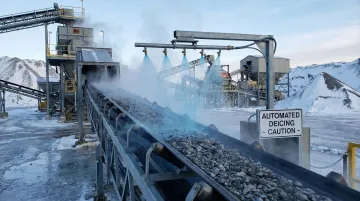
Bulk material deicers serve a fundamentally different purpose than consumer ice melts. They must perform on conveyor belts, chutes, idlers, rail cars, and stockpile surfaces — often at temperatures below -20°F where standard chloride products stop working. The right industrial-grade freeze control agent prevents frozen ore, sand, gravel, and coal from bonding to equipment and eliminates the production-killing clogs that follow.
Key Takeaways
- Industrial deicers for bulk material handling target conveyor belts, stockpiles, chutes, and rail cars—not roads or sidewalks
- Effective temperature range below -20°F, non-corrosive formulation, and automated spray compatibility are critical selection criteria
- Glycol-based and acetate-based deicers may reduce corrosion risk compared with chloride-heavy products, but buyers should verify corrosion data, SDS/TDS details, belt compatibility, runoff impact, and metal compatibility before use.
- Chloride products offer cost-effective surface treatment but come with corrosion trade-offs
- The 10 products below cover proven options across mining, aggregate, and bulk logistics operations
What Are Bulk Material Handling Deicers—and Why Do Standard Ice Melts Fall Short?
Bulk material handling deicers are chemical freeze control agents engineered to prevent frozen ore, sand, gravel, coal, and similar materials from bonding to conveyor belts. They also stop materials from clogging chutes, bridging in silos, or freezing solid in rail cars and truck beds — problems generic road salt simply wasn't designed to solve.
Why road salt fails in industrial applications:
- Loses 86% of its melting capacity at 15°F and becomes nearly useless below that point
- Corrodes conveyor steel, fasteners, structural components, and rubber belting
- Fails to break the freeze-bond between wet fines and cold rubber — the root cause of belt slippage and production stoppages
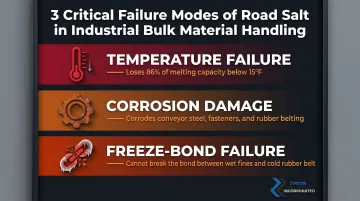
The 10 specialized bulk material deicers below are evaluated on freeze-point performance, material compatibility, application method, and operational fit for cold-weather mining and aggregate facilities.
Top 10 Bulk Material Handling Deicers for Winter Operations
Selection is based on sub-zero temperature performance, compatibility with conveyor and bulk material handling infrastructure, non-corrosive formulation where possible, and proven deployment across mining, aggregate, quarry, and rail environments.
1. Liquid Heat Conveyor Belt Deicer (Zircon Industries)
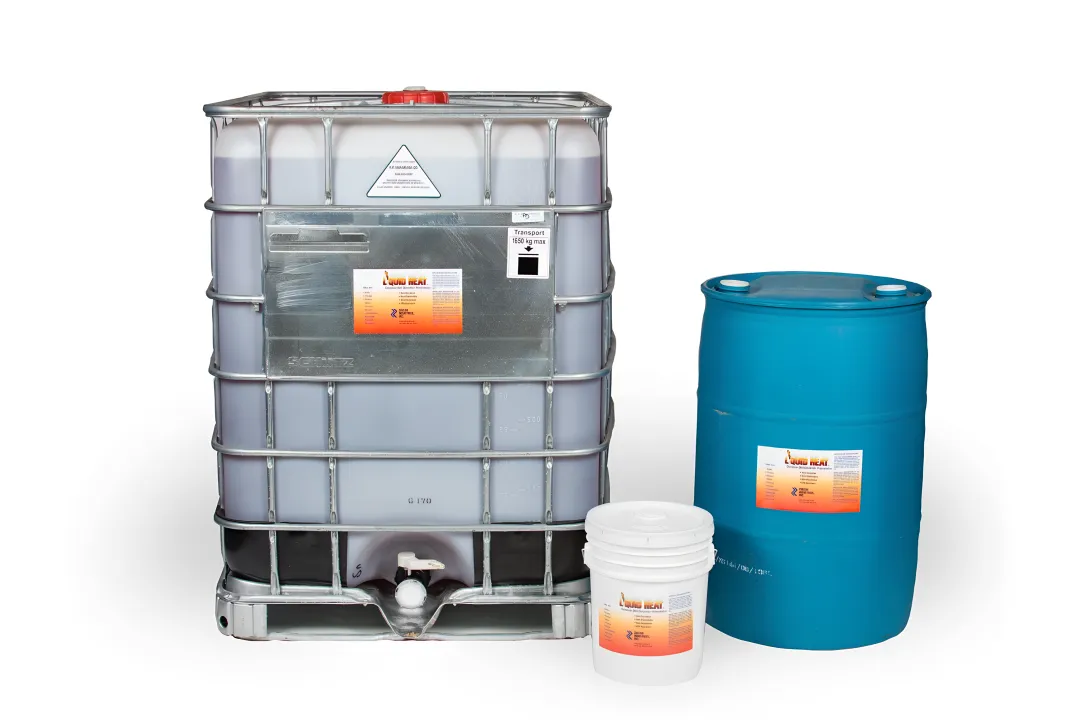
Zircon Industries’ Liquid Heat Conveyor Belt Deicer is built for conveyor belts, rollers, idlers, chutes, switches, truck beds, and other freeze-prone bulk material handling surfaces. Backed by 55+ years of Zircon Industries’ specialty chemical experience, Liquid Heat is positioned for extreme winter freeze-control applications in coal, aggregate, mining, rail, and industrial operations. Pioneered in 1972 for coal mines and power plants, the product is approved by Goodyear Belting and complies with OSHA and EPA ingredient standards.
Liquid Heat offers a -60°F freeze point, remains liquid and sprayable at extreme temperatures, and works as both a deicer and ice preventative. Compatible with automated spray systems that eliminate manual application errors and product waste. Liquid Heat is used for freeze control across conveyor belts, rollers, idlers, chutes, switches, truck beds, and other bulk material handling surfaces. Zircon’s official product page also notes use across industries such as aggregates, cement, steel, wood chips, gold, copper, iron ore, recycling, coal, and power generation.
| Feature | Specification |
|---|---|
| Freeze Point / Effective Temperature | -60°F |
| Key Features | Non-flammable, non-hazardous; sprayable via automated or manual systems; designed for conveyor belts, rollers, idlers, chutes, switches, and truck beds; Goodyear Belting approved |
| Best Use Case | Conveyor belts, idlers, chutes, rail car surfaces, stockpile material pre-treatment in extreme cold |
2. Benetech BT955++ Freeze Conditioning De-Icer
Benetech, Inc. serves aggregate, mining, coal power, and bulk material handling operations with BT955++ Freeze Conditioning De-Icer, a diethylene glycol-based product designed for conveyors, idlers, rollers, transfers, switches, trucks, and other equipment. The diethylene glycol formulation contains no oils or chlorides.
BT-955 functions as a freeze-point depressant and side-release agent that inhibits bonding between wet material and cold belt surfaces. It weakens ice crystal structure, prevents material backsliding on hardened belts, and suppresses dust during offloading operations.
| Feature | Specification |
|---|---|
| Freeze Point / Effective Temperature | -45°F |
| Key Features | Diethylene glycol-based, non-corrosive, inhibits cohesive bonds, weakens ice crystals, controls dust by trapping particles |
| Best Use Case | Conveyor belts, head drums prone to slippage, frozen bulk material surfaces in northern U.S. operations |
3. OxyChem Peladow Calcium Chloride Pellets
OxyChem (Occidental Chemical Corporation) is one of North America's largest producers of calcium chloride. Peladow is their premium pellet-form product at 90% calcium chloride concentration, used broadly in industrial and municipal deicing at extreme low temperatures.
Peladow delivers a -25°F effective temperature rating with exothermic dissolving action that initiates rapid melting. Round pellets penetrate ice up to 3x faster than flat or crystal melters, making them well-suited for breaking through thick ice packs. Compatible with industrial bulk spreaders and hopper systems.
| Feature | Specification |
|---|---|
| Freeze Point / Effective Temperature | -25°F |
| Key Features | 90% calcium chloride concentration, exothermic dissolution, rapid melt initiation, round pellet geometry for fast ice penetration |
| Best Use Case | Surface deicing for access roads, loading yards, walkways, and non-conveyor areas where calcium chloride is approved by the facility. Do not use directly on conveyor belts, idlers, pulleys, chutes, or structural components without manufacturer compatibility confirmation. |
4. OxyChem Dowflake Xtra Calcium Chloride Flakes
Also produced by OxyChem, Dowflake Xtra is a calcium chloride flake product at 83-87% concentration, noted for its flat geometry that resists rolling off sloped and wind-exposed surfaces — making it more practical than pellets in certain bulk handling environments.
Dowflake Xtra's flat flake shape allows it to sit and adhere to surfaces effectively, reducing wind displacement on elevated platforms, conveyor loading zones, and rail car floors. Compatible with standard spreading equipment.
| Feature | Specification |
|---|---|
| Freeze Point / Effective Temperature | -25°F |
| Key Features | 83-87% calcium chloride concentration, flat flake geometry stays in place on sloped surfaces, flows through standard spreading equipment |
| Best Use Case | Elevated platforms, conveyor loading zones, and rail car floors where rolling pellets are impractical |
5. Cargill Thawrox Treated Salt
Cargill is a global bulk salt supplier. Thawrox is their treated sodium chloride product pre-coated with magnesium chloride liquid and an organic carbohydrate to enhance performance at lower temperatures than untreated rock salt, used in both municipal and industrial bulk handling contexts.
Thawrox extends the effective temperature range down to 5°F, compared to 15°F for plain rock salt. The pre-treatment improves surface adhesion, reducing bounce and scatter by 25%, which translates to less product waste and better coverage on haul roads and yard surfaces.
| Feature | Specification |
|---|---|
| Freeze Point / Effective Temperature | 5°F (vs. 15°F for untreated rock salt) |
| Key Features | Pre-wetted/treated sodium chloride, 25% improved surface adhesion, bulk availability, eliminates need for on-site liquid storage |
| Best Use Case | Road, yard, and access-surface treatment where treated salt is appropriate. Verify corrosion impact, runoff limits, and site-specific suitability before use near conveyors, structural steel, or bulk material contact points. |
6. Compass Minerals Safe-T-Salt (Bulk Rock Salt)
Compass Minerals is one of North America's leading producers of bulk sodium chloride (rock salt), sourced from its Goderich mine — the world's largest underground salt mine. Safe-T-Salt serves as the baseline bulk deicer in industrial and municipal operations.
Safe-T-Salt offers the lowest cost per ton among deicers and is available in bulk quantities suitable for industrial procurement via truck, barge, or ship. Best suited for moderate cold above 15°F where budget is the primary constraint, though it carries real limitations in extreme cold and has a corrosive impact on equipment.
| Feature | Specification |
|---|---|
| Freeze Point / Effective Temperature | ~15°F practical limit |
| Key Features | 100% sodium chloride, bulk availability, lowest cost per ton, simple application, sourced from Goderich mine |
| Best Use Case | Haul roads and yard surfaces in moderate cold (above 15°F) where budget is the primary constraint |
7. Industrial Magnesium Chloride Brine (Liquid Pre-Treatment)
Liquid magnesium chloride brine is commonly used as an anti-icing or pre-wetting material for roads and surfaces, but concentration must be checked carefully. MgCl₂ reaches its eutectic point at about 21.6–22% concentration, around -28°F. Higher concentrations do not automatically mean a lower freezing point; FreezGard’s MgCl₂ freeze curve shows 30% MgCl₂ freezing at about 2°F.
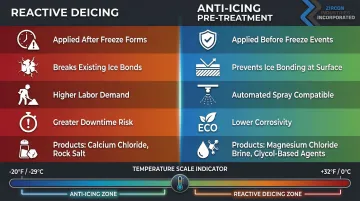
This brine prevents ice bonding before it forms rather than reacting after the fact — a meaningful operational advantage over reactive deicers. It offers a -28°F eutectic freeze point, carries lower corrosivity than sodium chloride, and supports automated spray application at mine sites and aggregate facilities.
| Feature | Specification |
|---|---|
| Freeze Point / Effective Temperature | Eutectic around -28°F at 21.6–22% MgCl₂; verify actual product concentration and working temperature from the supplier TDS |
| Key Features | 30.3% magnesium chloride liquid, automated spray application compatible, lower corrosivity than NaCl, anti-icing pre-treatment mode |
| Best Use Case | Pre-storm treatment on haul roads, conveyor structures, and loading docks in mining and aggregate sites |
8. Sodium Acetate (NAAC) — Industrial Grade
Sodium acetate at 97% anhydrous is a chloride-free, acetate-based deicer used in environments where metal corrosion and environmental chloride runoff are critical concerns. It carries SAE AMS 1431 certification for airfield use, but public product documentation does not confirm conveyor belt or bulk material handling use. Treat sodium acetate as an adjacent low-chloride deicing option for sensitive surfaces, and verify conveyor, chute, rail car, and runoff compatibility before specification.
Sodium acetate delivers exothermic melt action down to 0°F — similar in speed to calcium chloride but without the chloride ions. It is readily biodegradable and suited for use around conveyor metals, structural steel, and environmentally sensitive mine drainage zones.
| Feature | Specification |
|---|---|
| Freeze Point / Effective Temperature | 0°F |
| Key Features | 97% anhydrous sodium acetate, chloride-free, exothermic action, biodegradable, FAA-approved, low infrastructure corrosion |
| Best Use Case | Rail car and conveyor freeze control in operations near regulated waterways or with strict corrosion constraints |
9. Calcium Magnesium Acetate (CMA) — Industrial Grade
CMA is a chloride-free, low-corrosion deicer derived from acetic acid and dolomitic limestone at a 3:7 Ca to Mg molar ratio. It sees use in sensitive infrastructure environments including bridges, metal-framed conveyor systems, and operations adjacent to environmentally regulated waterways.
CMA is 2 to 4 times less corrosive to steel than sodium chloride per NCHRP research, and it is biodegradable — a combination that makes it the right fit for infrastructure-sensitive and environmentally regulated sites. One notable limitation: effectiveness decreases below 20°F, which rules it out for sustained sub-zero operations.
| Feature | Specification |
|---|---|
| Freeze Point / Effective Temperature | Effectiveness decreases below 20°F |
| Key Features | Chloride-free, biodegradable, 2-4x less corrosive than NaCl, infrastructure and environment friendly |
| Best Use Case | Conveyor structural components, metal-framed chutes, and operations with stringent environmental discharge requirements |
10. Midwest Ice-Free Conveyor (Glycol-Based Proprietary Blend)
Midwest Industrial Supply offers Ice-Free Conveyor, a multi-component glycol-based liquid formulated for automated spray systems covering both freeze prevention and dust suppression in heavy industry. It represents the category of organic, glycol-based proprietary blend freeze conditioning agents.
Ice-Free Conveyor achieves a -70°F effective temperature and increases belt cover friction to stop material backslides on hardened rubber belts — a common failure point in sustained sub-zero conditions. It prevents fines carry-back and build-up on idlers and pulleys, and integrates with automated "Cobra" spray systems.
| Feature | Specification |
|---|---|
| Freeze Point / Effective Temperature | -70°F |
| Key Features | Multi-component glycol-based liquid, automated spray compatible, dual freeze and dust suppression function, increases belt friction |
| Best Use Case | Steep conveyor belts, enclosed transfer points, and mines or quarries operating in sustained sub-zero conditions |
How We Chose the Best Bulk Material Handling Deicers
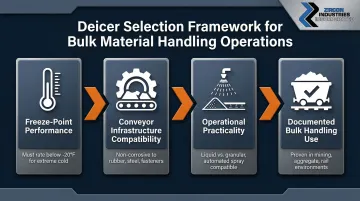
Each product was rated against four criteria tied directly to industrial performance — not just catalog specs:
- Freeze-point performance in field conditions — Products must be rated below -20°F for extreme cold. Lab-rated temperatures don't always translate to real conveyor environments with wind exposure and continuous material flow.
- Compatibility with conveyor infrastructure — Non-corrosive formulations protect rubber belting, metal components, fasteners, and structural steel, directly reducing total cost of ownership. The Conveyor Equipment Manufacturers Association (CEMA) notes that zinc-coated chains should not be used in chlorine environments, and stainless steels suffer reduced working loads in corrosive conditions.
- Operational practicality — Application method (liquid vs. granular), bulk availability, automated spray compatibility, and dual functionality like dust suppression all determine whether a product works on the floor.
- Documented use or adjacent relevance — Products were prioritised based on direct conveyor, rail car, truck bed, stockpile, mining, aggregate, quarry, or bulk material handling documentation. General road, pavement, and airfield deicers should be clearly labelled as adjacent surface-treatment options, not direct conveyor belt deicers.
Even with clear criteria, the selection process surfaces a consistent set of errors. These are the most common:
Common mistakes operations managers make:
- Choosing road-grade deicers on cost alone, without factoring in equipment corrosion and repair
- Ignoring downtime losses from belt slippage or frozen material clogs
- Missing chloride runoff compliance — EPA’s ambient water quality criteria for chloride include a chronic freshwater aquatic life criterion of 230 mg/L, but local limits depend on state water-quality standards, permits, receiving waters, and site-specific discharge conditions.
- Underestimating true cost-per-ton when a cheaper product needs higher application volumes and damages equipment
Conclusion
The best bulk material handling deicer matches actual operating conditions: freeze-point requirements, conveyor and equipment metallurgy, volume needs, environmental compliance, and whether a manual or automated application system is in place. No single product is optimal across all scenarios.
Use these factors as your shortlist before committing to a product:
- Freeze point — confirm the product's rated temperature covers your worst-case conditions
- Material compatibility — verify corrosion ratings against your conveyor belt type and equipment metals
- Volume and delivery format — match bulk concentrate, liquid, or aerosol to your throughput and storage setup
- Environmental compliance — check local discharge and runoff regulations before purchasing
- Application method — determine whether manual or automated spray delivery fits your labor and consistency needs
For operations in aggregate quarries, coal terminals, mining sites, rail yards, and other demanding freeze environments, Zircon Industries’ Liquid Heat Conveyor Belt Deicer is built for conveyor belts, rollers, idlers, chutes, switches, truck beds, and other freeze-prone bulk material handling surfaces. Backed by 55+ years of specialty chemical experience, Zircon also offers automated spray systems and manual sprayers to support consistent application. Call 800-547-4328 to identify the right freeze-control solution for your facility.
Frequently Asked Questions
What is the least harmful ice melt?
Chloride-free options like calcium magnesium acetate (CMA) and sodium acetate are the least harmful to metal infrastructure, concrete, and aquatic environments. For bulk material handling operations, glycol-based and organic freeze conditioning agents offer strong low-harm alternatives at industrial scale, though they carry higher BOD (Biochemical Oxygen Demand) as they biodegrade.
What do road crews use to melt ice?
Road crews in mining and aggregate operations typically use bulk rock salt (sodium chloride) and liquid magnesium chloride brine as cost-effective haul road treatments, with calcium chloride reserved for spot treatment in extreme cold. Conveyor belt applications call for non-corrosive, spray-compatible formulations — a different product category entirely.
How to keep conveyor belts from freezing?
Apply a purpose-built conveyor belt deicer (glycol-based or equivalent) via an automated spray system before freeze events, and keep belts running in sub-freezing conditions to prevent material bonding to pans and idlers. Select a product rated well below your site's lowest expected temperature — ideally -40°F or lower.
What temperature do conveyor belts stop working in?
Rubber conveyor belts stiffen around 20°F and can crack or shatter in sustained extreme cold without freeze conditioning. Keep belts in motion during freeze events and use a deicer rated below your site's lowest expected temperature to prevent bonding and mechanical failure.
Can calcium chloride damage conveyor equipment?
Yes. Calcium chloride is effective to -25°F but carries moderate-to-high corrosivity to metal components, fasteners, and structural steel. For direct belt treatment, non-corrosive glycol-based or acetate-based products are the better choice.