Seasonal deicer agents are the primary defense against these disruptions. But "deicer" covers a wide range of chemistries, formats, and applications — and picking the wrong one for your conditions can mean equipment damage, environmental liability, or product failure at the worst possible moment.
This guide covers what seasonal deicer agents are, the main chemical types and their effective temperature ranges, how deicing and anti-icing differ, where these products are applied, and what to evaluate when selecting one for your operation.
Key Takeaways
- Seasonal deicer agents lower water's freezing point to prevent ice formation or break existing ice bonds
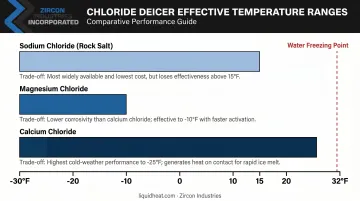
- Different chemistries suit different temperatures — sodium chloride fails below 15°F where calcium chloride keeps working to -25°F
- Deicing (reactive) and anti-icing (proactive) serve different purposes and work best used together
- Chloride-based products are cost-effective but carry corrosion and environmental trade-offs
- Quarries, mines, and railroads require purpose-built formulations that standard road salt cannot handle
What Are Seasonal Deicer Agents?
Seasonal deicer agents are chemical compounds formulated to lower the freezing point of water — a process called freeze point depression. When dissolved in water (or in the thin brine layer on ice), these compounds disrupt the hydrogen bonding structure that allows water to freeze. The result: ice either never forms, or its bond to the surface weakens enough to remove it.
"Seasonal" reflects their primary deployment window: fall through spring in cold climates. But these products serve far more than residential driveways. Road maintenance crews, mining operations, railroad facilities, and aggregate plants all depend on them — anywhere that frozen surfaces threaten safety or uptime.
Deicing vs. Anti-Icing: Two Distinct Approaches
Operations teams often use these terms interchangeably, but they describe two different processes — and confusing them leads to wasted product and avoidable ice events:
- Deicing is reactive — applying a chemical agent to an already-iced surface to break the bond between ice and the substrate
- Anti-icing is proactive — applying a liquid deicer before a freeze event to create a brine layer that prevents ice from bonding in the first place
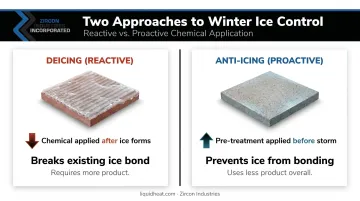
A complete winter operations strategy typically involves both. Anti-icing before a storm reduces the amount of product needed and keeps surfaces safer. Deicing handles situations where ice has already formed before treatment could be applied.
Why Product Selection Matters
The right deicer for one application may be the wrong choice for another. Key factors:
- Ambient and surface temperature — some products lose effectiveness below certain temperature thresholds
- Surface material — metal equipment, concrete, and asphalt respond differently to chloride exposure
- Corrosion risk — chloride-based products can accelerate corrosion on steel, reinforced concrete, and equipment components
- Environmental proximity — operations near waterways may face chloride runoff restrictions or discharge requirements
Common Types of Seasonal Deicer Agents
Chloride-Based Deicers
Sodium chloride (rock salt) is the most widely used deicer for roads and surfaces. It's inexpensive and effective — but only down to about 15°F under practical field conditions. Below that threshold, its melting capacity drops sharply. USGS data puts U.S. salt consumption at 39 million tons in 2025, with highway deicing accounting for roughly 37% of total use.
That temperature ceiling comes with infrastructure costs too. FHWA links chloride ingress from deicing salts to rebar corrosion, concrete cracking, and spalling — with one study estimating $8.3 billion in direct annual highway bridge corrosion costs.
Calcium chloride performs where rock salt gives out. It maintains ice-melting capacity down to -25°F in practice, with a eutectic point of -60°F at 29.8% concentration. It also releases heat when it dissolves — an exothermic reaction that accelerates melting.
According to OxyChem, dissolving one pound of calcium chloride pellets in a gallon of water can raise the solution temperature by more than 30°F. This makes it valuable for industrial and road maintenance applications in northern climates.
Magnesium chloride operates at a practical melting threshold around -10°F — better than rock salt, but not as low as calcium chloride. It's commonly chosen for applications where reducing chloride load matters, though it remains a chloride product and carries similar infrastructure risks. It's used in both anti-icing and deicing applications on roads and some industrial surfaces.
Glycol-Based Deicers
Glycol-based fluids — primarily ethylene glycol and propylene glycol — are the standard in aviation. The FAA classifies them into fluid types with distinct roles:
- Type I fluid (glycol-water mix, orange if dyed): heated and sprayed onto aircraft surfaces to remove existing ice and snow. Required minimum nozzle temperature of 60°C (140°F)
- Type IV fluid (thickened, non-Newtonian anti-icing fluid): applied to clean aircraft surfaces to prevent re-icing during taxi and pre-takeoff
These are not commodity ice melters. They're regulated operational chemicals tied to FAA ground deicing program requirements under 14 CFR 121.629(c).
Acetate and Formate-Based Deicers
Potassium acetate, sodium formate, and potassium formate are the primary alternatives where chloride use is restricted. Transport Canada and MnDOT both identify these as replacements for older urea-based airfield deicers.
Where chloride products create regulatory or infrastructure problems, acetate and formate products can offer several advantages:
- Lower chloride impact compared with rock salt, calcium chloride, or magnesium chloride
- Reduced corrosion risk in many applications, though compatibility still depends on the specific formulation, surface, and equipment
- Common use in airfield, infrastructure, and environmentally sensitive applications where chloride runoff is a concern
The trade-off is cost. Acetate and formate products can run several times the price of chloride alternatives, so they are usually selected when environmental compliance, corrosion control, or infrastructure protection justifies the added expense.
Deicing vs. Anti-Icing: How They Work
The Chemistry
When a deicer dissolves in water, it lowers the temperature at which that solution freezes. Pure water freezes at 32°F. A sodium chloride brine at optimal concentration freezes around -6°F. A calcium chloride solution can stay liquid to -25°F or lower. The deicer doesn't generate heat — calcium chloride is the exception, releasing warmth through an exothermic reaction — but primarily works by lowering the freeze point of the solution.
The Deicing Process
Deicing applies chemical agents to already-formed ice to break its bond with the surface underneath. The chemical penetrates the ice-substrate interface, forms a brine layer, and weakens adhesion enough that mechanical force (traffic, scrapers, or gravity) can displace the ice.
Heat accelerates this process. In aviation, heated glycol sprays chemically and thermally attack ice simultaneously. On roads, traffic friction contributes. In industrial settings, some operations combine chemical treatment with heated spray application.
The Anti-Icing Advantage
Anti-icing applies liquid deicer to a dry surface before a freeze event. The result is a pre-positioned brine layer that prevents ice from bonding to the substrate. FHWA research makes the efficiency case clearly: deicing requires large chemical quantities to work through existing accumulation, while anti-icing uses smaller amounts before the bond forms.
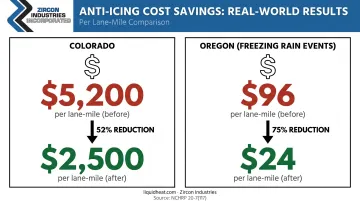
The documented savings are significant. NCHRP 20-7(117) reported winter operation costs in Colorado dropped from $5,200 to $2,500 per lane-mile after switching to anti-icing approaches. Oregon saw costs fall from $96 to $24 per lane-mile during freezing rain events.
Holdover Time and Residual Effectiveness
Those cost gains depend on one critical variable: how long a treatment stays effective. In aviation, this is called holdover time — the estimated window during which deicing or anti-icing fluid helps prevent frost, ice, or snow from accumulating on treated aircraft surfaces, as defined under 14 CFR 121.629. That window depends on several factors:
- Outside air temperature
- Precipitation type and intensity
- Fluid type and formulation
- Application concentration and procedure
Once holdover time expires, the aircraft cannot simply proceed as if the protection is still active. Depending on the approved ground deicing program and operating conditions, the crew may need a pre-takeoff contamination check, an approved alternate procedure, or another deicing/anti-icing treatment before departure.
The same concept applies in road and industrial settings as residual effectiveness — how long a treatment keeps working before precipitation, traffic, mechanical contact, or dilution reduces its performance. Automated reapplication systems help manage that variable by delivering more consistent, timed coverage instead of depending entirely on manual judgment.
Key Applications of Seasonal Deicer Agents
Roads, Highways, and Municipal Surfaces
Road maintenance operations represent the largest single category of seasonal deicer use. Municipal departments and township road crews apply both solid and liquid chloride products across roads, highways, bridges, and other winter-maintenance surfaces each year.
The shift toward liquid anti-icing before storms — rather than spreading dry material only after ice forms — has produced measurable results where it has been adopted. A NCHRP 20-7(117) benefit/cost study reported that 35 of 39 responding states were conducting anti-icing. In North Dakota, fixed automated spray technology systems on bridge decks produced benefit-cost ratios of 1.3 to 4.3 over a 20-year lifecycle, while related ITS reporting found crash reductions of 50% to 66% on treated bridge decks.
Aviation
Aircraft deicing is one of the most time-critical and regulated deicer applications. Type I and Type IV glycol fluids remove existing ice and provide temporary anti-icing protection, but the protection window starts during the final fluid application. Under 14 CFR 121.629, aircraft operating in ground-icing conditions must follow an approved ground deicing/anti-icing program, including holdover-time procedures, pre-takeoff checks, and contamination-check requirements.
At scale, deicing becomes a logistics operation as much as a chemical one. Munich Airport’s winter 2024/2025 aircraft deicing report recorded 6,937 aircraft deicing operations, using 3,041 cubic meters of Type I fluid and 535 cubic meters of Type IV fluid. EPA’s airport deicing technical documentation has also placed U.S. aircraft deicing fluid use in the tens of millions of gallons annually, depending on reporting year and measurement method.
Industrial and Heavy Equipment Operations
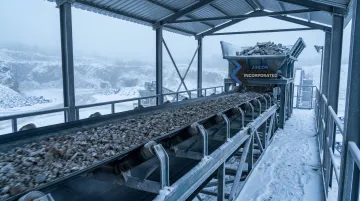
Quarries, aggregate operations, mines, railroads, and lumberyards face freeze challenges that standard road salt products are not built to solve:
- Aggregate, coal, ore, and other bulk materials can freeze in hoppers, rail cars, truck beds, and storage piles
- Conveyor belts, rollers, idlers, chutes, and switches can seize or lose function in extreme cold
- Frozen material can slow loading, unloading, crushing, conveying, and transfer operations
- Manual deicing can create delays, inconsistent coverage, and additional safety exposure for maintenance crews
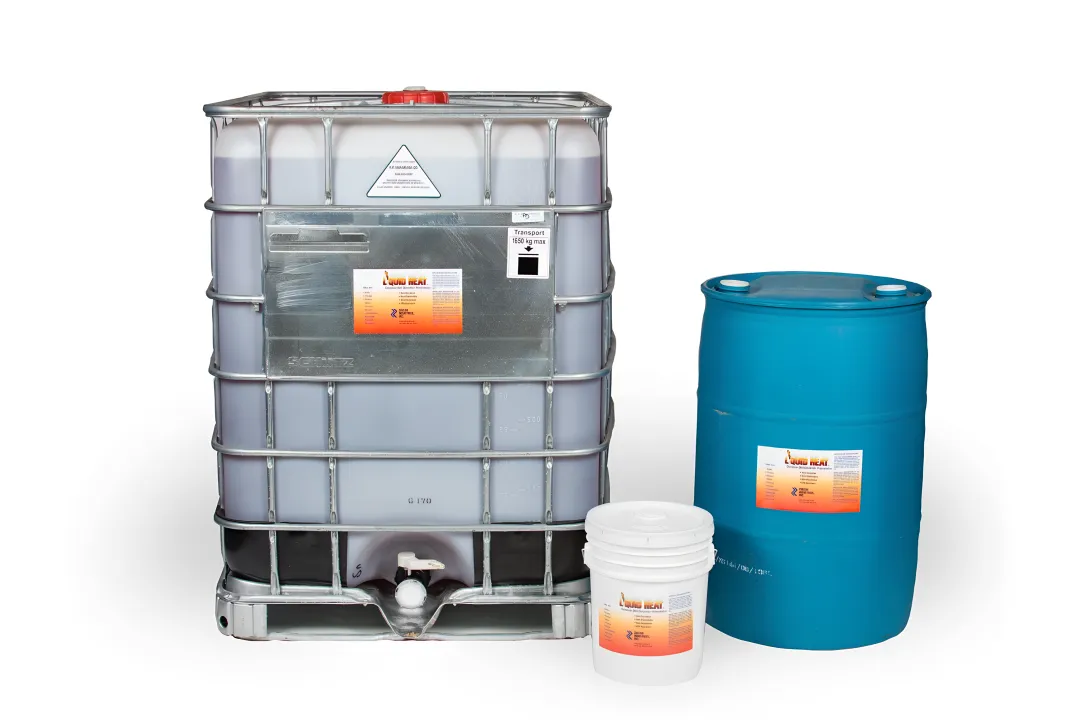
These environments require purpose-built industrial formulations. Zircon Industries’ Liquid Heat Conveyor Belt Deicer is built for conveyor belts, rollers, idlers, chutes, switches, truck beds, and other freeze-prone material-handling surfaces. It prevents ice from adhering to equipment surfaces at temperatures down to -60°F and is backed by 55+ years of Zircon Industries’ specialty chemical experience.
How to Choose the Right Seasonal Deicer Agent
Match the Product to Your Temperature Range
Effective temperature range is the first filter. Using a product outside its operational range doesn't just reduce performance — it can mean no performance at all.
| Deicer Type | Practical Field Temperature | Notes |
|---|---|---|
| Sodium chloride | ~15°F | Cost-effective; limited cold-weather use |
| Magnesium chloride | ~-10°F | Better than rock salt; still a chloride |
| Calcium chloride | ~-25°F | Exothermic; strong low-temp performer |
| Potassium acetate | Product/formulation dependent | Airfield and sensitive-site use; verify label, SDS, and approved application guidance |
| Industrial formulations | To -60°F | Purpose-built for bulk material and conveyor applications |
Surface temperature matters more than air temperature. Pavement and equipment surfaces can run significantly colder than ambient air, especially on exposed bridge decks and metal conveyor systems. That gap affects product selection as much as the forecast does.
Factor in Surface Compatibility and Corrosion
Not every surface handles deicer chemistry equally. Two areas where product choice has long-term asset implications:
- Metal exposure (conveyor systems, rail infrastructure, mining equipment): Chloride-based products accelerate corrosion on steel reinforcement and vehicle components. Acetate and formate alternatives, or corrosion-inhibited formulations, are worth evaluating even where a chloride product would technically work.
- Concrete surfaces: Certain deicer chemistries accelerate freeze-thaw deterioration on facility floors, loading docks, and paved areas around industrial sites. Verify compatibility before committing to a product for repeated seasonal use.
Consider Application Method
How a product is applied affects both performance consistency and overall cost:
- Manual spreading introduces variability in coverage rate and timing
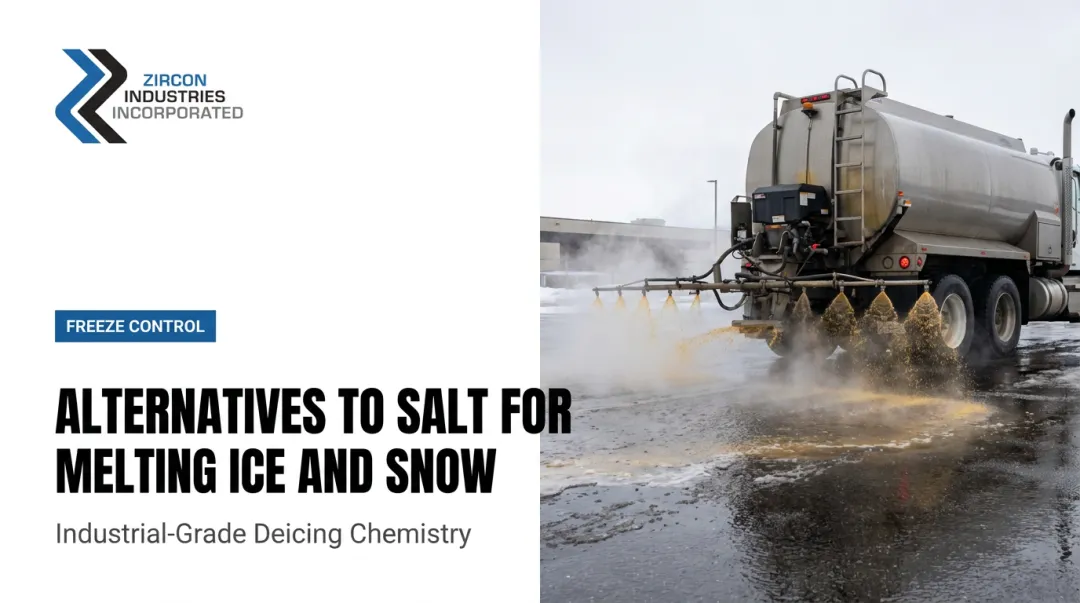
- Liquid spray trucks allow pre-treatment before storms and more controlled application rates
- Automated spray systems reduce manual variability by delivering consistent, measurable coverage on a programmed schedule
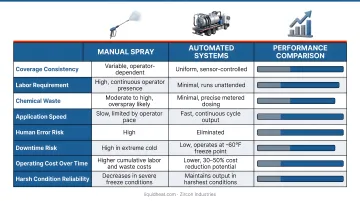
Zircon Industries’ automated deicer spray systems are built for high-volume industrial environments where timing and coverage consistency matter. The systems can support programmed spray cycles, temperature zones, belt-motion detection, and multiple spray points. In operations where a conveyor freeze can trigger a production shutdown, automation helps reduce manual variability and product waste.
Frequently Asked Questions
What is a seasonal deicer agent?
A seasonal deicer agent is a chemical compound used during cold weather months to lower water's freezing point, either preventing ice from forming on surfaces (anti-icing) or breaking down existing ice (deicing). Common applications include roads, airport runways, and industrial equipment like conveyor belts and rail cars.
What do they spray on planes to de-ice?
Aircraft are treated with glycol-based fluids classified by type. Type I fluid (a heated glycol-water mix, typically orange if dyed) removes existing ice and snow. Type IV fluid is a thicker anti-icing agent applied to clean surfaces to prevent re-icing during taxi and the pre-takeoff window.
What is the difference between deicing and anti-icing?
Deicing is reactive: it removes ice that has already formed. Anti-icing is proactive: applied before a freeze event, it prevents ice from bonding to the surface in the first place. Anti-icing generally uses less product and costs less per treated area when weather can be anticipated in advance.
Are deicer agents harmful to the environment?
Chloride-based products like rock salt can affect freshwater ecosystems, vegetation, and infrastructure when runoff is not managed properly. USGS data shows chloride in northern U.S. streams approximately doubled between 1990 and 2011, with 29% of monitored sites exceeding EPA chronic criteria. Acetate and formate alternatives can reduce chloride-related concerns, but cost more and still require product-specific environmental review.
What deicer works best in extreme cold?
Calcium chloride handles temperatures down to about -25°F in field conditions, making it one of the strongest chloride-based options. For industrial applications like conveyor belts and bulk material handling, purpose-formulated products such as Zircon Industries’ Liquid Heat Conveyor Belt Deicer can prevent ice adhesion on equipment surfaces at temperatures down to -60°F.
How often should deicer be reapplied during a winter weather event?
Reapplication depends on precipitation rate, temperature, traffic or mechanical action, and product type. Anti-icing treatments applied before a storm last longer than reactive deicing applications. Automated application systems maintain consistent coverage and timing throughout active weather events.