Introduction
Oil and gas sites present demanding dust control challenges because unpaved haul roads, well pad access routes, and frac sand delivery corridors often carry heavy vehicles such as water trucks, frac tankers, and equipment haulers. When these roads are not treated properly, traffic can generate dust that affects visibility, worker exposure, equipment maintenance, and site operations.
Dust control at O&G sites goes beyond nuisance mitigation. It can affect air quality planning, worker respiratory protection, equipment upkeep, and road access. A CDC/NIOSH haul road dust report notes that haul trucks at surface mining sites can account for approximately 78% to 97% of total dust emissions, making haul-road dust a major concern for heavy industrial sites with similar unpaved-road traffic patterns.
Equipment operating in high-dust environments may also need more frequent inspection and maintenance of air intake and filtration systems.
This guide evaluates the top 10 road dust suppressants for oil and gas operations—covering performance under heavy traffic, environmental compliance requirements, and application logistics at remote sites.
Key Takeaways
- O&G sites face unique dust challenges: extreme traffic loads, remote locations with limited water access, and strict environmental compliance near well pads
- This guide covers 10 suppressant types—from chloride salts and lignin sulfonates to synthetic polymers, bitumen emulsions, and produced water reuse—so you can match the right product to your conditions
- Selection depends on traffic volume, soil type, climate, water availability, environmental sensitivity, and reapplication logistics
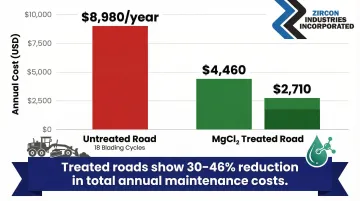
- True cost-effectiveness means weighing reapplication frequency, road maintenance savings, and avoided equipment downtime, not just upfront product price
- Turnkey or managed application programs can help simplify logistics for remote or high-traffic sites, but cost and performance depend on road length, traffic, product type, application method, and reapplication schedule
Why Dust Control Is a Critical Challenge on Oil & Gas Sites
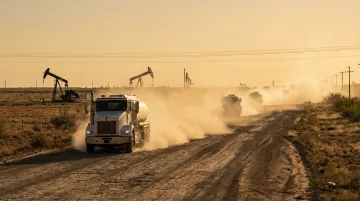
O&G road dust presents demanding conditions. Haul roads may serve tanker trucks, water trucks, frac sand delivery vehicles, and heavy equipment haulers, often in arid or semi-arid regions where frequent watering is difficult. Dust can affect visibility, road safety, equipment maintenance, and operating efficiency, especially on remote access roads and high-traffic well pad routes.
Compliance requirements vary by state, permit type, site location, and activity. The EPA's State Implementation Plan framework under 40 CFR Part 51 gives states a major role in implementing air quality requirements. Oil and gas operators should review their state air permits, local fugitive dust rules, and site-specific dust-control obligations before selecting a suppressant.
- Colorado ECMC Rule 427: Colorado oil and gas dust-control requirements include dust minimization measures, chemical dust suppressant documentation, and fresh-water-only requirements within 300 feet of the ordinary high-water mark of a water body. Operators should review Colorado Rule 427 and any local conditions, including requirements for lease access roads, before selecting a suppressant.
- Texas TCEQ: Texas oil and gas facilities should review applicable TCEQ air permit-by-rule requirements, including 30 TAC §106.352, and any related fugitive-dust requirements for roads, work areas, and material handling.
- State and local fugitive dust rules: Dust control obligations vary by jurisdiction, permit, and site activity. Operators should verify whether their air permit, local agency, or State Implementation Plan requires documented dust-control measures.
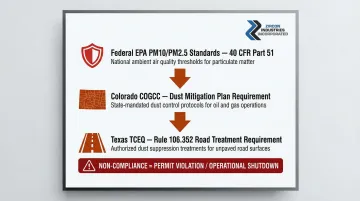
Those compliance requirements don't exist in isolation — they define the performance bar. O&G site roads need products that hold up under extreme traffic, stay compatible with nearby drilling operations and surface water, and can be applied reliably in remote locations. That combination of operational and regulatory pressure is what makes product selection genuinely difficult.
Top 10 Road Dust Suppressants for Oil & Gas Sites
These 10 suppressants were evaluated based on performance under heavy industrial traffic, suitability for arid and remote conditions common to O&G sites, environmental compliance profile, and practical application logistics.
Magnesium Chloride (Liquid)
Magnesium chloride is a hygroscopic chloride salt used for dust control on unpaved roads, gravel roads, and industrial haul roads. It works by attracting moisture from the air and helping keep road fines damp, which can reduce dust when humidity, road material, and traffic conditions are suitable.
Why it works on O&G roads:
- Draws moisture from the atmosphere to help keep road surfaces damp
- The USDA Forest Service dust palliative guide states that magnesium chloride starts to absorb water from the air at 32% relative humidity
- Can be applied through conventional liquid application equipment, depending on the product concentration and site setup
- Compatible with gravel and aggregate road surfaces common on well pads
- Dual-function capability with light freeze control
Limitations: Performance drops in very low humidity environments (below ~30% RH), and potential chloride runoff concerns exist near surface water.
| Attribute | Details |
|---|---|
| Type / Chemistry | Inorganic hygroscopic salt; typically applied as 30–33% aqueous solution |
| Best Application | High-traffic gravel haul roads; arid to semi-arid O&G regions; most effective where humidity stays above ~30% |
| Key O&G Advantage | Long track record in mining and O&G; can be applied via standard water trucks; dual-function with light freeze control |
Calcium Chloride (Liquid or Flake)
Calcium chloride is another commonly used hygroscopic dust suppressant for unpaved and gravel roads. It is available in liquid and dry forms, and it can be surface-applied or incorporated into road material depending on the road program and product guidance.
Performance characteristics for O&G:
- Attracts moisture from the air and helps retain moisture in the road surface
- The USDA Forest Service dust palliative guide states that calcium chloride can start absorbing moisture at 29% relative humidity at 77°F and 20% relative humidity at 100°F
- May perform better than magnesium chloride in some lower-humidity conditions, but product choice should still depend on road material, traffic, climate, and runoff risk
Caution: Calcium chloride can increase corrosion risk for vehicles and equipment and may create slick conditions if over-applied. Use product-specific application guidance and site-specific environmental controls before applying near sensitive areas.
| Attribute | Details |
|---|---|
| Type / Chemistry | Inorganic deliquescent salt; liquid (32–38%) or flake/pellet form |
| Best Application | Access roads with moderate-to-high traffic; effective in drier climates where magnesium chloride underperforms |
| Key O&G Advantage | Widest availability; dual use in winter freeze control; works at lower relative humidity than MgCl₂ |
Lignin Sulfonate
Lignin sulfonate is an organic, water-soluble binder derived from the wood-pulp industry. It can help bind fine road particles and reduce dust on some unpaved roads, especially where road material has enough fines for the binder to work.
Where it fits in O&G:
- Suitable for sites near wetlands, surface water, or areas with strict environmental permits
- Commonly used by the U.S. Forest Service as a baseline palliative
- Performs best on fine-grained soils with moderate clay content
Important limitations: Lignin sulfonate is water-soluble, so performance may decline in heavy rainfall or on roads with poor drainage. The USDA Forest Service dust palliative guide notes that lignin sulfonate can have environmental considerations, including effects associated with high biochemical oxygen demand and water quality if the material reaches waterways. Review USDA Forest Service dust palliative guidance, SDS materials, and site runoff controls before using lignin-based products near surface water.
| Attribute | Details |
|---|---|
| Type / Chemistry | Organic non-petroleum polymer; water-soluble; by-product of sulfite pulping process |
| Best Application | Light-to-moderate traffic roads; environmentally sensitive O&G corridors; fine-grained or clay-rich road surfaces |
| Key O&G Advantage | Biodegradable; reduced environmental liability; effective dust binder on clay-dominant wearing courses |
Synthetic Polymer Emulsions
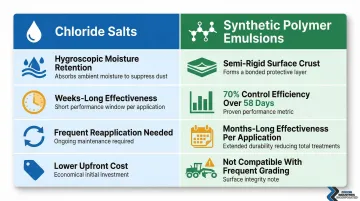
Synthetic polymer emulsions can form a binding layer or film on the road surface after the water carrier evaporates. They may be useful on roads where longer treatment life is more important than frequent grading, but performance depends heavily on product chemistry, road material, traffic, UV exposure, freeze-thaw conditions, and drainage.
O&G advantage:
- May reduce reapplication frequency on remote roads when the product is matched to the site
- Can help bind surface fines and reduce dust where the road surface is properly prepared
- USDA Forest Service guidance notes that synthetic polymer derivatives are generally applied once every few years, depending on the product and site conditions
Drawbacks: Polymer-treated surfaces can be difficult to maintain with conventional grading once a crust forms.
| Attribute | Details |
|---|---|
| Type / Chemistry | Synthetic organic polymer; typically polyvinyl acetate or acrylic emulsion; water-borne |
| Best Application | High-traffic, long-use haul roads that are not frequently graded; dry climates with minimal freeze-thaw |
| Key O&G Advantage | Months-long dust suppression per application; reduced reapplication labor on remote O&G roads |
Bitumen / Asphalt Emulsion
Bitumen/asphalt emulsions are diluted asphalt-in-water suspensions that penetrate road surfaces and bind particles through a cementing action. Used on mining haul roads and O&G access roads with heavy equipment traffic.
Strengths:
- Good binding on coarse aggregate
- Resistant to leaching in rainfall
- Effective at high traffic loads
Significant drawbacks for O&G sites:
- Asphalt- or bitumen-based products may raise handling, worker-exposure, runoff, and environmental concerns depending on the formulation
- Some bitumen-related exposures have been evaluated by IARC, so avoid broad safety claims without product-specific SDS review
- Once cured, asphalt emulsion treatments may be harder to maintain with conventional graders than temporary dust suppressants
- Hot-applied asphalt products have different hazards than cold-applied emulsions, so storage temperature, application method, SDS guidance, and site safety controls must be reviewed before use near O&G equipment or well pad infrastructure
| Attribute | Details |
|---|---|
| Type / Chemistry | Petroleum-based; diluted asphalt emulsion (anionic or cationic); not water-soluble after curing |
| Best Application | Heavy-load roads where long-term binding is needed; low environmental sensitivity; sites with infrequent grading |
| Key O&G Advantage | Strong particle binding; resistant to washout; suitable for very high axle-load haul roads |
Highly Refined Synthetic Fluids
Highly refined synthetic fluids are a product category used in some dust-control programs where water availability, evaporation, or humidity dependence is a concern. These products should be evaluated formulation by formulation because performance, toxicity profile, runoff behavior, and regulatory acceptance can vary.
Why some O&G operators evaluate synthetic fluids:
- They may reduce dependence on frequent water-truck application in arid regions
- They may be relevant where humidity-dependent chloride performance is limited
- Product-specific SDS materials, environmental data, and state/local permit requirements should be reviewed before use near grazing land, surface water, or sensitive habitats
- Do not claim a synthetic fluid is "EPA-compliant," "environmentally inert," "non-hazardous," or "safe near wildlife" unless the exact product documentation supports those claims
Trade-off: Higher per-gallon cost, but offset by infrequent reapplication and zero water usage.
| Attribute | Details |
|---|---|
| Type / Chemistry | Synthetic hydrocarbon fluid (iso-alkane based); adsorption-action, non-water-soluble |
| Best Application | Water-scarce O&G regions; underground or enclosed road areas; sites requiring EPA-compliant, non-toxic solution |
| Key O&G Advantage | Fully waterless; immediate effectiveness; no evaporation; clear and odorless—safe near wellheads and surface equipment |
Electrochemical / Ionic Stabilizers
Electrochemical or ionic stabilizers are typically used where road material contains reactive clay minerals. They are usually incorporated into the road material rather than only surface-sprayed, and their success depends on soil chemistry, gradation, plasticity, compaction, moisture, and curing conditions.
Potential fit for O&G sites with clay-heavy road bases:
- May support dust reduction and surface stabilization where the soil chemistry is compatible
- Should be specified only after soil testing confirms that the road material can react with the treatment
- FHWA's unpaved road dust management guidance notes that chemical treatments are generally ineffective when the shrinkage product is less than 50, because high application rates may be needed to fill voids between particles
Critical requirement: They require reactive clay minerals to work and are not effective on sandy, low-clay soils. Soil testing is recommended before specifying this treatment to verify clay mineral composition.
| Attribute | Details |
|---|---|
| Type / Chemistry | Sulfonated petroleum or ionic exchange chemistry; requires mixing into road base material |
| Best Application | Roads with high clay content; sites where both dust AND structural improvement are needed simultaneously |
| Key O&G Advantage | Reduces ruts and dust with one treatment; long-term stabilization reduces maintenance frequency on active O&G access roads |
Enzyme-Based Stabilizers
Enzyme-based stabilizers are bio-derived liquid treatments that target clay-mineral activity in the road surface, functioning similarly to electrochemical stabilizers but using biological processes. Applied as a diluted spray into the road base, they catalyze a binding reaction that reduces plasticity and dust generation over time.
Positioning for O&G:
- Enzyme-based stabilizers may be considered where the road base contains reactive clay minerals and the product has documented performance for similar soils
- Independent performance data can vary, so request field trial results, SDS materials, and soil-compatibility guidance before large-scale use
- Do not claim FDA/EPA acceptance, very low toxicity, or regulatory friendliness unless the exact product documentation and jurisdiction support those claims
Important considerations: Efficacy depends on clay mineral composition (require reactive clay). Independent performance verification varies—request field trial data before committing to large-scale use to ensure compatibility with your specific road base.
| Attribute | Details |
|---|---|
| Type / Chemistry | Bio-derived enzyme formulation; catalytic clay-reactive treatment; applied diluted in water |
| Best Application | Clay-rich road bases in environmentally sensitive O&G zones; sites prioritizing low-toxicity programs |
| Key O&G Advantage | Non-toxic, biodegradable; regulatory-friendly in sensitive areas; reduces dust and improves road structural integrity |
Produced Water / Brine Reuse
Produced water is the water co-produced during oil and gas extraction. Because it can contain dissolved salts, some operators and states have evaluated whether produced water or oilfield brine can be reused for dust suppression or deicing. This option should be treated as a regulated waste-management and environmental-permitting issue, not as a standard dust suppressant.
Important caveats:
Produced water composition varies widely by basin, formation, and well. A Permian Basin study reported produced water TDS concentrations ranging from 100,800 to 201,500 mg/L. USGS research on the northern Appalachian Basin reported that Marcellus Shale produced water samples had radium activities ranging up to 18,000 pCi/L. Another Permian Basin produced water characterization report detected VOCs including benzene, toluene, ethylbenzene, and xylenes in sampled produced water, but these values should be quoted only with the exact source and sample context.
Road application should be allowed only where state rules, permits, water-quality requirements, and composition testing allow it.
Road application is regulated at the state level:
| State | QC-Safe Regulatory Framing |
|---|---|
| Colorado | Colorado Rule 427 includes dust-control requirements and requires operators to use only fresh water for dust suppression activities within 300 feet of the ordinary high-water mark of a water body. Confirm any produced-water reuse proposal directly with Colorado ECMC and local permit conditions. |
| North Dakota | North Dakota has published guidelines for produced water spreading for dust/ice control, including minimum calcium plus magnesium, chloride, and radium limits. Produced water use requires approval and source testing. |
| Pennsylvania | Pennsylvania's DEP halted authorizations for conventional oil and gas brine road-spreading in 2018, and unconventional gas well brine has separate restrictions. Treat Pennsylvania road-spreading claims as current-policy-sensitive and verify with PA DEP before publishing. |
| Texas | Do not say produced water road spreading is broadly permitted. Produced water reuse in Texas is regulated and project-specific. Verify with the Railroad Commission of Texas, TCEQ, and site-specific authorization before describing produced water as a dust-control option. |
| Wyoming | Wyoming DEQ states that when no other alternative is reasonably available for disposal of limited quantities of wastewater or exploration-and-production-exempt oily wastes, applicants may apply for a Road Application of Waste or Wastewater permit. |
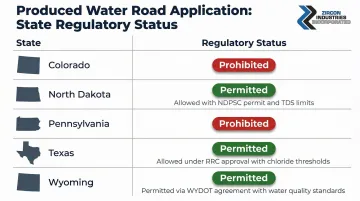
This option is viable only under compliant programs with proper permit authorization and composition verification.
| Attribute | Details |
|---|---|
| Type / Chemistry | Variable brine; dissolved salts (NaCl, CaCl₂, MgCl₂) with potential trace contaminants; field-sourced |
| Best Application | O&G sites with active produced water management programs; states with compliant land-application rules |
| Key O&G Advantage | Reduces freshwater consumption and disposal costs; uses on-site byproduct; hygroscopic suppression action similar to commercial chlorides |
Zircon Industries Road Dust Control Options
For oil and gas access roads, haul roads, and remote industrial sites, Zircon Industries offers product-specific dust control options including RDS38 Road Dust Stabilizer, Glycerin DC-100, and ZHP Water Wetter Non-Ionic Surfactant.
How Zircon's dust control options fit O&G sites:
- RDS38 Road Dust Stabilizer is a turnkey-applied road dust stabilizer lasting 3 to 4 months per application
- Glycerin DC-100 is a self-applied biodegradable dust control product is 100% biodegradable, safe for aquatic life, and available in 330-gallon totes
- ZHP Water Wetter Non-Ionic Surfactant is used in water-based dust suppression programs mixing at 1,500 to 3,000 parts water to 1 part surfactant
Zircon Industries provides pricing, availability, packaging options, and application guidance on request. Contact the team at 800-547-4328 for site-specific support.
| Attribute | Details |
|---|---|
| Product Options | RDS38 Road Dust Stabilizer, Glycerin DC-100, and ZHP Water Wetter Non-Ionic Surfactant |
| Best Application | Unpaved O&G access roads, haul roads, gravel routes, and water-based dust suppression programs |
| Key O&G Advantage | Product-specific options for longer-term turnkey application, biodegradable self-application, or water-truck dust suppression programs |
How We Selected These 10 Dust Suppressants
This guide compares suppressant categories using O&G-specific selection factors such as traffic load, road material, climate, water availability, proximity to surface water, reapplication logistics, regulatory constraints, and total cost of ownership. Final product selection should still be based on product documentation, road testing, SDS review, and site-specific permit requirements.
Common mistakes O&G operators make when selecting dust suppressants:
- Choosing products based solely on upfront cost, ignoring reapplication frequency
- Applying general road products without testing soil/aggregate compatibility
- Not accounting for environmental permit requirements or produced water disposal regulations
- Neglecting to evaluate logistics of product delivery to remote well sites
Pre-Application Testing
Soil and aggregate testing before product selection is essential. Most failures trace back to chemical-material incompatibility, not product quality:
- Polymer emulsions can fail on high-clay soils
- Chlorides can form non-hygroscopic compounds on iron-rich soils
- Chemical treatments are ineffective if the shrinkage product of the soil is less than 50
Pre-application testing should include road material gradation, fines content, plasticity, drainage, and traffic assessment. FHWA's unpaved road dust management guidance notes that chemical treatments are generally ineffective if the shrinkage product is less than 50, because uneconomically high application rates may be required to fill the voids between particles.
Conclusion
The right dust suppressant for an oil and gas site depends on a combination of site-specific variables—soil type, traffic intensity, climate, proximity to water resources, and regulatory environment. No single product is universally best. Operators should prioritize products that fit their compliance obligations and application logistics before brand name.
Before finalizing any dust control program, evaluate:
- Total cost of ownership across multiple well pads or access roads
- Reapplication frequency and road maintenance savings
- Equipment downtime avoided versus product cost
- Supplier reliability for consistent supply in remote regions
- Environmental compliance costs tied to product choice
For oil and gas operators evaluating dust control options, Zircon Industries offers dust control products and application guidance for unpaved access roads, haul roads, gravel routes, and water-based dust suppression programs. With 55+ years of specialty chemical experience, Zircon can help operators compare product fit, packaging options, application methods, and site-specific requirements. Contact the team at 800-547-4328 to discuss product availability and application guidance.
Frequently Asked Questions
What makes dust control on oil and gas sites different from standard road applications?
O&G haul roads handle far heavier loads than standard roads — frac trucks and tankers routinely exceed 80,000 lbs GVW. They're also typically located in water-scarce remote areas, with added constraints around environmental compliance and product safety near wellheads that municipal or rural road projects simply don't face.
How often do dust suppressants need to be reapplied on active oil and gas haul roads?
Reapplication frequency depends on product chemistry, road material, traffic, weather, drainage, and application rate. For Zircon-specific products, RDS38 Road Dust Stabilizer is listed as lasting 3 to 4 months while Glycerin DC-100 is listed as lasting 3 to 4 weeks. Water-only programs usually require more frequent application than longer-lasting chemical treatments.
Are chloride-based dust suppressants safe to use near oil and gas well pads?
Chloride-based dust suppressants can be used on many unpaved road applications, but suitability near oil and gas well pads depends on product formulation, application rate, runoff pathways, soil conditions, nearby water resources, and permit requirements. Operators should review SDS materials, product labels, and site-specific environmental permits before applying chloride products near surface water, wetlands, or sensitive infrastructure.
Can produced water from oil and gas operations be used as a dust suppressant?
Produced water may contain salts that behave similarly to commercial chloride dust suppressants, but road application is regulated at the state level and should never be treated as automatically acceptable. Composition can vary widely by formation and may include high total dissolved solids, VOCs, metals, and naturally occurring radioactive materials. Peer-reviewed research on Permian Basin produced water reported TDS values from 100,800 to 201,500 mg/L, while USGS research reported Marcellus Shale produced water radium activities up to 18,000 pCi/L. Always verify state rules, permits, testing requirements, and runoff controls before considering road application.
Do dust suppressants affect the load-bearing capacity of unpaved roads for heavy equipment?
Some dust suppressants mainly reduce dust without changing the road's structural capacity, while some stabilizers may improve surface binding or strength when the soil chemistry is compatible. FHWA guidance notes that chemical treatments are generally ineffective when the shrinkage product is less than 50, so soil testing is important before relying on any suppressant for structural improvement.
What should oil and gas operators ask a dust suppressant supplier before purchasing?
Before committing, request the following from any supplier:
- Soil compatibility data and performance documentation under equivalent traffic loads
- Safety Data Sheets (SDS) and regulatory acceptance status in your operating state
- Clarity on whether turnkey application is offered or logistics are separate
- Field trial data and references from comparable O&G operations