Introduction
Industrial operators face a persistent challenge: conventional oil-based lubricants fail when exposed to extreme temperatures, vacuum environments, contamination-sensitive processes, or components that are inaccessible for regular maintenance. In these demanding conditions, dry film lubricants deliver a reliable solution that liquid lubricants cannot.
This guide covers the major types of dry film lubricants and reviews top products across key industries. It also provides a selection framework for procurement and maintenance teams.
Whether you're evaluating railroad maintenance equipment, heavy industrial assemblies, or contamination-sensitive production systems, the right choice depends on matching lubricant chemistry to the application, operating environment, and compliance requirements..
Key Takeaways
- Dry film lubricants reduce friction without liquid oil—ideal for extreme temperatures, high loads, or contamination-sensitive environments
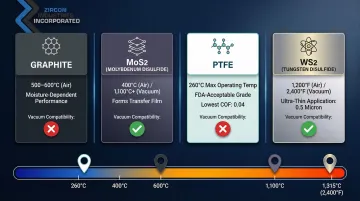
- Four main types—graphite, MoS2, PTFE, and WS2—each with distinct temperature limits and vacuum compatibility
- Match your choice to substrate, operating temperature, and regulatory requirements (FDA, AAR, MIL-spec) before selecting a product
- Zircon Industries’ Dry Graphite Lubricant is an AAR-approved railroad lubricant (M971-93) available in bulk and aerosol, making it a documented option for railroad maintenance teams that need compliant dry graphite performance.
- Always match lubricant type to the failure mode: galling, fretting corrosion, high-load wear, or clean operation in food/medical settings
Understanding Dry Film Lubricants: Types and How They Work
Dry film lubricants are solid-phase materials that reduce friction between two surfaces without a liquid oil carrier. Most rely on a hexagonal lamellar crystal structure, where atomic layers slide over each other with minimal shear force. Weak van der Waals interactions between basal planes make this slip possible under load.
Graphite: High-Temperature Performance with Moisture Dependency
Graphite achieves low friction through adsorbed moisture or water vapor on its surface. In the absence of these adsorbates—such as in vacuum environments—graphite loses its lubricity and fails as a lubricant. This environmental dependency limits its use to terrestrial, moisture-rich applications.
Graphite performs effectively from 500°C to 600°C in air; beyond that, oxidation degrades performance. Its electrical conductivity also rules it out for insulated electrical contacts.
Molybdenum Disulfide (MoS2): Vacuum-Compatible Workhorse
MoS2 is an intrinsic solid lubricant that does not require adsorbed moisture, making it highly effective in vacuum environments where graphite fails. The material achieves ultra-low friction by fracturing along basal planes and depositing a "transfer film" onto the mating surface—effectively lubricating both faces during sliding contact.
- Lower coefficient of friction than graphite in many conditions
- Performs especially well in vacuum and other low-moisture environments
- Air oxidation typically limits service temperatures to about 350°C–400°C.
- Often used where high load capacity and anti-seize performance matter most.
PTFE: Lowest Friction with Thermal Constraints
Unlike graphite and MoS2, PTFE achieves lubricity through macromolecular slip rather than a layered structure. Its coefficient of friction can reach as low as 0.04, the lowest among common dry film lubricants.
Key specs and safety limits:
- Continuous operating temperature must remain below 260°C (500°F)
- If PTFE is overheated beyond its service range, decomposition fumes can become hazardous.
- FDA-acceptable formulations are available for food production and pharmaceutical equipment
- Best suited for clean, low-friction applications where contamination cannot be tolerated
Tungsten Disulfide (WS2) and Boron Nitride: When Standard Options Fall Short
When graphite, MoS2, and PTFE hit their limits, two specialty materials step in for the most extreme temperature and vacuum requirements.
WS2 is applied via binder-less impingement at ultra-thin profiles (0.5 microns / 0.00002"), conforming to AMS2530 and DOD-L-85645A Type I. It operates from -460°F to 1,200°F in air and up to 2,400°F in vacuum, offering one of the widest temperature ranges and one of the lowest friction profiles among common dry film lubricant options.
Boron Nitride (h-BN) is a ceramic powder lubricant capable of operating up to 850°C in oxidizing atmospheres and 1,600°C to 2,000°C in inert/vacuum environments, suited for furnace components, high-temperature mold releases, and aerospace assembly where other lubricants decompose.
Best Dry Film Lubricants: Top Products Reviewed
These five products were selected based on industry certifications, verified temperature performance, and documented use in demanding sectors — from railroad and mining to aerospace and food production. Each serves a distinct application profile, so the right choice depends on your operating environment and compliance requirements.
Zircon Dry Graphite Lubricant (Zircon Industries)
Background: An AAR-approved (M-971-93) dry graphite lubricant manufactured by Zircon Industries, a U.S.-based specialty chemical company with over 55 years of experience. The product is specifically formulated for railroad applications, including track and switch components, where dry lubrication is required to maintain performance in demanding conditions.
Differentiators: AAR M-971-93 certification makes this a standards-compliant choice for railroad operators requiring documented performance and regulatory alignment. The dry graphite formulation is suited for freeze-prone and heavy-load environments, where traditional oil-based lubricants can fail or attract debris. Its non-oily composition supports consistent operation in conditions where cleanliness and reliability are critical.
| Category | Details |
|---|---|
| Key Applications | Railroad track and switch lubrication, mining conveyor systems, heavy construction equipment, aggregate operations |
| Temperature Range | Effective in extreme operating conditions; contact Zircon Industries at 800-547-4328 for specific temperature data |
| Certifications | AAR Certified M-971-93; GSA Canadian Compliant; 40+ years of field-proven use |
NEOLUBE No. 1.1 (Huron Industries)
Background: A colloidal graphite-in-isopropanol dry film lubricant from Huron Industries used in nuclear and other impurity-controlled applications. NEOLUBE No. 1 was discontinued on July 11, 2024, and NEOLUBE No. 1.1 is the current formula.
Differentiators: Conforms to MIL-L-24131C requirements, air-dries in approximately 5 minutes, and is specified for critical applications where impurity control matters. Published service limits are 400°F continuous and 850°F intermittent.
| Category | Details |
|---|---|
| Key Applications | Nuclear components, aerospace fasteners, military assemblies, electrical contacts, anti-seize applications |
| Temperature Performance | Continuous: 400°F (204°C); Intermittent: 850°F (454°C); not recommended for vacuum |
| Delivery / Form | Colloidal graphite suspension in isopropanol; brush, spray, or dip application |
WS2 Dry Film Lubricant — Process SL-39 (Micro Surface Corporation)
Background: A binder-less tungsten disulfide coating applied via impingement, conforming to AMS2530 and DOD-L-85645A Type I. Applied in aerospace, defense, precision bearing, and mold release applications where dimensional control is critical.
Differentiators: Among the thinnest available at under 0.00002" film thickness — thinner than most resin-bonded alternatives — making it the right call where dimensional tolerances are tight. Compatible with liquid oxygen, solid rocket propellants, and hard radiation environments. Functions as both sole lubricant and co-lubricant with oils or greases.
| Category | Details |
|---|---|
| Key Applications | Stainless steel fasteners, precision bearings, gears, vacuum applications, mold release (ejector pins, inserts) |
| Temperature Range | -460°F to 1,200°F in air; up to 2,400°F in vacuum; dynamic COF: 0.030, static COF: 0.070 |
| Certifications | AMS2530, DOD-L-85645A Type I; film thickness under 0.00002" |
Molykote D-708 (Heat-Cured Dry Film Anti-Friction Coating) — DuPont
Background: A heat-cured anti-friction coating from DuPont designed for lubrication and corrosion protection in metal/metal and metal/plastic pairings under low to medium loads.
Differentiators: Official DuPont materials emphasize low friction, corrosion protection, and long-term dry lubrication. Keep the corrosion claim tied to the published test condition: more than 700 hours of salt-spray resistance at 11-micron coating thickness over zinc phosphate..
| Category | Details |
|---|---|
| Key Applications | Military and aerospace assemblies, automotive components, fasteners, parts requiring permanent lubrication |
| Corrosion Resistance | >700 hours salt-spray (ISO R 1456) at 11 microns over zinc phosphate |
| Application | Heat-cure required; dispersion of PTFE in organic binder-solvent system |
Xylan PTFE-Based Dry Film Lubricant (Whitford / PPG)
Background: A PTFE-based dry film lubricant coating from Whitford (acquired by PPG in 2019) widely applied in food production, medical, automotive, and commercial laundry applications where FDA-acceptable, non-stick, and corrosion-resistant coatings are required.
Differentiators: Among the few dry film lubricants with verified FDA-acceptable resin systems (grades Xylan 8110 and 8840). Provides 1,500 to 5,000 hours of salt-spray resistance (ASTM B117) depending on primer and plating. Extremely low COF of 0.02 to 0.05. The clean, non-stick surface resists contamination buildup, making it a practical choice for food and pharmaceutical environments.
| Category | Details |
|---|---|
| Key Applications | Food production equipment, medical devices, automotive components, commercial laundry, pharmaceutical machinery |
| Temperature / COF | Operating ceiling: 260°C (500°F); COF as low as 0.02 to 0.05 |
| Regulatory Compliance | FDA-acceptable resin systems available (Xylan 8110, 8840); verify specific grade with manufacturer |
How to Choose the Right Dry Film Lubricant for Your Application
Operating Temperature and Environment
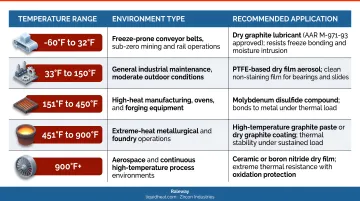
Match lubricant type to your operating conditions:
Graphite: Best for extreme high-temperature terrestrial environments (500°C to 600°C) where ambient moisture is present. Fails in vacuum because it needs ambient moisture to lubricate effectively.
MoS2: Ideal for vacuum and high-pressure applications up to 400°C in air, 1,100°C+ in vacuum. Transfers to mating surfaces in enclosed applications, lubricating both faces.
PTFE: Suited for moderate temperatures below 260°C (500°F) with strict cleanliness requirements. FDA-acceptable formulations available for food/medical industries.
WS2: Offers the widest temperature range (-460°F to 1,200°F in air; 2,400°F in vacuum) with dimensional precision due to ultra-thin application.
Substrate Type and Cure Requirements
Cure temperatures vary significantly across products:
- Some PTFE formulations cure at 300°F
- Others require 600°F minimum for optimal cross-linking
- MoS2 and WS2 impingement coatings require no heat cure at ambient temperature
Critical consideration: Plastic, plated, or heat-sensitive substrates may rule out certain high-cure products. Impinged MoS2 and WS2 offer ambient-temperature alternatives that preserve substrate integrity.
Regulatory, Certification, and Application Requirements
Identify whether your application requires:
- FDA-acceptable coatings (food/medical) → PTFE formulations like Xylan 8110, 8840
- AAR certification (railroad) → Zircon Industries Dry Graphite Lubricant (M-971-93)
- MIL-spec (military/defense) → WS2 Process SL-39 (AMS2530, DOD-L-85645A Type I)
- Vacuum compatibility (aerospace/space) → MoS2, WS2, or boron nitride
Spec mismatches can disqualify a product even when it performs well — confirm your certification requirements before selecting a formulation.
Load, Wear Mode, and Problem Being Solved
Once compliance is confirmed, match the lubricant to the specific failure mode you're preventing:
Galling/Seizing Prevention: MoS2 and WS2 offer high load-carrying capacity. Treat very high-load-capacity claims cautiously and verify them against the substrate, coating system, surface finish, and the test method used. Always request application-specific test data before final specification.
Fretting Corrosion: MoS2 transfers to mating surfaces, providing self-healing properties in enclosed applications.
Noise Reduction (NVH): PTFE's ultra-low COF reduces vibration and noise in automotive and mechanical assemblies.
Clean Operation: PTFE prevents oil/grease contamination in food, medical, and pharmaceutical equipment.
Permanent Lubrication: Resin-bonded formulations like Molykote D-708 are built for inaccessible parts — once applied, they provide long-term protection with little to no re-lubrication needed.
How We Selected These Products
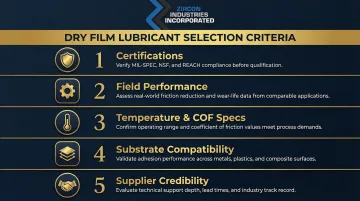
Every product in this guide was evaluated against the same set of standards used by industrial procurement teams — not marketing materials.
Evaluation criteria included:
- Industry certifications and compliance documentation (AAR, AMS, MIL-spec, FDA)
- Proven performance in industrial field applications with documented results
- Temperature and coefficient of friction specifications aligned to common use cases
- Substrate versatility and compatibility with standard industrial materials
- Established supplier credibility with decades of manufacturing experience
Common buyer mistakes to avoid:
- Selecting by brand name alone without verifying specification compliance
- Ignoring cure temperature constraints for heat-sensitive substrates
- Overlooking regulatory requirements (FDA, AAR, MIL-spec) that govern end-market compliance
- Accepting vendor load capacity claims at face value — always request substrate-specific test reports before specifying
Conclusion
Dry film lubricants are highly application-specific. The right product depends on several factors:
- Operating temperature range and environment
- Substrate material and surface prep requirements
- Regulatory compliance needs (food-grade, AAR, aerospace)
- The specific failure mode you're preventing — galling, fretting, wear, or corrosion
Getting this wrong can mean catastrophic equipment failures, compliance violations, or contamination incidents.
If your application requires an AAR-approved dry graphite lubricant for railroad maintenance, Zircon Industries’ Dry Graphite Lubricant is a relevant option to evaluate. Contact Zircon Industries to confirm fit, packaging, and approval requirements, or use the distributor network listed on Liquid Heat’s website to source the product through the appropriate channel.
Frequently Asked Questions
What is a dry film lubricant?
Dry film lubricants are solid lubricating materials or coatings that reduce friction without relying on a wet oil film. Common examples include graphite, MoS2, PTFE, and WS2. Some work through layered crystal structures, while fluoropolymers such as PTFE reduce friction through different molecular mechanisms.
When should I use a dry film lubricant?
Use dry film lubricants when operating temperatures exceed oil limits, when parts are inaccessible for re-lubrication, when contamination from oil or grease is unacceptable (food/medical), when operating in vacuum, or when fretting and galling are the primary failure modes.
What is a PTFE (Teflon) dry lubricant?
PTFE (polytetrafluoroethylene) is a synthetic polymer that achieves lubricity through molecular slip rather than a layered structure. It offers an extremely low COF and FDA-acceptable formulations with an operating ceiling of 260°C (500°F), but has lower abrasion resistance compared to MoS2 or WS2.
What is the best dry lubricant for metal-on-metal sliding under high pressure?
MoS2 and WS2 are preferred for high-load metal-on-metal applications due to their lamellar crystal structure, high load-bearing capacity, and strong adhesion to metal substrates. MoS2 also transfers to the mating surface in enclosed applications, lubricating both faces for extended wear protection.
What do plumbers use to lubricate O-rings?
For O-rings, installers typically use a lubricant that is explicitly compatible with the seal material and service environment, often silicone-based plumber’s grease in many water-system applications. Always check the O-ring manufacturer’s compatibility guidance before specifying a lubricant.
Can dry film lubricants be used in food-grade or FDA-regulated environments?
Certain PTFE-based dry film lubricants formulated with FDA-acceptable resin systems are suitable for food production and pharmaceutical equipment. Always confirm the specific product meets FDA compliance — not all PTFE lubricants qualify by default.