Introduction
A single rusted bolt can turn a routine 10-minute repair into a multi-hour delay. In industrial environments—mining, railroad operations, fleet maintenance, and heavy manufacturing—that delay isn’t just inconvenient. It directly impacts uptime, labor utilization, and production schedules.
Unplanned downtime is one of the most expensive failure points in industrial operations. Research shows that manufacturing downtime averages around $260,000 per hour, with total costs ranging from $10,000 to over $500,000 per hour depending on the operation and sector. Even minor maintenance bottlenecks—like a seized fastener—can cascade into idle crews, delayed production, and unplanned maintenance costs.
Not all penetrating oils deliver equal results. Some act quickly but evaporate before reaching a deep level of corrosion. Others lubricate well but lack the low viscosity required to penetrate tight thread gaps. Choose the wrong product, and you risk snapped bolts, damaged components, and extended downtime on jobs that should take minutes. This guide breaks down what separates high-performance penetrating oils from the rest—and how to choose the right one for industrial maintenance applications.
Key Takeaways
- Penetrating oil uses capillary action to seep into rusted threads and break corrosion bonds
- Zircon’s own De Aqua Lube is a non-flammable, all-purpose penetrant built for industrial and MRO use — effective on frozen fasteners, wet electrical systems, and mechanical linkages. -Other top performers include Kroil, PB B’laster, Liquid Wrench, WD-40 Specialist Penetrant, and CRC Freeze-Off.
- Low viscosity and adequate soak time (15–30 minutes minimum) determine success more than brand name
- Industrial operations should prioritize high-penetration formulas available in bulk — consumer aerosols often fall short on heavy equipment
What Is Penetrating Oil and Why Does It Matter for Rusted Bolts
Penetrating oil is a low-viscosity blend of oil and solvent engineered to seep into microscopic gaps between corroded metal surfaces. Unlike general-purpose lubricants such as standard WD-40—which function primarily as moisture displacers—penetrating oils break down the iron oxide bonds that lock fasteners in place.
The mechanism comes down to capillary action: the best penetrating oils balance low viscosity (so they flow easily) with optimized surface tension (so they pull themselves deep into threads). How well a formula achieves that balance determines how far it penetrates and how fast.
Once inside the threads, the oil does two things:
- Dissolves the rust bond holding the fastener in place
- Re-lubricates the metal surfaces to reduce the torque needed to turn the bolt
It doesn't fully eliminate rust — it weakens the grip enough to allow removal.
For industrial sectors like construction, railroad, and heavy manufacturing, seized bolts on critical equipment translate directly to lost operational time. A quality penetrant is essential MRO (maintenance, repair, and operations) inventory — the kind of item that earns its place on the shelf by preventing the downtime that costs far more than the product itself.
Best Penetrating Oils for Removing Rusted Bolts
Each pick below was evaluated on penetration speed, corrosion-breaking ability, and real-world performance across professional and DIY applications — from light surface rust to bolts seized for years.
De Aqua Lube Penetrant Lubricant — by Zircon Industries
Formulated by Zircon Industries with industrial maintenance crews in mind, De Aqua Lube is the penetrant we recommend first for operations in mining, railroad, fleet maintenance, and heavy manufacturing. Unlike every other product, it is non-flammable — a critical safety advantage when working around electrical systems, fuel lines, or equipment where flammable aerosols present real risk.
What sets it apart: De Aqua Lube does more than loosen frozen nuts and bolts. It dries wet electrical and ignition systems, prevents rust on metal surfaces, and reduces friction on mechanical linkages and squeaking parts — making it a genuine all-purpose MRO aerosol rather than a single-use penetrant. Available in 16 oz aerosols, 12 per case, it’s practical for stocking maintenance shops and field kits alike.
Its non-flammable formula is especially significant because all other penetrants reviewed here carry flash points between 126°F and 150°F and use highly flammable propellants — a real hazard in enclosed spaces or near hot equipment.
| Specification | Details |
|---|---|
| Best For | Industrial MRO, railroad, fleet maintenance, frozen fasteners, electrical systems |
| Key Mechanism | Non-flammable formula — safe near electrical systems and heated equipment |
| Application Format | 16 oz aerosol, 12 per case, Available from Zircon Industries |
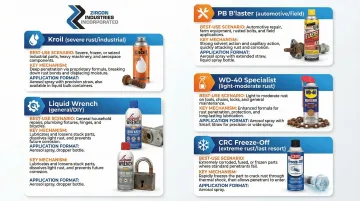
Kroil Original Penetrant
Manufactured by Kano Laboratories since 1939, Kroil has built a reputation on one thing: getting into places other penetrants can't. MRO professionals in aviation, oil and gas, manufacturing, and fleet maintenance reach for it when standard products fall short.
What sets it apart: Kroil is engineered to seep into crevices as small as one-millionth of an inch. Professional mechanics and maintenance technicians consistently rate it highest for deep penetration and minimal waste. It can be harder to find at retail stores but is readily available online and through industrial suppliers like Grainger.
| Specification | Details |
|---|---|
| Best For | Severe rust, industrial equipment, specialty fasteners |
| Key Mechanism | Ultra-low viscosity formula engineered for maximum capillary penetration |
| Application Format | Aerosol spray, liquid can, drip bottle |
PB B'laster
In production since 1957, PB B'laster has earned its place as the most widely used penetrant in North America through consistent results in automotive, industrial, and field maintenance applications.
What sets it apart: Widely available at hardware stores and home improvement retailers, making it the most practical choice for urgent jobs. The updated formula now includes a precision ProStraw applicator. Pre-soaking bolts a day or two before the job significantly improves results.
| Specification | Details |
|---|---|
| Best For | Automotive, general maintenance, field repairs |
| Key Mechanism | Penetrating catalyst with lubricating residue for sustained bolt loosening |
| Application Format | Aerosol can with ProStraw precision applicator |
Liquid Wrench Penetrating Oil
Liquid Wrench is a staple at major retailers and a go-to for DIYers and automotive enthusiasts who need a fast-acting penetrant they can grab off the shelf today.
What sets it apart: User reviews praise it for loosening rusted bolts within minutes with minimal effort. The formula clings to metal surfaces to reduce friction during removal—a strong all-around choice for both light and moderately corroded fasteners.
| Specification | Details |
|---|---|
| Best For | General automotive, household, light industrial |
| Key Mechanism | Fast-seeping, metal-clinging formula that minimizes friction on contact |
| Application Format | Aerosol can with ProStraw precision applicator |
WD-40 Specialist Penetrant
Distinct from the original multi-purpose WD-40 formula, the WD-40 Specialist Penetrant is a dedicated rust-penetrating product designed specifically for freeing seized fasteners.
What sets it apart: Features a built-in Smart Straw for precision or wide-spray application. Works well for surface rust and moderately seized bolts. Best suited for everyday maintenance tasks.
| Specification | Details |
|---|---|
| Best For | Light to moderate rust, everyday maintenance |
| Key Mechanism | Petroleum distillate-based penetrating catalyst with a non-evaporating lubricating residue for sustained bolt loosening |
| Application Format | Aerosol with Smart Straw (precision stream or wide spray) |
CRC Freeze-Off Super Penetrant
CRC Freeze-Off uses a unique freeze-shock mechanism instead of relying solely on oil penetration. It's the go-to choice for extreme cases where other penetrants have already been tried and failed.
What sets it apart: The chemical reaction chills the metal on contact, causing rust layers to crack and contract. This opens pathways for the oil to penetrate faster and deeper than conventional products. Maintenance teams often keep it as a dedicated escalation tool — something reserved for the fasteners that have already beaten everything else on the shelf.
| Specification | Details |
|---|---|
| Best For | Extreme rust, last-resort situations, brake hardware |
| Key Mechanism | Freeze-shock action cracks rust layers to accelerate penetration |
| Application Format | Aerosol spray can |
What to Look for in a Penetrating Oil for Rusted Bolts
Viscosity and Capillary Action
Lower viscosity allows oil to penetrate tighter thread gaps more effectively. A thicker formula may look more substantial but will often sit on the surface rather than seep into corroded threads.
The Lucas-Washburn equation explains why: penetration depth increases as the ratio of surface tension to viscosity rises — meaning thinner, lower-surface-tension fluids travel deeper into seized threads. This is the single most critical performance factor for rusted bolt removal.
Soak Time and Residue Retention
The best penetrating oils balance fast initial penetration with a residue that continues working over time. Products that evaporate within minutes may loosen the bolt surface but fail to work deep into long-seized threads. For tough bolts, look for formulas with documented extended soak benefit—15 minutes to several hours depending on severity.
Corrosion Inhibition
Premium penetrating oils include anti-corrosion additives that protect the fastener and surrounding metal after the bolt is removed. This is especially valuable in industrial environments where equipment is exposed to moisture, salt, or harsh chemicals. Common additives include:
- PTFE (polytetrafluoroethylene): Suspended particles that keep metal surfaces lubricated long after initial application, reducing friction between bolt and thread.
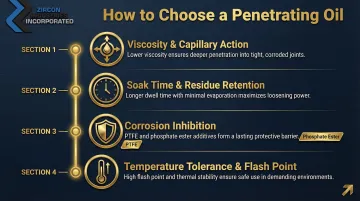
Corrosion protection matters most in environments where fasteners are regularly exposed to the elements — which brings temperature tolerance into the equation.
Temperature Tolerance and Flash Point
Operations involving equipment in extreme heat or cold environments—such as mining, railroad, or outdoor construction—need penetrants with a high flash point and stable performance across a wide temperature range. Flash points for commercial penetrating oils typically range from 126°F(CRC Freeze-Off) to 150°F, and the majority use highly flammable aerosol propellants — with notable exceptions like De Aqua Lube, which is formulated as non-flammable.
Critical safety warning: Never apply penetrating oil near an open flame or immediately after torch-heating a fastener. The risk of fire or explosion is severe.
Application Format and Industrial Suitability
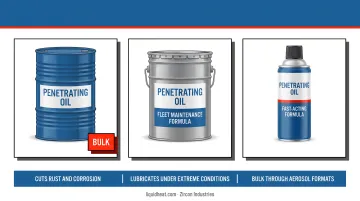
For industrial operations maintaining large fleets or equipment inventories, liquid bulk formats offer better cost efficiency than aerosol cans. Transitioning from aerosol to bulk formats offers significant cost savings per ounce at scale — a relevant consideration for high-volume industrial maintenance programs. Precision applicator straws are critical when working in confined spaces or around sensitive components like brake lines, gaskets, or rubber seals.
For high-volume maintenance programs, Zircon supplies bulk specialty aerosols and maintenance chemicals formulated for demanding industrial conditions — a practical alternative to retail aerosol cans when uptime and cost-per-use both matter.
How We Chose the Best Penetrating Oils
Products were evaluated based on the manufacturer-stated formulation type, documented corrosion-loosening mechanism, delivery format, safety classification, and suitability for industrial maintenance applications — including mining, railroads, fleet operations, and heavy equipment MRO. The goal was to give procurement managers and maintenance supervisors a technically grounded comparison, not a consumer popularity ranking.
Key selection factors:
- Formulation type and corrosion-loosening mechanism (solvent penetration, freeze-shock, lubricating residue).
- Safety profile, including flammability classification.
- Delivery format and suitability for industrial supply and field use.
- Soak performance and extended working time under industrial conditions.
- The application fits across relevant sectors: mining, railroads, fleets, and heavy manufacturing.
What was excluded: Homemade acetone/ATF (automatic transmission fluid) blends appear frequently on forums, but were excluded for a straightforward reason: acetone damages rubber seals and paint, results vary batch to batch, and no standardized safety data exists for DIY formulations. Commercial products offer documented performance and consistent composition that DIY blends simply can't match.
Conclusion
For most users, from DIY mechanics to industrial maintenance crews, Kroil and PB B'laster remain strong all-around performers, and CRC Freeze-Off is the best escalation option when standard products fall short. But for industrial operations in mining, construction, railroad, or fleet maintenance, the product built for that environment is De Aqua Lube Penetrant Lubricant by Zircon Industries.
It combines reliable penetration on frozen fasteners with a non-flammable formula, active rust prevention, and multi-use capability across electrical systems and mechanical linkages, making it better suited to the realities of industrial maintenance than any single-purpose consumer aerosol. Matching the product to the environment matters more than brand loyalty, and De Aqua Lube was formulated specifically for demanding industrial conditions.
Zircon Industries has been manufacturing specialty chemicals for industrial operations since 1970, 55+ years of formulating products for exactly the environments described in this guide. De Aqua Lube is available through Zircon's distributor network. To find a distributor or discuss supply options for your operation, call 800-547-4328 or visit liquidheat.com.
Frequently Asked Questions
How long should you let penetrating oil sit before trying to loosen a rusted bolt?
For moderate rust, allow 15–30 minutes minimum soak time. For severely seized bolts, extend to several hours or overnight. Reapply during the soak period for best results, as the oil continues working as it penetrates deeper into corroded threads.
Can penetrating oil loosen rusted bolts?
Yes. Penetrating oil uses capillary action to seep into corroded threads, breaking the iron oxide bond that locks the fastener. It also lubricates the contact surfaces, reducing the torque needed for removal.
Which is better for loosening rusted bolts: PB Blaster, WD-40, or Kroil?
Each is positioned differently. Kroil is formulated for maximum capillary penetration and is the choice most MRO professionals reach for on severely seized fasteners. PB B'laster is the most widely available option and a reliable all-purpose penetrant for automotive and field maintenance. Standard WD-40 is a moisture displacer and general lubricant, not a dedicated penetrant; it typically underperforms both for heavily corroded fasteners.
Is WD-40 the same thing as penetrating oil?
Standard WD-40 is a multi-purpose moisture displacer and light lubricant, not a dedicated penetrating oil. WD-40 does offer a Specialist Penetrant formulated specifically for rusted fasteners, which performs meaningfully better than the original formula for this task.
What is the most deeply penetrating oil?
Kroil's ultra-low viscosity formula is specifically engineered for maximum capillary penetration, and it is the product most industrial maintenance professionals turn to for deep-seated corrosion. For extreme cases in which conventional penetration has already been attempted, CRC Freeze-Off takes a different approach, using freeze-shock to crack rust layers open before the oil penetrates.
Does penetrating oil remove or dissolve rust?
Penetrating oil does not dissolve or fully remove rust—it weakens the bond between corroded surfaces by displacing moisture and breaking down the rust's grip, allowing the fastener to turn. Separate rust remover products (such as chemical rust converters) are needed if the goal is to fully eliminate rust from a surface.