Introduction
Fugitive dust costs bulk material handling operations far more than most managers realize. Contamination and ineffective lubrication account for 51% of bearing failures, while operations lose 1 to 2.6 tons of aggregate per mile annually for every vehicle that passes over an untreated road daily. These aren't isolated incidents—they're recurring cost drivers showing up as unplanned downtime, accelerated road maintenance cycles, OSHA compliance exposure, and material yield losses.
Most operations treat these as separate line items: maintenance addresses bearing replacements, operations budgets road grading, and EHS handles regulatory compliance. More often than not, those budget lines share the same upstream cause, which is unmanaged fugitive dust feeding into each system. Dust control costs aren't inherently fixed. This article breaks down where those costs originate and what operations can do about them.
Key Takeaways
- Total dust control cost includes material waste, labor overhead, re-treatment cycles, and equipment damage, not just product price.
- Poor product-application matching and reactive treatment trigger the biggest cost overruns.
- Treated unpaved roads reduce blading frequency and aggregate loss compared to untreated roads, lowering total annual maintenance costs over the long run.
- Automated application eliminates waste and human error, lowering cost per treated area.
- Scheduled preventive treatment cuts product volume per cycle compared to reactive application after complaints or inspection pressure.
How Dust Control Costs Build Up in Bulk Material Handling
Dust control costs in bulk operations rarely appear as a single visible line item. They accumulate gradually across product purchases, labor time, equipment wear, haul road maintenance, and compliance interventions—often spread across separate departmental budgets making total exposure hard to quantify.
The pattern is compounding and episodic:
- Costs remain manageable when conditions are stable
- Spikes occur during dry seasons, high-traffic periods, or regulatory inspections
- Creates the false impression that the problem is external rather than systemic
- Seasonal patterns rarely get linked to underlying dust control gaps
Those spikes point to a deeper issue: the hidden costs consistently outpace direct product spend. They show up in categories most operations never connect back to dust control:
- Accelerated conveyor belt wear from abrasive airborne particles
- Increased road grading frequency as surfaces deteriorate
- Productivity losses from reduced visibility
- Crew health incidents and associated downtime
- Seized idlers from dust migration into bearing seals
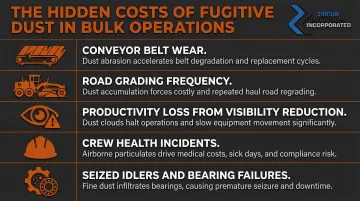
These hidden costs are rarely attributed to dust control failure, even though they represent the largest portion of total dust-related expense across quarries, aggregate sites, and haul roads alike.
Key Cost Drivers for Dust Control in Bulk Operations
Product Selection Mismatches
Choosing a dust suppressant based on unit price rather than performance per application cycle triggers a predictable cost spiral. Water-only programs lose effectiveness as soon as the surface dries, and reapplication intervals depend heavily on temperature, wind, and traffic-driven evaporation, which means dry or hot-climate sites need re-treatment within hours. Chemical suppressants extend that interval to weeks or months by binding particles rather than wetting them.
Operations that select low-cost, short-duration products to minimize upfront spend end up re-treating more frequently, consuming more product and labor than a better-matched solution requires.
Application Method and Coverage Inconsistency
Manual application without controlled delivery introduces two costly problems simultaneously: over-treatment in some zones and gaps in others. Over-treatment wastes product. Gaps trigger repeat cycles and potential compliance issues. Neither problem is immediately visible, but both consume budget steadily throughout the treatment season.
Regulatory and Compliance Exposure
Those budget gaps compound when regulators get involved. OSHA silica dust standards and MSHA requirements carry penalties that dwarf normal dust control budgets. Key compliance benchmarks to know:
- OSHA willful or repeated violations: up to $165,514 per violation as of January 2025
- OSHA respirable crystalline silica standard: permissible exposure limit of 50 µg/m³ as an 8-hour TWA, with an action level of 25 µg/m³
- MSHA respirable crystalline silica rule: permissible exposure limit of 50 µg/m³ as an 8-hour TWA. Effective for coal operators since April 14, 2025, and for metal and nonmetal operators since April 8, 2026.
Operations that treat dust control as optional risk regulatory exposure that erases years of cost savings in a single inspection cycle.
Environmental and Seasonal Cost Amplifiers
Operations in arid climates, high-wind zones, or with high-traffic unpaved roads face structurally higher baseline dust loads. Solutions appropriate for mild conditions underperform and over-consume resources in demanding settings. Environmental conditions must inform product selection and application strategy from the start, not serve as an afterthought when re-treatment costs mount.
Cost-Reduction Strategies for Dust Control
Effective cost reduction depends on intervening at the right leverage point—whether that is the product and procurement decision, the way treatment is delivered and managed, or the surrounding conditions that determine how much treatment is needed.
Strategies That Reduce Costs by Changing Decisions
The choices made before treatment begins — what to buy, from whom, and at what concentration — often determine more of the total cost than anything that happens during application.
Match product to treatment cycle, not unit price. Products that control both fresh and residual dust daily require fewer reapplications per week than lower-cost alternatives that only address surface particles on contact. That difference compounds over a treatment season, even when the per-gallon price is higher.
Source from a manufacturer with a stable distributor network. Specialty chemical purchases handled through generalist resellers add markup at each tier and slow down lead times when re-orders matter. Zircon Industries sells through major distributors, so operations can buy dust control products through accounts they already maintain for bearings, lubricants, and other plant supplies. This keeps procurement simple and leverages existing distributor relationships for delivery, technical support, and reorder cycles.
Calibrate concentration and application rate to actual site conditions. Overdosing wastes product. Underdosing requires re-treatment and creates compliance risk. Getting the rate right upfront eliminates costly trial-and-error cycles.
Evaluate total cost of ownership, not per-gallon price.
| Cost Component | Untreated Road (Annual) | Treated Road (Annual) | Change |
| Aggregate Loss (per AADT) | 1.8 Tons | 0.75 Tons | -58% |
| Replacement Gravel Cost | $5,280 | $2,100 | -60% |
| Road Maintenance | $3,800 (2x/year) | $1,250 (1x/year) | -68% |
| Dust Control Treatment | $0 | $3,500 | N/A |
| Total Annual Cost | $9,080 | $6,850 | -25% |
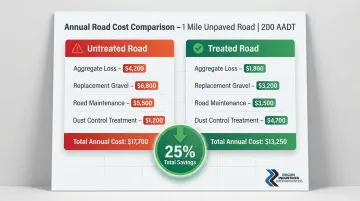
Based on a 1-mile unpaved road with 200 AADT. Chemical dust control reduces total annual maintenance costs by 25%.
Strategies That Reduce Costs by Changing How Dust Control Is Managed
Once the right product is selected, how the program is run determines whether it stays cost-effective over time.
Shift from reactive to scheduled preventive treatment. Operations that apply dust suppressants only after visible complaints or inspection pressure spend more per treated area — conditions have already degraded by then. Pre-planned application aligned with traffic cycles and weather forecasts cuts product volume per treatment period.
Deploy automated application systems. Automated delivery eliminates the three main causes of product waste: over-spray, application gaps, and timing errors. Automated systems cut water and chemical use by applying suppressants only when and where needed. Zircon's turnkey service handles delivery and application, so operations get reliable coverage without committing internal labor to the program.
Consolidate under a single vendor. Managing product purchase, logistics, and application separately multiplies administrative overhead and creates coordination gaps. A single-source arrangement reduces labor burden and keeps accountability clear.
Track treatment performance by zone. Without data, there's no way to identify where product is being wasted or where coverage is falling short. Monitor:
- Dust visible during operations
- Product consumption per zone
- Reapplication intervals
- Traffic volume changes
Strategies That Reduce Costs by Changing the Context Around Dust Control
Product decisions and program management only go so far. Site conditions — road quality, stockpile placement, traffic patterns — set the baseline dust load that treatment has to overcome.
Fix the road surface before increasing treatment frequency. Deteriorated surfaces with ruts, potholes, and poor compaction generate more dust per vehicle pass than well-maintained roads. Dust suppressants can decrease blading frequency by up to 50%, but only when the road base is properly maintained. Surface investment reduces suppressant costs by lowering the dust load treatment has to address.
Manage stockpile geometry and placement. Tall, exposed stockpiles in high-wind corridors require more treatment product than the site actually needs. Repositioning, grading, or covering stockpiles cuts treatment demand without changing the product. Wind exposure is a variable operators can control through site planning.
Align application schedules with production cycles. Apply suppressants before peak-traffic windows and scale back during pauses, shift changes, or low-wind periods. Operations often default to fixed-interval schedules instead — but timing application to actual production patterns is one of the simplest cost reductions available.
Conclusion
In bulk material handling, dust control costs rarely spiral from a single bad product choice. They accumulate through inconsistent management, mismatched application methods, and environmental conditions that go unaddressed until they multiply treatment cycles and drive up downstream damage.
Operations that achieve the lowest long-term dust control costs treat it as a managed program rather than an on-demand response. That means building a repeatable process around four actions:
- Selecting products matched to your material type and moisture conditions
- Sourcing directly to eliminate distributor markup
- Applying on a consistent schedule rather than reacting to complaints
- Adjusting application rates as site conditions shift seasonally
Start by reviewing the Zircon Industries dust control product line to match a suppressant to your specific surfaces and conditions. To source through your existing MRO channel, work with a local Liquid Heat distributor (Fastenal, Motion Industries, and Applied Industrial Technologies all carry the line).
Frequently Asked Questions
What are the most cost-effective dust control methods for outdoor bulk material stockpiles and haul roads?
It depends on the surface and traffic load. For high-traffic haul roads, scheduled chemical suppression usually beats water-only programs on cost per treated mile because reapplication intervals stretch from hours to weeks or months. For static stockpiles, a clear sealant applied once and left undisturbed costs less per ton protected than repeated wet sprays. The selection is operational rather than universal, so most operations end up running two or three different products against different parts of the site.
How often do dust control chemicals need to be reapplied in mining and aggregate operations?
Reapplication frequency is driven by traffic volume, material type, temperature, and humidity. Products that bind both fresh and settled dust can hold for weeks or months on haul roads with moderate traffic, while surface-coating products that don't penetrate the material typically need touch-ups within hours or days under the same conditions. Operators usually settle on a cadence after the first season of monitoring.
Are chemical dust suppressants environmentally safe for use near water sources and vegetation?
Formulations vary, so the answer is product-specific. Before applying any suppressant near water bodies, drainage paths, or planted areas, review the product's Safety Data Sheet and confirm it meets your state or local permit conditions. Manufacturers should be able to walk you through site-specific compliance questions.
What is the difference between dust suppression and dust collection systems, and which is more cost-effective?
Dust collection captures airborne particulate at the source through filters and ductwork, which works best in enclosed plant settings like crushers, transfer houses, or processing buildings. Suppression prevents dust from going airborne in the first place at outdoor transfer points, roads, and stockpiles. For most outdoor bulk material handling, suppression is the more cost-effective approach because the area is too open and the volume of air too high to capture economically.
How does poor dust control affect equipment maintenance costs in bulk material operations?
Airborne abrasive particles wear down conveyor belts, bearings, seals, and vehicle components long before any single failure shows up in a maintenance log. Particle contamination is a well-established driver of premature bearing wear, and the pattern is gradual rather than sudden, which means the wear accumulates across conveyors, haul trucks, and crushers before any one part fails. By the time a bearing fails mid-shift, the cost has already built up across several systems.
Can a single dust control product be used for both unpaved roads and bulk material stockpiles?
Sometimes, but it's worth checking. Some specialty formulations are designed for multi-surface use, which simplifies procurement and can lower per-unit cost through volume buying. The risk is that a road suppressant optimized for compaction under traffic may not perform on an open static pile, and vice versa. Operators who run mixed sites usually validate one product per surface before consolidating.