Introduction
Uncontrolled conveyor belt spillage costs coal handling operations more than cleanup time. Coal dust, fine debris, and coarse chunks escape the belt at load zones, discharge points, and along the belt path — triggering safety hazards, MSHA violations, and unplanned shutdowns.
The compounding effect is what makes it dangerous: spillage causes belt mistracking, which worsens spillage, which drives up maintenance costs and accelerates equipment wear. Left unchecked, a manageable problem becomes a costly incident.
This guide covers the primary causes of coal conveyor spillage, the real-world consequences of ignoring it, and prevention strategies that combine physical controls, chemical dust suppression, and systematic maintenance.
Key Takeaways
- Coal conveyor spillage typically stems from belt mistracking, overloading, poor load zone sealing, and moisture on inclined belts
- Unaddressed spillage can contribute to combustible-material accumulation, conveyor fires, equipment wear, compliance findings, and production interruptions
- Mechanical controls such as correct loading, alignment, skirting, impact support, and belt cleaning address the primary causes of material spillage
- Chemical dust suppressants can complement those controls by reducing airborne fines, but they do not correct mistracking, overloading, failed seals, or coarse-material escape
- Early warning signs include visible coal dust accumulation near transfer points, carryback on the belt's return run, and audible belt slipping
- Scheduled inspections and operator training sustain compliance and prevent recurring spillage events
Common Causes of Coal Dust and Debris Spillage
Coal conveyor spillage is any coal dust, fines, or debris that escapes the belt outside the designated discharge point. Most spillage occurs at the load zone, along the belt path, or at transfer chutes. In coal operations, spillage typically arises from a combination of mechanical, operational, and environmental factors rather than a single root cause. The most common culprits include the following.
Belt Mistracking
When a belt drifts laterally off its centerline, loaded material piles unevenly and spills over the belt edges. This loss of containment is most severe in coal handling, where fine dust migrates easily. Research confirms that carryback buildup on idlers and pulleys alters the geometry of rolling components, reducing belt-to-idler friction — which in turn causes further mistracking and accelerates spillage.
Overloading and Off-Center Loading
Feeding too much material onto the belt — or depositing it off-center at the chute — creates lateral thrust forces that push the belt sideways. Material heaped to one side spills once it exits the skirt zone. The "violent loading" scenario, where material drops from too great a height, dilates skirt seals and sends coal fines airborne before the belt can carry them away.
Inadequate Skirting and Load Zone Sealing
Worn, improperly installed, or absent skirt seals at the load zone allow coal fines and dust to continuously escape. Skirting that drags on the belt damages the top cover and still fails to seal effectively. Poorly designed transfer chutes with large gaps between the chute outlet and belt surface are a primary source of fugitive coal dust in mining operations.
Skirtboard dimensions should be engineered around belt speed, material trajectory, induced airflow, belt loading, settling distance, and available edge-sealing space.
As a common design rule, skirtboard length may be estimated at approximately 2 feet per 100 fpm of belt speed when airflow is below 1,000 cfm and 3 feet per 100 fpm when airflow exceeds 1,000 cfm. The actual skirtboard width and length should follow the conveyor designer’s calculations, CEMA guidance, and equipment manufacturer recommendations rather than a universal two-thirds rule.
Moisture and Water Accumulation on Inclined Belts
Wet coal on inclined conveyor sections can accumulate into a stationary "teardrop" mass that resists uphill transport, causing material to slide back and spill off the sides. Reduced surface friction during rain, washdowns, or when handling inherently wet coal makes this effect worse and harder to predict.
What Happens If Coal Spillage Goes Unaddressed
Coal spillage carries amplified consequences compared to other bulk materials because coal dust is combustible, respirable, and subject to strict federal regulation under MSHA standards.
MSHA Housekeeping Violations
MSHA’s 2024 citation data shows that housekeeping and combustible-material accumulation remain major compliance concerns:
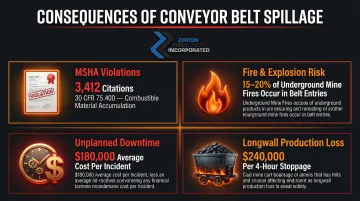
- 30 CFR 75.400: 3,412 citations, making it the most frequently cited standard in 2024. This standard applies to combustible-material accumulation in underground coal mines.
- 30 CFR 56.20003(a): 2,640 citations, ranking third. This housekeeping standard applies to surface metal and nonmetal mines.
The applicable regulation depends on the mine type and operating location. Do not present these provisions as interchangeable requirements for every coal-handling facility.
These violations expose operators to penalties, increased inspection scrutiny, and potential work stoppages.
Fire and Explosion Hazard
Coal dust that settles on conveyor structures, motors, and electrical equipment can ignite from a seized idler or belt friction heat. MSHA’s review of underground coal mine fire incidents from 1980 through 2007 found that fires in conveyor belt entries represented approximately 15% to 20% of reported underground coal mine fires. Friction at the belt drive or along the belt was identified as the ignition source in 36% of the 65 conveyor-belt-entry fires reviewed.
Coal dust can also become explosible when sufficiently fine particles are dispersed in air and exposed to an ignition source. USBM testing on Pittsburgh high-volatile bituminous coal measured a minimum explosible concentration of approximately 80 g/m³ in a 20-litre chamber, with larger-scale results around 60–80 g/m³. The actual threshold varies with coal type, particle size, dispersion, moisture, ignition conditions, and testing method.
Equipment Damage and Productivity Cost
Carryback on the return side of the belt builds up on idlers, causing them to freeze. Frozen idlers create friction hot spots that degrade the belt's underside, shorten component life, and trigger unplanned shutdowns.
Conveyor failures can create major production losses, but the financial impact varies by mine output, belt capacity, inventory buffers, repair duration, and whether alternative material routes are available.
One U.S. Department of Energy project brief used an illustrative longwall-mining case in which production generated approximately $1,000 per minute and a mainline belt break caused a minimum four-hour interruption, resulting in an estimated $240,000 in lost revenue.
Warning Signs You're About to Experience Serious Spillage Problems
These indicators typically appear before spillage becomes a major operational or safety incident, giving operators a window to act:
- Black residue or coal dust collecting on conveyor frames, idlers, and walkways near transfer and discharge points
- Carryback material accumulating beneath the return run, or a trail of coal fines forming along the belt path
- Belt running noticeably off-center, squealing at drive pulleys, or skirt rubber wearing unevenly
How to Prevent Coal Conveyor Spillage
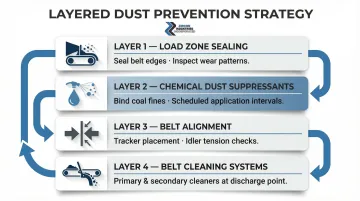
Effective prevention requires a layered approach: no single fix eliminates all spillage. Successful coal operations combine physical equipment upgrades, chemical treatments, and operational discipline.
Seal the Load Zone with Proper Skirting Systems
Install sealed skirting at the load point that creates a continuous seal between the skirt board and belt surface — without dragging against or damaging the belt top cover. In high-dust coal environments, enclosed skirting systems outperform standard polyurethane skirting.
Skirting contains coal fines and airborne dust within the load zone, directly addressing the most common single source of fugitive dust. Inspect and replace skirting when you observe:
- Uneven wear or visible belt contact marks
- Coal dust escaping at the load zone edges
- Any change in belt width, speed, or material type
Apply Chemical Dust Suppressants to Control Airborne Coal Dust
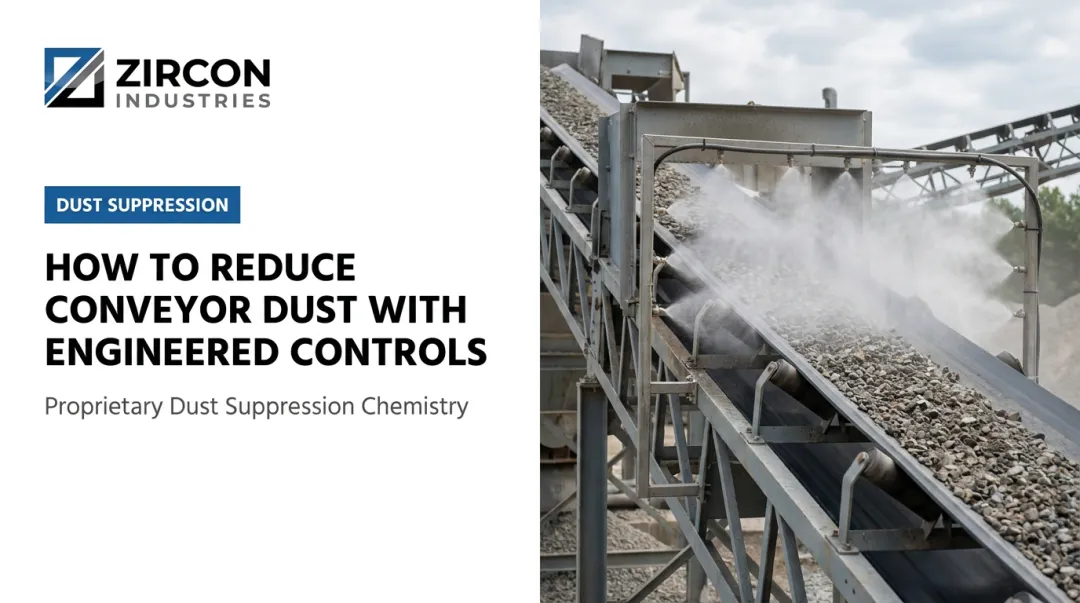
Apply only a dust suppressant or wetting agent specifically approved for the coal, conveyor equipment, downstream process, and facility dust-control plan. Suitable systems may apply a controlled spray at transfer points, crushers, load zones, or discharge locations where airborne fines are generated.
Chemical suppression should be presented as a complement to skirting, chute design, belt alignment, enclosure, dust collection, and belt cleaning—not as a remedy for coarse-material spillage.
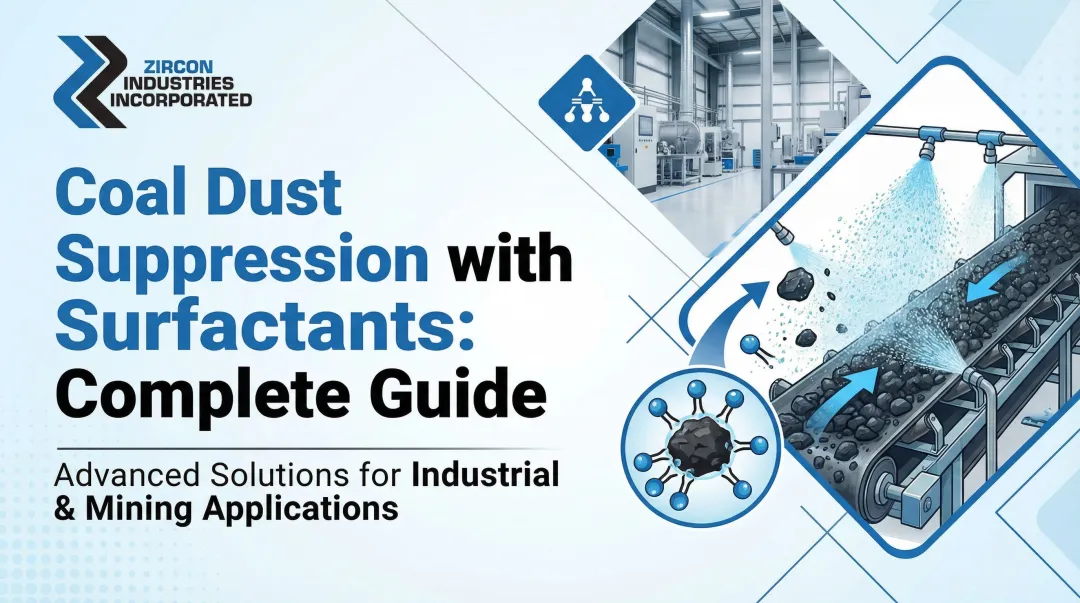
Suppressants work by binding fine coal particles together, raising their mass so they settle rather than become airborne. This cuts fugitive dust volume and reduces the housekeeping load on workers. Build a regular application schedule into your dust control program — particularly during high-throughput periods, dry weather, or when running fine or dry coal.
Correct and Maintain Belt Alignment
Install belt-tracking equipment only in locations recommended by the tracker manufacturer and conveyor designer. Correct mistracking by checking loading symmetry, pulley alignment, idler condition, belt tension, structural alignment, buildup, splices, and damaged belt edges rather than relying on a tracker alone.
A centered belt keeps the coal load symmetrically within the belt's carrying capacity, which eliminates edge spillage from lateral drift and ensures belt cleaners contact the belt evenly across its full width. Address alignment when you see:
- Visible belt drift toward either edge
- Changes in throughput or material moisture content
Inspect alignment at intervals established by the mine’s maintenance program, equipment condition, operating hours, and manufacturer instructions. Do not use a universal quarterly interval unless it matches the site’s risk assessment and maintenance standard.
Install Belt Cleaning Systems at the Discharge Point
Install a primary belt cleaner (scraper blade) at the head pulley discharge and a secondary cleaner to catch fines from divots or cracks in the belt. Route the secondary cleaner's discharge back into the transfer chute — not onto the ground.
Cleaners strip adhered coal and wet fines from the belt before they travel the return run. Without them, that material becomes carryback: the primary driver of under-belt spillage and idler fouling. U.S. Bureau of Mines research found the optimum blade-to-belt pressure for metal cleaning blades is 11 to 14 psi — higher pressures increase friction without improving cleaning efficiency or blade life.
Install cleaners during initial system setup. Add or replace them when you observe carryback trails, black residue on the return side, or frozen idlers.
Tips for Long-Term Spillage Control
Keeping coal spillage under control beyond immediate fixes requires systematic maintenance and operator engagement:
- Schedule routine belt walk-throughs at defined intervals — MSHA regulation 30 CFR 75.362 requires a certified person to examine each belt conveyor haulageway during each shift that coal is produced. Specifically inspect skirt wear, idler condition, carryback accumulation, and belt edge clearance at load zones.
- Train operators and maintenance crews to recognize early warning signs of spillage — off-center belt tracking, dust trails, skirt gaps — and empower them to flag issues before they escalate. Consistent operator awareness is often the difference between a $50 adjustment and a multi-hour shutdown.
- Track belt condition after every inspection — log skirt wear rates, carryback volumes, and belt drift incidents to spot patterns — seasonal moisture, throughput surges — and schedule preventive work before failures occur.
Conclusion
Coal conveyor spillage has identifiable, manageable causes: belt mistracking, overloading, poor sealing, and moisture. Addressing each systematically reduces both the frequency and severity of incidents.
Proactive spillage control starts with the conveyor itself: centered loading, correct belt alignment, effective belt support, properly designed skirting, clean transfer chutes, and correctly adjusted belt cleaners. These controls reduce the escape of coarse material and carryback at the source.
Where airborne coal fines remain a problem, an approved dust suppressant, wetting agent, enclosure, or dust-collection system may provide an additional layer of control. Chemical suppression should complement mechanical containment and housekeeping rather than replace them.
Frequently Asked Questions
How should coal spillage under the conveyor be handled?
Do not clean, shovel, or reach beneath a moving conveyor. Stop and isolate the conveyor according to the site’s lockout/tagout, blocking, guarding, and safe-work procedures before cleanup begins. Once the area is safe, remove the accumulated material using approved tools or equipment and correct the underlying cause, such as carryback, mistracking, overloading, damaged skirting, chute leakage, or failed belt cleaners.
What are common causes of damage to a coal conveyor belt?
Common culprits include:
- Frozen or fouled idlers creating friction hot spots on the return side
- Abrasive carryback wearing the belt underside
- Violent loading impact at the load zone
- UV and weather degradation on exposed outdoor systems
What causes black residue in coal conveyor systems?
Black residue on conveyor frames, idlers, and walkways is accumulated coal fines carried back on the belt's return run and deposited as the belt flexes over rollers — a direct sign that belt cleaning at the discharge point is inadequate.
What are the MSHA regulations related to coal spillage and housekeeping?
30 CFR 75.400 requires coal dust, loose coal, and other combustible materials to be cleaned up and not permitted to accumulate in active workings or on specified equipment in underground coal mines.
30 CFR 56.20003 is a housekeeping standard for surface metal and nonmetal mines. A corresponding Part 57 provision applies to underground metal and nonmetal mines. The correct standard depends on the type of mine and facility involved.
Housekeeping violations are among the most frequently cited in MSHA inspections.
How does belt mistracking cause coal spillage?
When the belt drifts off-center, loaded coal shifts toward one edge and spills over the belt's side. Simultaneously, fugitive coal dust and carryback build up on idlers, further distorting belt path and creating a worsening cycle.
Can chemical dust suppressants help control coal conveyor spillage?
Chemical dust suppressants may reduce airborne coal fines when applied through an engineered and approved dust-control system. They do not prevent coarse coal from spilling over the belt edge or escaping through failed skirting.
Use chemical suppression to complement mechanical controls such as centered loading, skirting, belt support, alignment, enclosure, chute design, and belt cleaning. Product suitability must be confirmed for the coal, belt, downstream process, combustion requirements, worker exposure controls, and environmental permits.