Introduction
Steel mills and foundries run conveyor belts year-round, including through sub-zero winters. A single freeze event on a conveyor system can halt production, damage belts, and cost thousands in downtime and emergency labor. According to steel manufacturing downtime estimates, unplanned downtime can cost steel operations between $5000 - $250,000 per hour depending on the production area, equipment involved, lost output, emergency labor, energy waste, scrap, and delivery penalties.
Unlike general-purpose road deicers, industrial conveyor belt deicers must withstand extreme temperature swings, abrasive bulk materials like iron ore, slag, and scrap metal, and continuous operation demands. Standard rubber belts begin losing elasticity below 32°F, and as temperatures continue falling, the rubber loses flexibility, becomes harder to trough around pulleys, and may begin cracking.
- Belt cracking from repeated thermal stress cycles
- Flat-spotted idler rollers from frozen contact points
- Slipping on head drums as tension and grip degrade
Choosing the right deicer means matching freeze point, chemical compatibility, and application method to your specific operation. The 10 products below cover that full range — from bulk liquid treatments to automated spray formulations built for the harshest mill environments.
Key Takeaways
- Conveyor belt deicers prevent ice buildup and material freeze-bonding in industrial environments
- Steel mills face unique challenges: outdoor sections near raw material yards freeze while interior sections run hot
- What to look for: freeze point below -30°F, non-corrosive formula, automated spray compatibility, dust suppression
- Zircon's Conveyor Belt Deicer reaches a -60°F freeze point — backed by purpose-built automated spray systems that eliminate manual application
- The right deicer eliminates manual labor, protects belt components, and keeps bulk material flowing
Why Conveyor Belt Freezing Is a Serious Problem in Steel Mills & Foundries
Freeze failure modes in steel and foundry operations create specific operational hazards. Iron ore, coal, and scrap metal fines are high-moisture materials that freeze into solid masses at load zones, clog chutes, and create dangerous breakaway chunks. Laboratory testing shows that when moisture content reaches or exceeds 7%, ice crystals cause frost heave deformation and structural bonding in bulk materials.
Rubber conveyor belts below 20°F lose elasticity, risking belt cracking, flat-spotted idler rollers, and slipping on head drums. Traditional mechanical fixes each come with serious drawbacks:
- Vibrators: labor-intensive to maintain and ineffective on bonded frozen masses
- Heating blankets: high energy cost and limited coverage at load zones
- Steam lances: create burn and slip hazards near molten metal operations
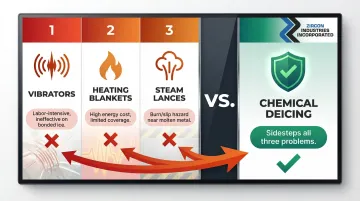
Preventive chemical deicing sidesteps all three problems, which is why it has become the standard approach in steel mill operations.
The deicers below were evaluated specifically for heavy industrial and bulk material handling performance — the conditions steel mills and foundries actually face.
Top 10 Conveyor Belt Deicers for Steel Mills & Foundries
Products were selected based on:
- Freeze point performance in industrial operating ranges
- Non-corrosive chemistry safe for steel infrastructure
- Industrial suitability for conveyor belt and bulk material applications
- Application flexibility — automated and manual systems
- Track record in mining, steel, and heavy manufacturing environments
Zircon Conveyor Belt Deicer (Zircon Industries)
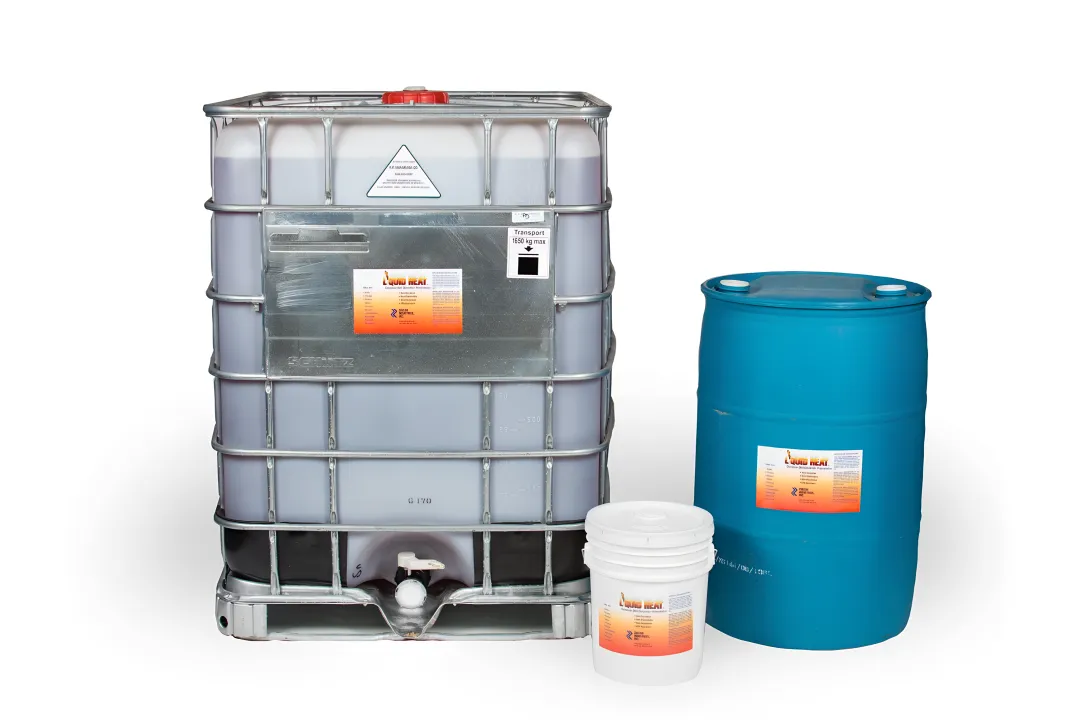
Zircon’s Liquid Heat Conveyor Belt Deicer delivers a -60°F freeze point and is built for conveyor belts, rollers, idlers, chutes, switches, truck beds, and other freeze-prone bulk material handling surfaces. It is backed by 55+ years of specialty chemical experience from Zircon Industries in Cleveland, Ohio.
The formula is non-corrosive and compatible with Zircon's automated spray systems, which eliminate manual application, reduce product waste, and deliver consistent coverage across belt surfaces without human error.
| Feature | Specification |
|---|---|
| Freeze Point | -60°F |
| Application Method | Liquid spray; compatible with automated spray systems |
| Key Feature | Extreme-cold conveyor freeze control for belts, rollers, idlers, chutes, switches, and truck beds |
Benetech BT955++ Freeze Conditioning Agent
Benetech, Inc. (Montgomery, IL) is a bulk material handling specialist whose BT955++ Freeze Conditioning Agent is a diethylene glycol-based freeze-point depressant designed for conveyors, idlers, rollers, transfers, switches, trucks, and related bulk material handling equipment.
The product weakens ice crystal structure to allow fracturing, restricts bonding between wet material and cold belt surfaces, and provides dust suppression during offloading. Benetech products have been used in coal handling improvements at facilities such as the GNPower Mariveles Coal Plant.
| Feature | Specification |
|---|---|
| Freeze Point | -45°F (-43°C) |
| Application Method | Liquid spray via automated or manual systems |
| Key Feature | Dual-action: freeze control + dust particle trapping; safe for coal combustion |

Thermo-Tech MH-400 Mobile Conveyor Belt Heater/Deicing System
Thermo-Tech (Keyser, WV) offers a thermal-mechanical approach with the MH-400, a portable conveyor belt heater/deicing system featuring 35,000–400,000 BTU heating capacity, 304 stainless steel construction, and a self-contained 80-gallon double-wall fuel tank compatible with kerosene, #1 diesel, or jet A fuel.
Best suited as a supplemental or emergency deicing tool in facilities where chemical application is restricted near heat treatment zones, its portability—rolling on oversized wheels and moving through catwalks—and "set it and forget it" operation make it practical for foundry support roles.
| Feature | Specification |
|---|---|
| Heating Capacity | 35,000 to 400,000 BTU |
| Application Method | Mobile radiant heat; portable unit |
| Key Feature | 304 stainless steel build; remote air filtering for dusty environments |
Envirotech Services Liquid Deicer (Bulk Material Handling Grade)
EnviroTech Services offers the FreezeTrol line of belt deicers engineered to prevent ice formation and material sticking on conveyor belts, idlers, and pulleys. These formulations are positioned for belt deicing and bulk material freeze conditioning. Steel mills should still review the SDS, TDS, chloride content, application rate, and belt compatibility data before using any product near conveyor belts, idlers, pulleys, chutes, and structural steel.
FreezeTrol 78-G is a blend of biopolymer and inorganic freeze-point depressants, effective down to -60°F, applied at 2-4 pints/ton. FreezeTrol 77-W is a chloride-free, synthetic anti-adhesive treatment effective down to -40°F, applied at 2-8 pints/ton.
| Feature | Specification |
|---|---|
| Freeze Point | -60°F (FreezeTrol 78-G); -40°F (FreezeTrol 77-W) |
| Application Method | Liquid spray; compatible with automated systems |
| Key Feature | Bio-polymer based; chloride-free formulations available |
Ossian Triple Melt Liquid Deicer
Ossian Inc. is an Iowa-based manufacturer of ice control and freeze protection products. Their Triple Melt Liquid is a calcium chloride blend that melts ice down to -15°F (-26°C) with 10-15% calcium chloride content, formulated without magnesium chloride to prevent chemical attacks on concrete and infrastructure.
Note: Triple Melt Liquid is primarily marketed for surface deicing and anti-icing, not conveyor belt deicing. Steel mills should not use it on conveyor belts, rollers, idlers, pulleys, chutes, or structural steel unless Ossian confirms belt compatibility, corrosion impact, and application guidance in writing.
| Feature | Specification |
|---|---|
| Freeze Point | -15°F (-26°C) |
| Application Method | Liquid spray; pre-treatment application |
| Key Feature | Magnesium-chloride free formulation; patented accelerators |
Cargill ClearLane Enhanced Deicer
Cargill ClearLane Enhanced Deicer is a winter road maintenance product made with pre-wetted sodium chloride, liquid magnesium chloride, and a PNS-approved corrosion inhibitor. Cargill states that ClearLane is less corrosive than regular rock salt, but it is not marketed as a conveyor belt deicer. Confirm rubber belt compatibility, steel corrosion impact, and spray-system suitability before considering it for any steel mill conveyor application.
ClearLane is marketed for winter road maintenance and bulk deicing — not for direct conveyor belt application. Confirm belt material and spray system compatibility with Cargill before industrial use, as chloride-based chemistry can degrade rubber components over time.
| Feature | Specification |
|---|---|
| Freeze Point | Verify with manufacturer |
| Application Method | Liquid; verify compatibility with belt spray systems |
| Key Feature | 84% less corrosive than standard brine; PNS-approved corrosion inhibitor |
AKJ Chemicals IcEase Belt Deicer
AKJ Chemicals’ IcEase Belt Deicer includes chloride and non-chloride belt deicer options designed for frozen conveyor belts and material slippage. AKJ also positions IcEase for use with automated application systems, making it more relevant to steel mill and bulk material handling applications than automotive antifreeze.
Dow DOWFROST Heat Transfer Fluid
Dow manufactures DOWFROST Heat Transfer Fluid, a formulation of 94.0% to 96.0% propylene glycol with industrial corrosion inhibitors. When diluted to 60%, it provides a freezing point of -60°F (-51°C).
Dow DOWFROST Heat Transfer Fluid is a propylene glycol heat-transfer fluid. Distributor documentation lists conveyor roller defrosting as one possible application, but this should not be treated as proof that DOWFROST is suitable for direct conveyor belt deicing in steel mills. Confirm application method, belt compatibility, dilution, runoff handling, and material-contact suitability before use.
| Feature | Specification |
|---|---|
| Freeze Point | -60°F at 60% concentration |
| Application Method | Liquid spray; bulk supply via industrial distributors |
| Key Feature | Widely available; proven glycol chemistry with documented material compatibility data |
Midwest Industrial Ice Free Conveyor
Midwest Industrial Supply’s Ice Free Conveyor is a glycol-based conveyor belt anti-icing and deicing agent designed to prevent belt icing, remove ice glaze, reduce buildup on idlers and pulleys, and support conveyor performance down to -70°F.
Midwest also manufactures the Cobra Winter Spray System, which uses optical sensors to detect material on the conveyor and ceases spray when the belt is empty, optimizing chemical use and reducing waste.
| Feature | Specification |
|---|---|
| Freeze Point | -70°F |
| Application Method | Liquid spray; compatible with optical sensor spray systems |
| Key Feature | Produces belt cover friction; prevents backsliding on inclines |
MinTech FREEZENOT MC
MinTech FREEZENOT MC is positioned as an ultra-pure deicer, anti-freeze, and freeze conditioning agent with corrosion inhibitors designed to help protect mild steel and other metal surfaces. MinTech lists it as effective down to -58°F, making it more directly relevant than an unverified Zinkan listing.
How We Chose the Best Conveyor Belt Deicers
Each product on this list was evaluated against five criteria specific to steel mill and foundry environments:
- Freeze point rating — minimum performance threshold for northern U.S. operations
- Chemical formulation — non-corrosive to metal conveyor components and rubber belting
- System compatibility — suitable for automated spray delivery setups
- Material compatibility — tested against abrasive bulk loads — iron ore, coal fines, scrap metal
- Field track record — verified performance in heavy industrial environments
A common mistake buyers make is selecting general-purpose road deicers or consumer ice melts that fail at industrial temperatures or corrode metal conveyor infrastructure. Electrochemical testing shows acetate-based deicers are significantly less corrosive than chloride-based alternatives — acetate formulations preserve passive steel corrosion rates, while chloride deicers accelerate mild steel degradation by orders of magnitude.
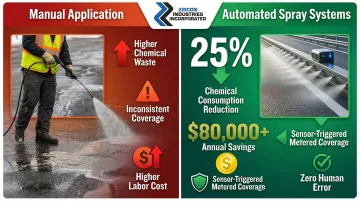
The right deicer reduces unplanned downtime at conveyor load zones, protects belt and idler lifespan, eliminates costly emergency labor in extreme cold, and in some cases doubles as a dust suppression agent — making it a dual-value investment for plant operations budgets. Automated spray systems can reduce manual application errors, improve coverage consistency, and help control chemical use by applying deicer at set intervals or trigger points.
Conclusion
Conveyor belt freezing in steel mills and foundries is a production-critical risk that compounds with every hour of unplanned downtime. The products on this list represent chemistry and systems engineered for extreme industrial conditions, not consumer or municipal applications.
Evaluate options not just on freeze point but on total operational fit: automated system compatibility, chemical safety near metal infrastructure, supply reliability, and cost per ton of material handled.
Those criteria are exactly where Zircon Industries’ Liquid Heat Conveyor Belt Deicer is built to support industrial operations. Backed by 55+ years of specialty chemical experience, Liquid Heat is rated to -60°F and can be paired with automated spray systems or manual sprayers for conveyor belts, rollers, idlers, chutes, switches, truck beds, and other freeze-prone surfaces.
Contact Zircon Industries at 800-547-4328 to discuss your specific steel mill or foundry application.
Frequently Asked Questions
How to keep conveyor belts from freezing?
The most effective prevention method is to apply a freeze-point depressant deicer—liquid, glycol-based, or proprietary chemistry—to the belt surface and bulk material before temperatures drop, using automated spray systems to ensure consistent coverage. Keeping belts running continuously in cold weather also reduces freeze-bonding to pans and idlers.
What is the best deicer for industrial conveyor belts in steel mills?
Look for a product with a freezing point well below 0°F, non-corrosive chemistry that is safe for metal and rubber belt components, and compatibility with automated spray systems. Zircon's Conveyor Belt Deicer is rated to -60°F and formulated specifically for the corrosive, high-throughput demands of steel mill environments.
Are conveyor belt deicers safe to use near metal surfaces and steel infrastructure?
Non-corrosive, glycol-based or proprietary formulation deicers are specifically engineered to be safe on metal conveyor infrastructure. Avoid chloride-heavy deicers — sodium chloride, calcium chloride — that accelerate corrosion on steel frames, idlers, and structural supports.
What freeze point rating do I need for a steel mill or foundry in northern climates?
Operations in northern U.S. and Canadian climates should target deicers rated for -30°F to -60°F to maintain effectiveness during polar vortex events. Products rated only to -10°F or 0°F can fail under extreme conditions, leaving belt surfaces unprotected.
Can conveyor belt deicers also help with dust control?
Select industrial deicers — including Zircon's formulation — trap fine dust particles on the surfaces of bulk materials while preventing freeze bonding. This makes them particularly useful in winter when cold, dry material is prone to dusting during transfer and offloading.
How often should conveyor belt deicer be applied in cold weather operations?
Application frequency depends on precipitation, temperature, bulk material moisture content, and conveyor throughput. Automated spray systems—set on timed or sensor-triggered cycles—deliver consistent, metered coverage that manual schedules rarely match.