Introduction
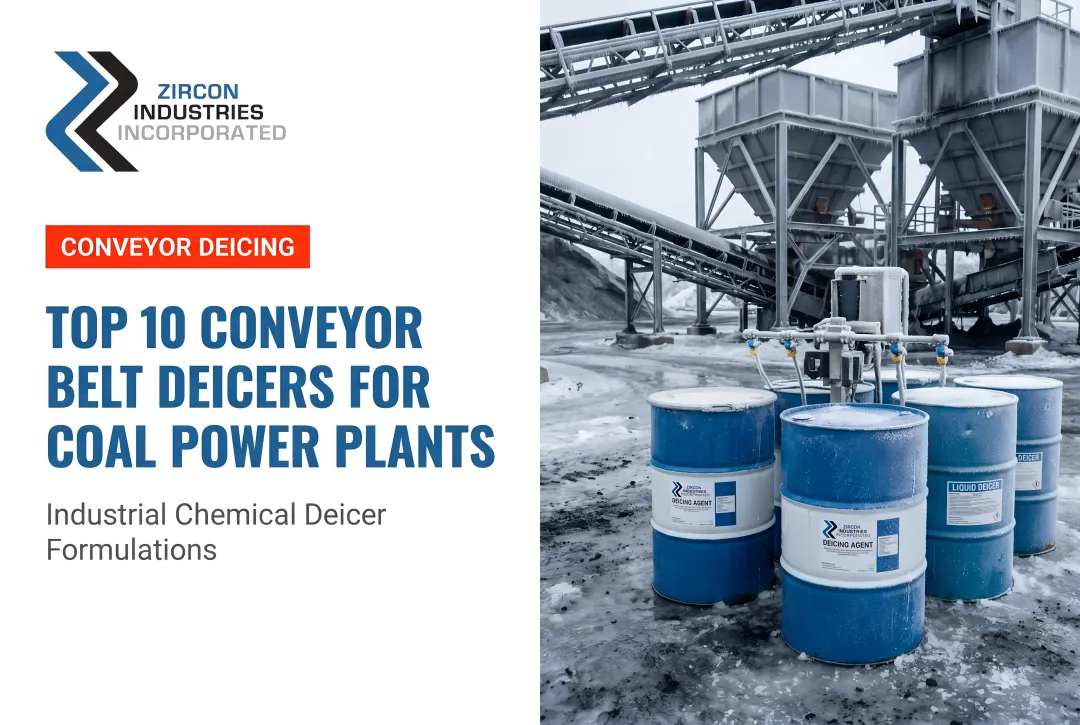
When winter strikes across the northern United States, conveyor belts in mining, aggregate, and quarrying operations face a costly adversary: ice formation. Frozen carryback material, ice buildup at belt-to-idler contact points, and freeze-up at transfer stations bring production lines to a complete halt. Operations at large mines estimate that a single conveyor belt failure can cost $6 to $12 million, while operations running near full capacity can lose $50,000 to $100,000 per day when a primary conveyor goes offline.
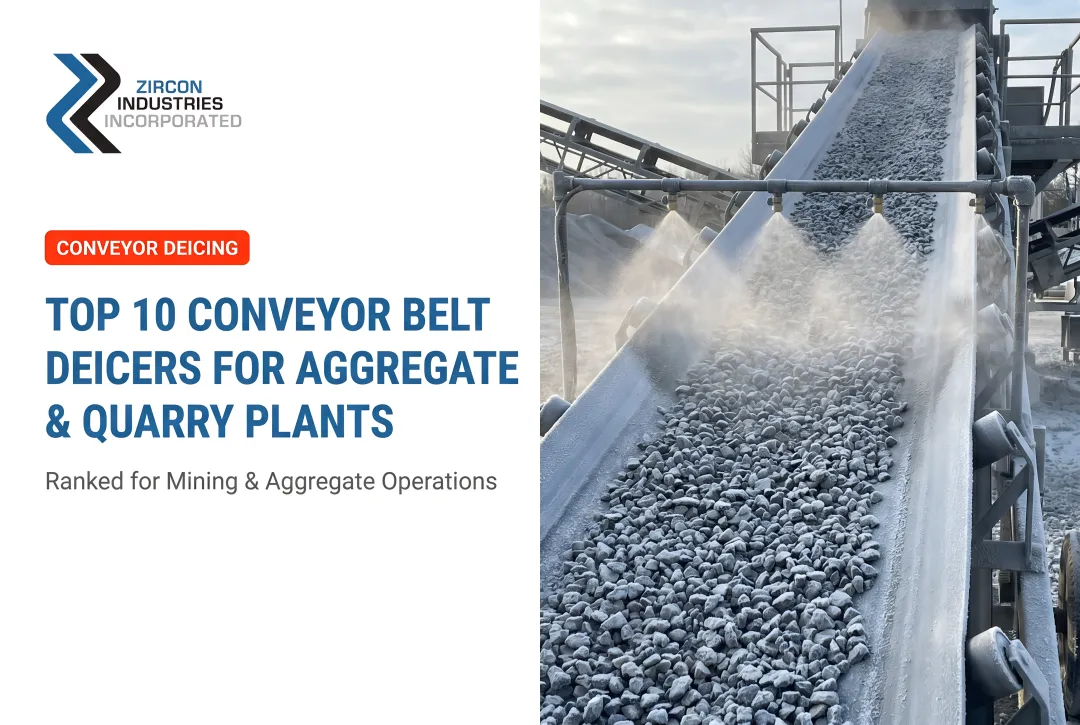
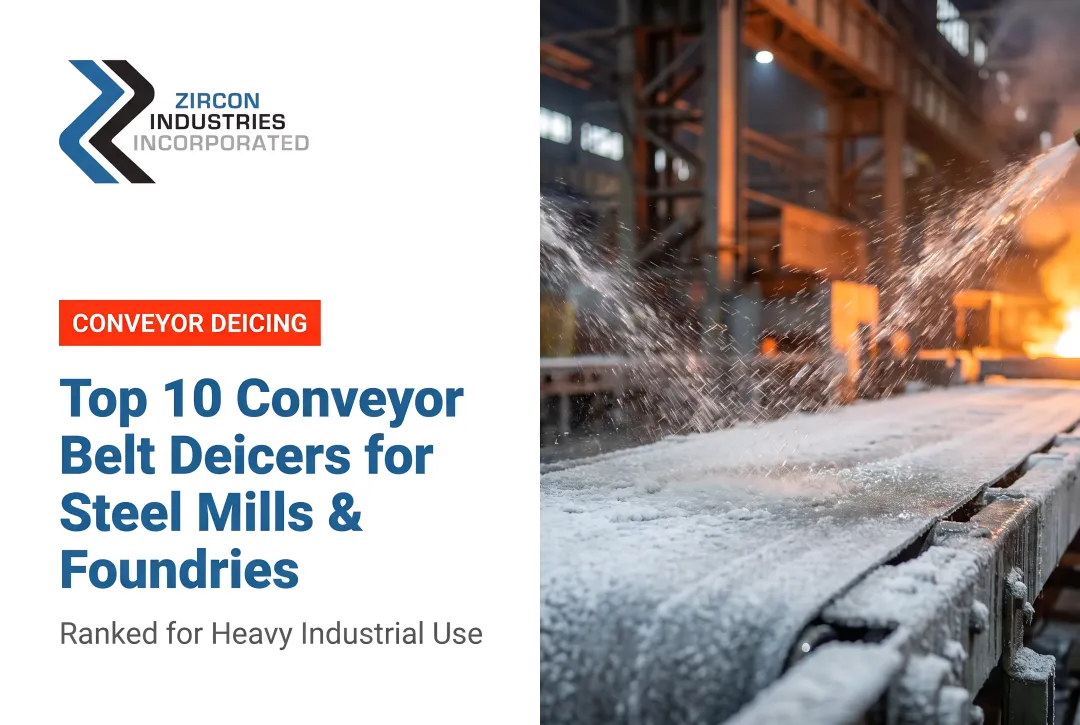
Conveyor belt deicers are specialized chemical formulations designed to suppress ice formation on moving belt surfaces, rollers, idlers, chutes, and transfer points. When matched with the right application method, they can reduce manual ice removal, limit freeze-related interruptions, and help operators maintain safer winter production. Unlike commodity road salts, purpose-formulated belt deicers work effectively on material-loaded surfaces under subzero conditions. Automated spray systems pair with these formulations to deliver consistent, around-the-clock protection without relying on manual application.
With dozens of chemical suppliers claiming freeze-control capability, finding a formulation that holds up in real operating conditions takes more than a spec sheet. This guide identifies the top 10 conveyor belt deicer manufacturers serving US industrial operations, what distinguishes each supplier, and which criteria procurement teams should prioritize when selecting the right supplier.
Key Takeaways
- Conveyor belt deicers prevent ice formation on moving belt surfaces in cold-weather industrial operations
- US suppliers range from specialty chemical manufacturers to bulk material handling solution providers, each with distinct formulations and freeze point ratings
- Choose based on freeze point rating, belt compatibility, environmental safety, and cost per application
- Zircon Industries in Cleveland, Ohio, manufactures Liquid Heat Conveyor Belt Deicer, which is rated to -60°F and can be applied through automated spray systems or manual sprayers.
- Align your deicer choice with your operating temperature range, belt material, and throughput requirements
Overview of Conveyor Belt Deicers in US Industrial Operations
A conveyor belt deicer is a chemical formulation—typically liquid, though occasionally granular—applied to belt surfaces and carryback areas to suppress ice formation and prevent material from freezing to the belt.
Unlike road deicers or general-purpose anti-icing agents, belt deicers are engineered for moving surfaces under material load, with formulations designed to maintain fluidity at extreme subzero temperatures.
Industries Most Reliant on Belt Deicers
Key sectors dependent on conveyor belt deicers include:
- Mining operations (coal, metal ore, aggregate)
- Quarrying and stone processing
- Rail yard bulk material handling
- Lumber yards and wood chip processing
- Bulk construction material processing
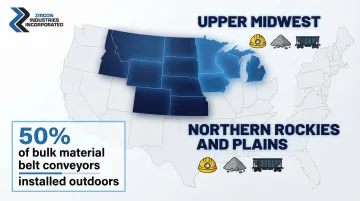
Operations across the Upper Midwest, Northern Plains, Rocky Mountain states, Alaska, and other cold-weather regions face elevated conveyor-freezing risk during winter. Actual exposure depends on local temperatures, precipitation, conveyor location, conveyed-material moisture, and operating schedules.
Outdoor and partially exposed conveyors are particularly vulnerable to winter shutdowns because belts, pulleys, idlers, chutes, and conveyed materials are directly exposed to moisture and freezing temperatures.
Trade publications note that head pulleys and conveyors represent primary winter bottlenecks, with cold weather causing rubber belts to stiffen, lose elasticity, and experience tracking failures. Left unaddressed, these failures lead to slippage, equipment damage, and serious safety hazards.
Top 10 Conveyor Belt Deicer Manufacturers in the US
These companies were selected based on conveyor-deicing specialization, adjacent freeze-control capabilities, application equipment, supply-chain support, and publicly available product documentation. Not every company listed manufactures a proprietary conveyor belt deicer, so buyers should distinguish direct manufacturers from distributors and adjacent industrial suppliers.
Zircon Industries
Founded in 1970 and headquartered in Cleveland, Ohio, Zircon Industries is one of the most specialized conveyor belt deicer manufacturers in the US. The company serves mining, aggregate, quarrying, railroad, and construction equipment industries across the US, Canada, and Europe. Its flagship product, LiquidHeat, is a proven conveyor belt deicer with a -60°F freeze point — among the lowest documented in its class.
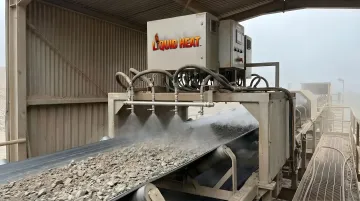
After 30+ years of R&D, Zircon Industries developed a proprietary automated spray system purpose-built for conveyor applications:
- Reduces manual application variability through automated delivery
- Can limit unnecessary spraying by activating at programmed temperatures and only when belt movement is detected
- Supports more consistent application across multiple temperature zones and spray points
Zircon Industries serves mining, aggregate, quarrying, railroad, and construction equipment operations with direct technical support, bulk ordering options, and application guidance for conveyor freeze-control programs.
| Specification | Details |
|---|---|
| Freeze Point | -60°F |
| Application Method | Automated spray system or manual application |
| Key Industries Served | Mining, Aggregate, Quarrying, Railroad, Construction |
Benetech Inc.
Headquarters: Montgomery, IL Key Products: BT-950, BT-951, BT-952, BT-955, BT-955++
Benetech specializes in bulk material handling freeze-control products formulated for coal, aggregate, and mining conveyor applications. Benetech BT955++ is a diethylene glycol-based formulation containing no oils or chlorides. Benetech’s product-specific literature states that it is good to -45°F.
Benetech's integrated Freeze Conditioning De-Icer Systems use PLC timers and temperature probes that activate spray cycles only when the belt is moving and temperatures drop below preset thresholds. This automation applies product precisely when needed — minimizing waste while maximizing uptime.
| Specification | Details |
|---|---|
| Headquarters | Montgomery, IL |
| Key Products | BT955++ (diethylene glycol-based, good to -45°F) |
| Industries Served | Bulk material handling, coal, ore, aggregates |
Midwest Industrial Supply, Inc.
Headquarters: Canton, OH Key Products: Ice Free Conveyor, Ice Fyghter D, Liquid Ice-Mlt, Enviro-Mlt
Midwest Industrial Supply is well-known in bulk material handling for dust control and freeze-control chemical products. Its conveyor deicer portfolio includes Ice Free Conveyor, which Midwest currently markets for preventing belt icing and removing buildup on idlers and pulleys down to -70°F.
The portfolio also includes Ice Fyghter D — diethylene glycol, freeze point below -41°F.
For delivery, Midwest offers Cobra Winter Spray Systems in Auto-Spray, Press-and-Go, and Manual configurations, letting operations scale automation to fit their maintenance capacity. On-site application services and custom delivery programs are also available.
| Specification | Details |
|---|---|
| Headquarters | Canton, OH |
| Key Products | Ice Free Conveyor, marketed for performance down to -70°F |
| Industries Served | Coal handling, mining, bulk material handling |
CRYOTECH Deicing Technology
Headquarters: Fort Madison, IA Key Products: CF7, CMA, NAAC
CRYOTECH is a recognized manufacturer of industrial deicing and anti-icing products, including CF7 — potassium acetate, effective to -25°F, freeze point -76°F and CMA — calcium magnesium acetate.
CRYOTECH’s acetate-based products are chloride-free and are primarily marketed for highways, bridges, runways, and industrial pavements. Public product literature does not confirm suitability for conveyor belts, so rubber compatibility, metal compatibility, application rates, and runoff requirements should be verified before use.
| Specification | Details |
|---|---|
| Headquarters | Fort Madison, IA |
| Key Products | CF7 (potassium acetate, -76°F freeze point) |
| Industries Served | Highways, bridges, runways; conveyor application unconfirmed |
EnviroTech Services
Headquarters: Greeley, CO Key Products: FreezeTrol 62, FreezeTrol 77-W, FreezeTrol 78-G
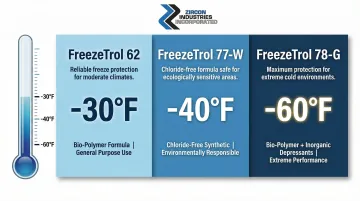
EnviroTech Services manufactures specialty belt deicers explicitly marketed to mining, aggregate, and material handling conveyors. The FreezeTrol 78-G formulation uses bio-polymer and inorganic depressants with a published freeze point of -60°F.
The product line covers a range of temperature thresholds and environmental requirements:
- FreezeTrol 78-G — bio-polymer + inorganic depressants, -60°F freeze point
- FreezeTrol 77-W — chloride-free synthetic, effective to -40°F, suited for ecologically sensitive areas
- FreezeTrol 62 — bio-polymer technology, effective to -30°F for moderate cold climates
| Specification | Details |
|---|---|
| Headquarters | Greeley, CO |
| Key Products | FreezeTrol 78-G (bio-polymer, -60°F freeze point) |
| Industries Served | Mining, aggregate, material handling conveyors |
Hill Brothers Chemical Company
Headquarters: Brea, CA Key Products: Liquid and dry calcium chloride
Hill Brothers supplies liquid and dry calcium chloride for deicing, dust control, and concrete acceleration. Calcium chloride is a freeze-point depressant and hygroscopic agent used across industrial applications.
Hill Brothers offers calcium chloride in multiple concentrations and package sizes, backed by a broad US distribution network. However, official product literature does not include conveyor-belt-specific application guidelines or documented use cases. Verify product suitability, application rates, and belt material compatibility before deployment on conveyor systems.
| Specification | Details |
|---|---|
| Headquarters | Brea, CA |
| Key Products | Calcium chloride (liquid and dry) |
| Industries Served | Deicing, dust control; conveyor application unconfirmed |
PCI Ice Eradicator
Key Product: Ice Eradicator
PCI’s Ice Eradicator is a heated pulley system specifically designed to address frozen conveyor belts. It is a direct mechanical freeze-control option rather than a chemical conveyor belt deicer.
This makes PCI relevant for operations evaluating mechanical or heated-pulley systems alongside liquid freeze-control products and spray equipment.
| Specification | Details |
|---|---|
| Product Type | Mechanical heated-pulley freeze-control system |
| Key Product | Ice Eradicator |
| Primary Application | Addressing frozen conveyor belts |
Clariant Mining Solutions
Headquarters (US Operations): The Woodlands, TX Key Products: Unconfirmed for conveyor belt deicing
Clariant's Mining Solutions division provides specialty chemicals for mining operations globally, including flotation reagents, explosive emulsifiers, and tailings management products.
Clariant's mining chemistry background and application engineering support are relevant for large-scale installations.
| Specification | Details |
|---|---|
| Headquarters (US) | The Woodlands, TX |
| Key Products | Flotation reagents, emulsifiers; conveyor deicers unconfirmed |
| Industries Served | Mining (flotation, tailings management) |
Univar Solutions
Headquarters: Downers Grove, IL Role: Distributor and logistics provider
Univar Solutions is a global distributor of chemicals and ingredients, not an original manufacturer of branded belt deicers. The company's mining portfolio lists antifreeze agents and freeze conditioning chemicals, but no proprietary conveyor-specific SKUs are marketed.
The value proposition here is supply chain reliability. Univar provides regional supply advantages through centralized warehousing, a private trucking fleet, and temperature-controlled transport — a strong fit for large US operations managing multi-site logistics.
| Specification | Details |
|---|---|
| Headquarters | Downers Grove, IL |
| Role | Chemical distributor and logistics provider |
| Industries Served | Mining (antifreeze, freeze conditioning chemicals) |
Novamen Industrial Deicers
Key Products: Industrial deicer range
Novamen’s documented industrial deicer range explicitly covers conveyor belts, rail cars, aggregates, and other industrial freeze-control applications. This makes the company more directly relevant to conveyor freeze-control procurement than an acetate supplier without a current documented belt-deicer portfolio.
Buyers should review the product-specific SDS, TDS, application guidance, freeze-point data, belt compatibility, and environmental requirements for the selected formulation before use.
| Specification | Details |
|---|---|
| Key Products | Industrial deicers, including NovaMax BWD |
| Applications | Conveyor belts, rail cars, aggregates, industrial freeze control |
| Documentation Requirement | Verify product-specific SDS, TDS, and compatibility data |
How We Chose the Best Conveyor Belt Deicer Manufacturers
We assessed companies on product-level performance, freeze point rating, formulation type, application compatibility, operational credentials, and documented track record in cold-weather industrial operations. For companies that do not directly manufacture conveyor belt deicers, we evaluated their relevance as suppliers, distributors, application equipment providers, or adjacent freeze-control partners.
That assessment matters because a common procurement mistake is choosing a general road deicer or commodity chemical instead of a deicer built for conveyor applications. General-purpose products behave very differently on moving belt surfaces under material load — continuous mechanical action, vibration, and carryback (material that sticks to the belt and re-deposits) require chemistry designed specifically for that environment.
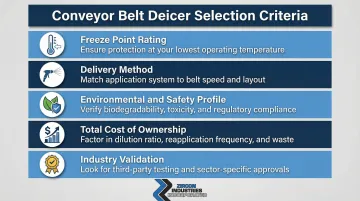
Core Selection Factors
- Freeze point rating: Match the product's rated freeze point to your region's actual low temperatures. A -40°F-rated deicer can fail in Montana's -50°F winters, causing costly shutdowns.
- Delivery method: Properly installed and calibrated automated spray systems can improve coverage consistency, reduce manual variability, and limit unnecessary application. Manual application may still be appropriate for smaller systems, spot treatment, or backup use.
- Environmental and safety profile: Verify biodegradability, runoff impact, and compatibility with belt materials and metal components. Chloride-free formulations reduce corrosion risk.
- Total cost of ownership: Compare product cost, application efficiency, labor savings, and downtime prevention — not just unit price.
- Industry validation: Look for product-specific SDS and TDS documentation, belt-manufacturer compatibility guidance, independent test data, documented case studies, and references from comparable operations. Industry-association membership can provide useful context, but it should not be treated as product certification or proof of performance.
Conclusion
Choosing a conveyor belt deicer manufacturer directly affects production continuity, equipment longevity, and worker safety in cold-weather operations. The right partner brings proven formulations, proper freeze point ratings, and application systems that match the scale and demands of your operation.
Before finalizing a purchase decision, evaluate:
- Ongoing performance guarantees and freeze point ratings
- Availability of automated delivery systems
- Cost-per-application metrics at your volume
- Direct technical support capability from the manufacturer
Zircon Industries checks each of those boxes. Liquid Heat Conveyor Belt Deicer & Ice Preventative is built for conveyor belts, rollers, idlers, chutes, switches, and truck beds, with 55+ years of Zircon Industries' specialty chemical experience behind it. It can be paired with automated spray systems or manual sprayers to support consistent winter freeze-control programs. Contact Zircon Industries at 800-547-4328 to discuss your application.
Frequently Asked Questions
What is a conveyor belt deicer and how does it work?
A conveyor belt deicer is a chemical formulation applied to belt surfaces and carryback areas to suppress ice formation and prevent material from freezing to the belt. It lowers the freezing point of water at contact surfaces. Automated spray systems deliver it consistently without manual application.
At what temperature should you start using a conveyor belt deicer?
Most operations begin applying deicer when ambient temperatures approach 32°F, particularly when wet or damp materials are being conveyed. Select a deicer with a published operating or freezing-point range that covers the site’s expected temperatures with an appropriate safety margin. Not every northern operation requires a -60°F product, and freeze-point data should not be treated as a guarantee of field performance.
What is the difference between a liquid conveyor belt deicer and an automated spray system?
A liquid deicer is the chemical product itself, while an automated spray system is the delivery mechanism that applies it consistently at set intervals or trigger points along the conveyor. Automated systems can improve application consistency, reduce manual variability, and limit unnecessary product use when they are correctly installed, calibrated, and maintained.
Are conveyor belt deicers safe for the environment and equipment?
Some conveyor belt deicers are formulated to reduce corrosion risk, improve belt compatibility, or support environmentally sensitive operations. However, performance varies by chemistry. Always review the product's SDS, TDS, chloride content, runoff profile, and belt compatibility before using it on conveyor systems.
How much can a conveyor belt deicer save in operational costs?
Potential savings come from reducing freeze-related downtime risk, manual ice-removal labor, product over-application, and equipment damage. Operators at large mines estimate conveyor failures can cost $50,000 to $100,000 per day in lost production.
What industries use conveyor belt deicers most?
The heaviest users are mining, aggregate and quarry operations, coal handling, railroad material handling, lumber yards, and bulk construction material processing. Outdoor operations conveying wet or moisture-bearing material in sub-freezing conditions may benefit from a properly selected deicer or mechanical freeze-control system.