Introduction
In aggregate and quarry operations, a single hard freeze can halt an entire production line. Frozen conveyor belts cause material to clump, chutes to clog, pulleys to slip, and rubber belts to crack under stress. According to industry data on mining downtime, unplanned conveyor shutdowns can cost operations between $50,000 to $100,000 per day in lost profit, with catastrophic failures reaching millions in total losses.
Winter downtime translates directly to lost tonnage and revenue. Standard rubber belts begin losing elasticity at 32°F and become brittle enough to shatter in extreme cold.
As temperatures continue to fall below freezing, standard rubber belts progressively lose flexibility and may become unable to trough or pass around pulleys. The actual failure temperature depends on the belt compound, construction, moisture exposure, loading conditions, and whether the belt was designed for extreme cold. Fenner Dunlop Cold-Resistant Conveyor Belting
The right deicer keeps your line moving through all of it. This guide compares 10 cold-weather solutions for aggregate and quarry plants, including dedicated conveyor belt deicers, freeze-conditioning agents, a mechanical heated-pulley system, and adjacent surface deicers that require compatibility verification before use on conveyor equipment.
Key Takeaways
- Chemical deicers prevent frozen bulk material from bonding to belts by lowering freeze points and weakening ice crystal bonds
- The best deicer depends on minimum operating temperature, material moisture, and automation compatibility
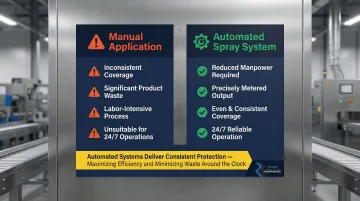
- Automated spray systems consistently outperform manual application in consistency and chemical efficiency
- Zircon's Liquid Heat leads for extreme cold environments, with a -60°F freeze point built for the harshest conditions
- Liquid Heat is built for aggregate, quarry, mining, cement, steel, recycling, wood chip, iron ore, and other bulk-material-handling operations that need conveyor freeze control.
Why Conveyor Belt Freezing Shuts Down Aggregate Plants
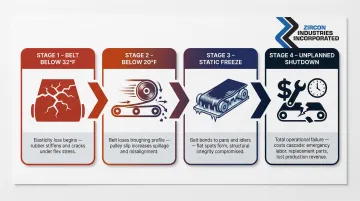
When conveyor belts freeze in aggregate operations, the consequences cascade quickly. Rubber belts below 32°F lose elasticity. Below 20°F, they can no longer trough or pass around pulleys — and if left static, they freeze to pans and idlers, wearing flat spots that destroy rollers and force unplanned shutdowns. Emergency labor, replacement parts, and lost production hours add up fast.
Two strategic approaches exist:
- Prevention — Chemical deicers applied before freezing occurs
- Cure — Mechanical methods like vibrators, hydraulic rams, or heat torches
Preventive chemical treatment is often more effective than waiting for heavy ice buildup, but the best approach depends on the conveyor system, temperature, material moisture, shutdown schedule, and site-safety requirements. Some operations combine chemical prevention with heated pulleys or other mechanical controls.
The 10 products below cover the most effective prevention-first options for aggregate and quarry environments, including chemical deicer sprays, freeze conditioning agents, and automated spray systems built specifically for conveyor operations.
Top 10 Conveyor Belt Deicers for Aggregate & Quarry Plants
These products were evaluated on freeze-point protection, application compatibility (including automated spray systems), performance with high-fines bulk materials like sand and gravel, non-corrosive properties, and proven use in aggregate or mining environments.
Zircon Industries – Liquid Heat Conveyor Belt Deicer
Zircon Industries’ Liquid Heat Conveyor Belt Deicer is built for conveyor belts, rollers, idlers, chutes, switches, truck beds, and other freeze-prone material-handling surfaces. Backed by 55+ years of Zircon Industries’ specialty chemical experience, it is positioned for aggregate, quarry, mining, rail, cement, steel, recycling, and related industrial operations.
The product is built for aggregate, mining, quarry, cement, steel, wood chip, iron ore, and recycling operations that need freeze-control support across conveyor systems.
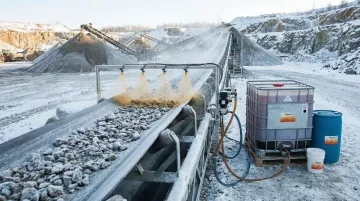
Liquid Heat stands out because it is built for conveyor belt deicing and ice prevention across belts, rollers, idlers, chutes, switches, and truck beds. It remains sprayable in extreme cold and can be paired with automated or manual sprayers for consistent freeze-control application. It can be paired with automated deicer spray systems or manual sprayers. Automated systems can improve application consistency, reduce manual variability, and limit unnecessary spraying when properly installed, programmed, and maintained.
| Specification | Details |
|---|---|
| Product Type / Active Ingredient | Proprietary liquid conveyor belt deicer and ice preventative |
| Freeze Point Protection | Rated to -60°F — one of the lowest freeze points available in the conveyor belt deicer category |
| Best For / Ideal Application | Aggregate, quarry, mining, and railroad operations requiring extreme-cold protection; compatible with automated spray systems |
Benetech BT955++ – Freeze Conditioning De-Icer
Benetech, a bulk material handling specialist serving aggregate, mining, and power industries, offers BT955++ Freeze Conditioning De-Icer for conveyors, idlers, rollers, transfers, switches, trucks, and other freeze-prone equipment.
BT955++ is a diethylene glycol-based freeze conditioning de-icer designed for conveyors, idlers, rollers, transfers, switches, trucks, and other equipment. Benetech's product literature states that BT955++ is non-corrosive, non-hazardous, non-flammable, and good to -45°F. It also traps dust particles on material surfaces during offloading — useful for combined freeze and dust management.
| Specification | Details |
|---|---|
| Product Type / Active Ingredient | Diethylene glycol-based non-corrosive freeze-point depressant blend |
| Freeze Point Protection | -45°F (-43°C) verified effective temperature rating |
| Best For / Ideal Application | Bulk material operations including aggregate, coal, and ore; suited for spray application to belts, idlers, and chutes |
PCI – Ice-Eradicator Heated Drum Pulley
PCI (Precision Conveyor Industries) offers a mechanical, flame-free approach with the Ice-Eradicator — a drum-style heated pulley installed at the head position of the conveyor that warms the belt from the inside out before and during startup.
Unlike chemical deicers, the Ice-Eradicator uses an internal heating element powered by a 120V, 15A supply. It raises pulley surface temperature by approximately 25°F per hour, which in turn heats the belt to discourage freezing and restore belt-to-pulley grip — most useful for operations that shut down overnight in freezing conditions.
| Specification | Details |
|---|---|
| Product Type / Active Ingredient | Mechanical thermal system — heated drum pulley with internal liquid solution and slip ring |
| Freeze Point Protection | Performance-based (temperature-raising mechanism); effective in documented case study at 20°F ambient with 5 inches of snow |
| Best For / Ideal Application | Quarry and aggregate operations with overnight shutdowns in freezing conditions; eliminates need for propane burners or chemical agents at drive position |
EnviroTech Services – FreezeTrol Series
EnviroTech Services produces FreezeTrol belt deicers and freeze-conditioning products for conveyors and bulk materials.
The FreezeTrol line is engineered specifically for belt deicing and bulk material freeze conditioning. FreezeTrol 62 (effective to -30°F), FreezeTrol 78-G (effective to -60°F), and FreezeTrol 77-W (effective to -40°F) provide options based on operational temperature extremes. The range includes bio-polymer and chloride-free synthetic options. Buyers should review the exact product’s SDS, TDS, chloride content, runoff profile, application rate, and equipment compatibility before use.
| Specification | Details |
|---|---|
| Product Type / Active Ingredient | Bio-polymer based and chloride-free synthetic formulations depending on grade |
| Freeze Point Protection | FreezeTrol 62: -30°F; FreezeTrol 78-G: -60°F; FreezeTrol 77-W: -40°F |
| Best For / Ideal Application | Sites requiring environmentally responsible freeze control with options for varying temperature extremes; suitable for belts, idlers, and pulleys |
Cargill – ClearLane Enhanced Deicer
Cargill ClearLane Enhanced Deicer is a pre-wet sodium chloride product made with a patented liquid magnesium chloride formula, a PNS-approved corrosion inhibitor, a coloring agent, and a leaching inhibitor. It is marketed for winter road maintenance, so conveyor belt use should be verified directly with Cargill before applying it to aggregate conveyor systems.
While effective for pavement applications, documentation specific to conveyor belt use in aggregate plants is not available. Operators considering this product should evaluate corrosion potential on metal equipment and compatibility with rubber belt compounds.
| Specification | Details |
|---|---|
| Product Type / Active Ingredient | Pre-wet sodium chloride treated with a magnesium-chloride-based agent, corrosion inhibitor, coloring agent, and leaching inhibitor |
| Freeze Point Protection | Cargill states that the product continues melting below 0°F; no -85°F eutectic rating is published for the finished ClearLane product |
| Best For / Ideal Application | Winter road and thoroughfare deicing; direct conveyor use is not documented and requires manufacturer confirmation |
Compass Minerals – Safe Step Calcium Chloride 7300
Compass Minerals Safe Step Calcium Chloride 7300 is marketed for driveways, walkways, and general winter maintenance, not conveyor belt systems. Operators considering calcium chloride for conveyor belt deicing should confirm rubber belt compatibility, corrosion impact on steel components, and application guidance directly with the manufacturer before use.
| Specification | Details |
|---|---|
| Product Type / Active Ingredient | Calcium chloride pellets |
| Freeze Point Protection | Melts ice down to -25°F, according to Compass Minerals |
| Best For / Ideal Application | Driveways, walkways, yards, and general surface deicing; conveyor-belt use is not documented and requires written compatibility guidance |
Midwest Industrial Supply – Ice Free Conveyor
Midwest Industrial Supply’s Ice Free Conveyor is a multi-component, glycol-based anti-icing and deicing agent developed specifically for conveyor belts operating in extreme winter conditions.
Midwest states that the product remains effective down to -70°F. It is designed to support wet materials, steep or weathered belts, heavy precipitation, and extremely cold operating environments. Ice Free Conveyor also increases belt-cover friction to reduce material backsliding and helps limit fines carryback and buildup on belts, idlers, and pulleys.
The product can be applied to the top or bottom of the conveyor belt, trough idlers, and tail pulleys. It may be applied before shutdown to prevent ice glazing or during startup and operation to accelerate ice removal and limit further buildup.
| Specification | Details |
|---|---|
| Product Type / Active Ingredient | Multi-component, glycol-based conveyor anti-icing and deicing agent |
| Freeze Point Protection | Effective down to -70°F, according to Midwest Industrial Supply |
| Best For / Ideal Application | Wet aggregate, steep or weathered belts, idlers, pulleys, and conveyors operating in sustained extreme cold |
AKJ Chemicals – IcEase Belt Deicer
AKJ Chemicals’ IcEase Belt Deicer is a conveyor belt deicer product line available in both chloride and non-chloride formulations. The products combine anti-icing and deicing components to help prevent frozen belts, material slippage, and winter-related production interruptions.
IcEase is designed for use with AKJ’s automated application systems, allowing facilities to apply freeze-control treatment consistently across conveyor belts and rollers. The product line is positioned for operations where ice buildup increases conveyor strain, equipment wear, unsafe working conditions, and downtime risk.
AKJ does not publish one universal temperature rating or chemistry for the entire IcEase range on its public product page. Buyers should request the specific product TDS and SDS to compare freeze-point protection, chloride content, application rate, and belt compatibility.
| Specification | Details |
|---|---|
| Product Type / Active Ingredient | Belt deicer product line with chloride and non-chloride options |
| Freeze Point Protection | Varies by IcEase formulation; confirm using the grade-specific TDS |
| Best For / Ideal Application | Aggregate and quarry conveyors requiring automated anti-icing and deicing treatment for belts, rollers, and material-slippage control |
Novamen – NovaMax BWD Belt Wetting Deicer
Novamen NovaMax BWD is a belt-wetting antifreeze and deicing compound developed for conveyor systems operating in cold industrial environments.
Novamen describes the product as non-hazardous, non-toxic, non-corrosive, biodegradable, and safe on conveyor belts. It is also compatible with common belt-wetting fluids, including potassium acetate, ethylene glycol, and propylene glycol formulations.
NovaMax BWD has been freeze-tested for stability and retains low viscosity at -40°C (-40°F), helping it remain suitable for spraying in severe cold. However, low-temperature viscosity should not be treated as a confirmed effective deicing temperature. Buyers should request the product TDS for its exact freeze point, application rate, and operating range.
| Specification | Details |
|---|---|
| Product Type / Active Ingredient | Non-toxic belt-wetting antifreeze and deicing compound |
| Freeze Point Protection | Retains low viscosity at -40°C (-40°F); confirm exact freeze point and effective range through the product TDS |
| Best For / Ideal Application | Conveyor belt wetting and deicing where belt safety, low-temperature sprayability, and compatibility with existing glycol or potassium-acetate fluids are priorities |
Novamen – NovaMax Deicer Type II
NovaMax Deicer Type II is manufactured from non-toxic, biodegradable organic compounds and is designed to prevent coal, steel, aggregates, and other bulk materials from freezing to industrial equipment.
The product can be sprayed on conveyor belts, rail cars, truck boxes, hoppers, and other material-contact surfaces before loading. Novamen states that it adheres well to most surfaces and helps reduce freezing, product buildup, carryback, and winter-related downtime.
NovaMax Deicer Type II has a published minimum freezing point of -40°C (-40°F). Novamen also offers support for designing and implementing spray systems for conveyor, rail, truck, and material-handling applications.
| Specification | Details |
|---|---|
| Product Type / Active Ingredient | Non-toxic, biodegradable organic deicing and release-agent formulation |
| Freeze Point Protection | Minimum freezing point of -40°C (-40°F) |
| Best For / Ideal Application | Conveyor belts, rail cars, truck boxes, hoppers, and aggregate-contact surfaces requiring both freeze prevention and improved material release |
Automated Application: The Efficiency Advantage
Choosing the right deicer is only half the equation — how you apply it determines whether you get consistent protection or wasted product and uneven coverage. Automated spray systems address this directly.
Liquid Heat can be applied through Zircon’s automated deicer spray systems, including timer-controlled, Allen Bradley PLC-controlled, and remote-controlled configurations.
Separately, Midwest Industrial Supply’s Cobra Winter Spray System is available in Auto-Spray, Press and Go, and Manual configurations.
Automation can provide operational benefits:
- Can reduce reliance on manual spraying
- Supports controlled and metered product delivery
- Can improve coverage consistency when nozzles are positioned and calibrated correctly
- Can support continuous operations when the system is inspected, maintained, and replenished as required
How We Chose These Top Conveyor Belt Deicing Solutions
The products and systems in this guide were evaluated using criteria that matter in aggregate and quarry operations:
- Conveyor relevance: Priority was given to products with documented use on conveyor belts, idlers, pulleys, chutes, bulk materials, or automated belt-wetting systems.
- Cold-weather performance: We reviewed published freeze points, operating ranges, low-temperature viscosity, or documented thermal performance, depending on whether the solution was chemical or mechanical.
- Material compatibility: Products were assessed based on available corrosion, belt-safety, metal-compatibility, and SDS/TDS information.
- Application method: Automated spray compatibility, manual application, belt wetting, mechanical heating, and surface spreading were considered.
- Operational fit: We considered aggregate moisture, fines content, belt incline, cold startups, continuous operation, and exposure to snow or freezing rain.
General road and surface deicers are clearly identified as adjacent options rather than direct conveyor belt deicers. Buyers should request product-specific compatibility guidance before using any surface deicer on conveyor equipment.
Common Buyer Mistakes to Avoid
- Select a deicer rated at least 10–15°F below your lowest expected operating temperature — a product rated to 0°F won't hold at -20°F
- Confirm compatibility with your spray infrastructure before purchasing; not all formulations work with every automated or manual system
- Don't overlook dual-function products — some formulations handle both freeze control and dust suppression, cutting application time and chemical spend
- Compare total landed cost, application efficiency, technical support, shipping availability, and bulk ordering options before selecting a supplier.
The variables below ultimately determine which product fits your site — two quarries running the same conveyor system can have very different needs:
- Particle size and fines content
- Moisture level of the aggregate
- Duration of exposure before unloading
- Whether the conveyor runs continuously or restarts from cold
- Environmental compliance requirements in the plant's jurisdiction
Conclusion
Frozen conveyor belts in aggregate and quarry plants drain revenue through lost tonnage, equipment damage, emergency labor, and safety incidents. The right deicer or mechanical freeze-control system, applied and maintained correctly, can reduce freeze-related downtime, manual ice-removal work, equipment damage, and winter safety exposure.
Before selecting a product, evaluate your specific cold-weather conditions rather than defaulting to whichever deicer is cheapest or most familiar. Key factors to assess:
- Minimum ambient temperature at your site, since some products lose effectiveness below their rated operating range
- Material type being conveyed (wet aggregate vs. dry stone behaves differently)
- Conveyor run time and cycle frequency during freeze conditions
- Automation capability — manual vs. spray system application
For aggregate and quarry plants that need a dedicated conveyor belt deicer, Zircon's Liquid Heat Conveyor Belt Deicer is built for belts, rollers, idlers, chutes, switches, and truck beds. It can be paired with automated spray systems or manual sprayers to help support consistent winter freeze-control programs.
Contact the Zircon Industries team to discuss your plant's winter freeze control needs:
- Phone: 800-547-4328
Frequently Asked Questions
What is a conveyor belt deicer and how does it work?
Conveyor belt deicers are chemical agents (or mechanical systems) that lower the freeze point of moisture on belt surfaces and bulk materials, preventing ice bonds from forming. Chemical deicers also weaken existing ice crystal structure so it fractures more easily, allowing material to release from the belt during discharge.
At what temperature do conveyor belts start to have freezing problems in aggregate plants?
Rubber conveyor belts begin losing elasticity and flexibility below 32°F, can stop troughing or passing over pulleys below 20°F, and traditional deicing approaches often fail below 0°F to -10°F. Check freeze-point ratings against your region's typical low before selecting a product.
Can a conveyor belt deicer also control dust in aggregate operations?
Some freeze-conditioning formulations also provide documented dust-management benefits by trapping or binding fine particles. Treat this as a product-specific capability and verify the manufacturer’s TDS, application rate, and environmental guidance before combining freeze-control and dust-control programs.
How is a conveyor belt deicer applied in a quarry or aggregate plant?
Deicers are applied through manual spray equipment or automated spray systems. Automated systems deliver consistent coverage without human error or product waste and are generally preferred for continuous or high-volume aggregate conveyor operations, especially in 24/7 production environments.
What is the difference between chemical deicers and heated pulley (mechanical) deicing systems?
Chemical deicers are applied to the belt or bulk material surface to prevent freezing through freeze-point depression, while mechanical systems like heated pulleys warm the belt from contact to restore flexibility and grip. Both approaches are valid. Some operations combine them, using chemical deicers for prevention and mechanical systems for startup assurance in extreme cold.
How often does conveyor belt deicer need to be reapplied during winter operations?
Reapplication frequency depends on precipitation, temperature, material moisture content, and the specific product used. Most sites running automated spray systems set timer-based intervals tuned to their conditions, which removes the guesswork of manual scheduling.