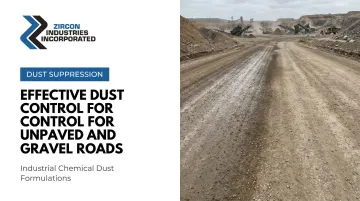
FHWA’s Unpaved Road Dust Management handbook notes that gravel roads may require about 1.0 to 1.5 tons of gravel per mile per vehicle of average daily traffic per year to maintain acceptable conditions. At 200 vehicles per day, that means a road can lose more than 200 tons of aggregate per mile annually through traffic abrasion, dust, erosion, and snow-removal activity.
This article covers why dust control on unpaved roads is non-negotiable, which treatment methods work best under different conditions, how to prepare and apply treatments correctly, and how to match the right solution to your specific road.
Key Takeaways
- PM10 and PM2.5 particles from unpaved roads pose real respiratory health risks and visibility hazards
- Water usually controls dust for 1–12 hours; chloride salts often last 8–15 weeks under suitable conditions; polymer performance is product-, traffic-, soil-, and climate-specific
- Proper road preparation — grading, cross-slope, moisture content — determines whether any treatment succeeds
- Product selection hinges on traffic volume, climate, soil type, and proximity to sensitive areas
- Chemical suppressants reduce total maintenance costs compared to water-only approaches
Why Dust Control on Unpaved Roads Can't Be Ignored
Health and Safety Risks
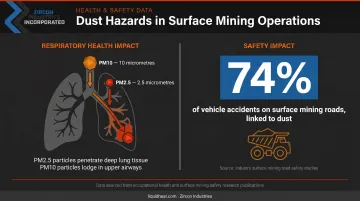
Dust from unpaved roads isn't just a nuisance — it's a documented health hazard. EPA classifies PM10 as inhalable particulate matter 10 micrometers and smaller, with PM2.5 — 2.5 micrometers and smaller — posing the greatest risk because it penetrates deep into the lungs and can enter the bloodstream. Unpaved roads are a direct source of both.
A 2018 peer-reviewed literature review found 17 studies reporting adverse respiratory effects from road dust exposure, including respiratory inflammation and asthma-related outcomes. Workers on haul roads, residents near rural routes, and drivers all face disproportionate exposure.
Visibility is the other critical risk. NIOSH research on surface-mine haul roads notes that uncontrolled haul-road dust can impair operator visibility and increase the probability of haul-truck accidents. The same research found haul roads can account for 78% to 97% of total dust emissions at surface mine sites, making dust control a safety, health, and operational issue.
Environmental and Infrastructure Costs
Dust settling on roadside vegetation can block photosynthesis and suppress plant growth. When dust-laden runoff reaches nearby streams, it can introduce fine particles and suppressant residues into aquatic habitats. USGS research on road dust suppressants found that acute aquatic toxicity varied by more than 1,000-fold across tested products, so suppressant selection matters as much as application.
The infrastructure costs are just as significant. FHWA’s Unpaved Road Dust Management handbook notes that maintaining acceptable gravel-road conditions can require 1.0 to 1.5 tons of gravel per mile per vehicle of average daily traffic per year. At 250 vehicles per day, that can mean hundreds of tons of aggregate per mile annually lost through dust, erosion, traffic abrasion, and snow-removal activity. Left unchecked, that loss drives:
- Washboarding and potholing that accelerates between maintenance cycles
- Frequent regrading and material replenishment costs
- Reduced road life and increased long-term capital spend
The Most Effective Dust Control Methods for Gravel and Unpaved Roads
No single method works for every road. Here's a practical breakdown of the main options:
Water Application
Water is the most widely used dust control method — low cost, simple to deploy, and effective at temporarily binding surface particles through capillary action. But the results don't last. The Federation of Canadian Municipalities dust-control guide notes that water is usually effective for only 1 to 12 hours. NIOSH haul-road dust research found that watering haul roads once per hour produced about 40% control efficiency for total suspended particulates, while watering every half-hour increased control efficiency to about 55%.
Water works for short-term suppression, emergency response, or pre-wetting before a chemical treatment. It's not a standalone strategy for any road carrying meaningful traffic.
Key limitations:
- Requires frequent reapplication — sometimes multiple times per day in hot, dry conditions
- No lasting surface binding
- Can oversaturate the subgrade if applied too heavily
- High water demand can be environmentally problematic in drought-prone regions
Chloride-Based Suppressants
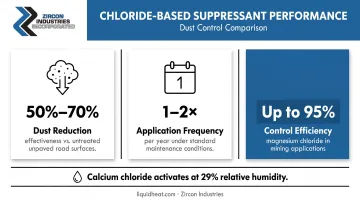
Calcium chloride and magnesium chloride are hygroscopic salts — they draw moisture from the atmosphere and retain it, keeping the road surface continuously damp. This ongoing moisture retention binds fine particles, reduces aggregate loss, and slows the need for regrading. Calcium chloride starts absorbing atmospheric moisture at just 29% relative humidity, making it effective across a wide range of conditions, though performance drops in very dry climates.
Performance data supports their use, but duration depends on site conditions. The Federation of Canadian Municipalities dust-control guide reports that calcium chloride and magnesium chloride treatments reduced fugitive dust emissions by 50% to 70% in a Colorado State University field study, with many agencies applying one treatment per year and seeing performance periods of 8 to 15 weeks. NIOSH haul-road research also cites a study where magnesium chloride achieved 95% control efficiency for haul-truck-generated dust.
Drawbacks to consider:
- Corrosion risk to vehicles and equipment
- Runoff can elevate chloride levels in nearby streams and groundwater
- FCM recommends keeping chloride applications at least 26 feet — 8 meters from any water body
- Less effective in very low-humidity environments
Organic Binders and Lignosulfonates
Where chloride salts depend on atmospheric moisture, lignosulfonates take a different approach: they act as a glue, binding road particles together mechanically. These wood-pulp by-products can reduce dust generation and slow surface erosion, but performance depends on rainfall, traffic, soil type, and application rate. They can also leach during heavy rain, so environmental fit should still be reviewed before use near sensitive areas.
Government guidance indicates lignosulfonates generally require 1 to 2 treatments per year at 0.5 to 1.0 gal/sq yd of 10%–25% solution. FHWA rates them as effective for low to medium traffic under wet or damp conditions.
Key limitations:
- Water-soluble — heavy rain can destroy surface binding and leach the material away
- Treated surfaces can become slippery when wet
- Poor performance in dry climates; best in areas with some ambient humidity
Synthetic Polymer Emulsions
Polymer emulsions — such as polyvinyl acetate or acrylic copolymers — form a semi-rigid or flexible crust on the road surface, locking fine particles in place. They work across both dry and humid climates, making them more versatile than chloride salts in some applications.
FHWA guidance treats synthetic polymer performance as highly dependent on material properties, traffic, climate, application rate, and supplier recommendations. Some synthetic polymer emulsions and related treatments may require road closure during application and curing, with curing times typically ranging from 15 minutes to 2 hours.
Key limitations:
- Difficult to rework with a conventional grader once cured
- High-speed light vehicles can fracture fragile polymer crusts
- Some formulations carry environmental concerns depending on composition
- Longevity is product-, traffic-, soil-, and climate-specific — there's no universal benchmark
Gravel and Aggregate Surfacing
Applying properly graded crushed aggregate creates a hard protective layer over bare soil, shielding fines from tire abrasion and wind. FHWA recommends aggregate with 8%–15% passing No. 200 sieve and plasticity index of 8–15 in drier climates — under 20 inches annual precipitation — and 3%–12% passing No. 200 with PI 3–10 in wetter regions.
Aggregate quality directly determines whether any chemical treatment holds. Poor-quality gravel sheds fines rapidly, accelerating both dust generation and regraveling costs.
Key limitations:
- Gravel alone does not stop wind-driven dust
- Migrates under traffic and requires regular topping off
- Works best when combined with chemical suppressants to anchor the surface layer
How to Prepare Your Road Surface Before Treatment
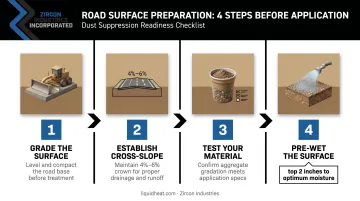
Surface preparation is where most dust control programs succeed or fail. Applying product to a poorly shaped, dry, or degraded road wastes both money and material.
Critical preparation steps:
- Grade the surface: Remove corrugations and fill potholes before treatment. A smooth, uniform surface allows even product distribution and prevents pooling.
- Establish correct cross-slope: FHWA recommends a 4%–6% cross-slope — approximately 1/2 inch per foot — to ensure water sheds off rather than pooling. Less than 4% invites dangerous ponding; more than 6% can cause truck trailers to drift on curves.
- Test your material: Know your road's fines content, clay content, and aggregate gradation before selecting a treatment. FHWA specifies that fines act as the "glue" of a gravel road's wearing course — mismatching product to soil type guarantees underperformance. Basic material testing is low-cost and directly improves treatment selection.
- Apply to a properly moist surface: FHWA guidance emphasizes that dust suppressants work best on damp road materials and warns against spraying additives onto dry, poorly prepared surfaces. Avoid standing water or pooling before application, and follow the product supplier’s application instructions for moisture, rate, and timing.
Best Practices for Applying Dust Suppressants
Getting application right is as important as choosing the right product.
Timing matters. The Federation of Canadian Municipalities dust-control guide notes that chlorides and lignosulfonates work best when applied to damp road materials, often in late spring after seasonal rains while the road surface has not fully dried. Avoid applying water-soluble suppressants during heavy rainfall or when runoff is likely.
Calibrate your rate to your conditions. High-traffic roads, roads with low fines content, and roads in arid climates all require higher application rates than standard recommendations. Don't use a one-size-fits-all rate on roads with different traffic volumes or soil compositions.
Protect the crust. FHWA warns that chemical treatments often form a surface crust after application — unnecessarily breaking that crust with grading causes washboarding and accelerated dust return. Keep traffic off treated surfaces for up to 2 hours after application.
Plan follow-up applications. Reapplication timing depends on suppressant type, traffic, climate, road material, rainfall, and supplier guidance. Chloride products often use reduced follow-up dosages, while bio-based and polymer products vary widely by formulation. Maintaining residual product before failure occurs usually costs less than waiting for dust to return fully and retreating from scratch.
Zircon Industries offers multiple dust-control options for different site needs. RDS38 Road Dust Stabilizer is delivered and applied as a turnkey service, with one application lasting approximately 3 to 4 months. Glycerin DC-100 is a soy-derived, biodegradable, do-it-yourself dust-control option for unpaved roads, with effects lasting approximately 3 to 4 weeks per application. Contact Zircon Industries for current pricing, product selection guidance, application details, and availability.
How to Choose the Right Dust Control Solution for Your Needs
Match to Traffic Volume
Traffic is the single most decisive factor in product selection:
| Traffic Level | Recommended Options |
|---|---|
| Low-volume rural roads (<100 vehicles/day) | Water, lignosulfonates, light polymer treatments |
| Moderate traffic (100–250 vehicles/day) | Chloride salts, lignosulfonates, polymer emulsions |
| High-traffic haul roads (>250 vehicles/day) | Chloride salts, higher-rate polymer applications, aggregate upgrades |
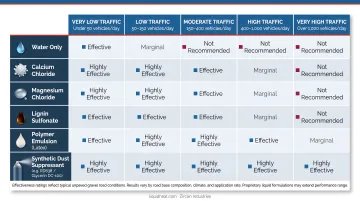
Light vehicles at high speed can fracture newly cured polymer crusts, so application rate must account for both volume and vehicle type — not just one.
Factor In Climate
Climate determines which products can sustain themselves between applications:
- Chloride salts work best in moderate-humidity environments where hygroscopic action — moisture absorption from the air — keeps the surface damp; they self-rejuvenate in humid climates
- Lignosulfonates leach out in high-rainfall regions and underperform in very dry climates
- Synthetic polymers may degrade in freeze-thaw cycles but offer broader climate versatility than salts
- Arid climates generally require more frequent reapplication of any product
Account for Environmental Sensitivity
Roads near waterways, wetlands, or residential zones require careful product selection. Chloride runoff can elevate stream chloride levels and affect aquifers — setback distances matter.
Key regulatory benchmarks to know:
- FCM guidance: Keep chloride applications at least 8 metres from any body of water and avoid use near salt-sensitive vegetation where required
- Clark County, NV guidance: Organic petroleum products, deliquescent/hygroscopic salts, and lignin-based palliatives may be restricted within 20 yards of open bodies of water, drinking-water wellheads, natural washes, or flood-control channels
- SDS review: Always check the product’s Safety Data Sheet, label, local regulations, and site-specific runoff controls before committing to a method
Evaluate Lifecycle Cost — Not Just Product Price
Research from the Federation of Canadian Municipalities shows that dust suppressants can reduce total annual road maintenance costs by 30% to 46% compared to untreated roads. The relevant cost comparison isn't product price per gallon — it's total cost over the maintenance cycle, including regrading avoided, aggregate replacement deferred, and equipment wear reduced.
To run a meaningful comparison, track your current annual spend on grading passes, aggregate top-dressing, and equipment hours — then model those same costs against one or two suppression applications per season.
Frequently Asked Questions
How can I reduce dust on roads?
The most effective approach combines proper road preparation — grading, shaping, and establishing correct cross-slope — with a dust suppressant matched to the road's traffic, soil type, and climate. Water works for short-term relief; chloride salts or polymer treatments provide lasting control for roads with regular traffic.
How much does dust control on gravel roads cost?
Costs vary by method, road length, traffic volume, reapplication frequency, freight, road preparation, and whether application service is included. Water is cheapest upfront but can generate higher total seasonal cost through repeated watering, regrading, aggregate loss, and labor. Chemical suppressants can reduce total maintenance costs when matched to the road and applied correctly. Contact Zircon Industries for current product pricing, application options, and availability.
How long do dust suppressants last on gravel roads?
Longevity depends on product type and site conditions. Water lasts 1–12 hours; chloride salts typically hold 8–15 weeks under moderate conditions; lignosulfonates generally need 1–2 applications per year. Synthetic polymers vary too widely to generalize, so ask the manufacturer for site-specific guidance.
When is the best time to apply dust suppressants?
Late spring — after seasonal rains end and while the road surface retains some moisture — is optimal for first application. A follow-up application in late summer or early fall extends protection through the dry season and helps prevent frost-heave damage in winter.
Are chemical dust suppressants safe for the environment?
Safety varies by product — chloride salts can pose runoff risks near waterways, while organic binders and synthetic polymers differ in biodegradability. Always review the product's SDS, select options appropriate for sensitive areas, and confirm the supplier meets applicable regulatory standards before application.
What is the difference between dust suppression and road stabilization?
Dust suppression targets airborne fine particles by wetting or binding the road surface layer. Road stabilization chemically or mechanically improves the structural load-bearing capacity of the road material itself. Some products — particularly polymer emulsions applied at higher rates — can achieve both, but most dust palliatives are surface treatments only and don't improve structural strength.