Managing coal dust effectively requires understanding which suppression methods work where, how chemical additives extend the reach of water-based systems, and why automated monitoring outperforms fixed-schedule sprinklers. This guide covers all of it, giving plant operators a practical framework for building a layered dust control strategy.
Key Takeaways
- Coal dust creates overlapping health, explosion, and compliance risks across every stage of handling
- Effective dust control requires a layered approach: wet suppression, dry extraction, and chemical treatment matched by zone
- Chemical additives can improve water penetration, dust wetting, and surface binding when matched to the dust source, coal type, particle size, and application zone
- Automated and targeted spray systems can reduce manual variability, water waste, and over-wetting when designed around actual operating conditions
- System selection hinges on dust volume, location type, coal moisture sensitivity, and local regulations
The Hazards of Coal Dust in Coal Handling Plants
Health Risks: Black Lung and Respiratory Disease
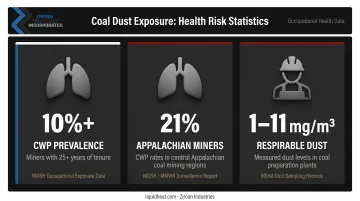
Long-term inhalation of fine coal particulate causes coal workers' pneumoconiosis (CWP), commonly known as black lung disease. The disease has resurged sharply in recent decades: a 2019 review published in PMC found that among miners with 25 or more years of tenure, national CWP prevalence exceeded 10%, reaching 21% in central Appalachian miners. Progressive massive fibrosis — the most severe form — exceeded 5% in that population by 2014.
Surface coal workers and plant-side handling personnel carry exposure risk as well. A CDC/NIOSH report on surface coal miners reviewed chest radiographs from 2,328 miners and found coal workers’ pneumoconiosis in 46 of 2,257 miners with more than one year of surface mining experience. Of those, 37 had never worked underground; the report also found progressive massive fibrosis in 12 miners, including 9 with no underground mining history.
NIOSH research on airborne dust during coal crushing also cites field measurements from 18 coal preparation plants, where respirable dust concentrations ranged from 1 to 11 mg/m³. That range shows why plant-side handling areas need engineered dust controls, not just occasional cleanup.
Explosion and Fire Risk
Coal dust is combustible. MSHA’s coal dust explosion hazard guidance places the minimum explosive concentration for bituminous coal dust at approximately 100 g/m³, with coal dust cloud ignition temperatures as low as 440°C and dust-layer ignition temperatures as low as 160°C. MSHA also notes that finer particles, including material around 74 microns, require less energy to ignite and can increase explosion severity.
Crusher rooms, belt galleries, enclosed transfer stations, pulverizers, baghouses, and other confined handling areas are especially vulnerable. Settled dust disturbed by air movement, mechanical activity, or a primary event can create hazardous suspended dust clouds and increase secondary explosion risk.
Operational Costs of Uncontrolled Dust
Uncontrolled dust also cuts directly into operating margins:
- Equipment wear: Abrasive coal fines accelerate deterioration on conveyor belts, bearings, and rollers
- Product loss: Wind displacement from exposed stockpiles sends saleable material into the air as airborne fines
- Btu degradation: Over-wetting from poor spray control lowers the heating value of the product
- Maintenance burden — facilities without dust control spend more on cleaning, repairs, and unplanned downtime
Types of Dust Suppression Systems for Coal Handling Plants
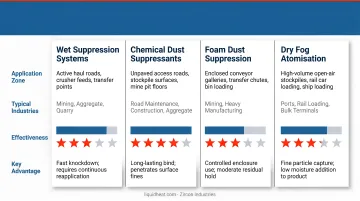
No single system handles every zone in a coal handling plant. Transfer points, conveyors, stockpiles, crusher rooms, and truck/rail unloading areas each generate dust differently and require matched solutions.
Water Spray and Sprinkler Systems
Low-pressure water sprays applied at transfer points, chutes, and conveyor loading zones wet coal before dust becomes airborne. They're cost-effective and straightforward to install, making them common as a baseline layer.
Limitations to plan around:
- Risk of over-wetting, leading to slurry formation and coal quality loss
- Less effective against respirable fine dust when droplet size, spray pattern, contact time, and coal wettability are not matched to the dust source
- Water evaporates quickly in dry or windy outdoor conditions, requiring frequent reapplication
Best suited for: high-throughput open-area transfer zones where moisture addition is tolerable.
Dry Fog (Atomized Mist) Systems
Dry fog systems produce ultra-fine droplets, often in the 1 to 10 micron range. POWER Magazine’s coal dust control article explains the capture mechanism: similarly sized droplets and dust particles agglomerate, increasing particle weight until gravity returns them to the product stream.
Dry fog systems are commonly selected where operators need dust control with minimal added moisture. For power plant operators, that matters because excessive moisture addition can reduce coal heating value and create handling problems. Actual moisture addition depends on nozzle design, system layout, water rate, coal flow, and operating conditions.
Best applications: enclosed transfer points, primary crusher stations, railcar unloading, and silo fills.
Dust Extraction and Bag Filter Systems
These systems use negative pressure to capture dust at the source — hoppers, crusher enclosures, conveyor hoods, and transfer points — then pull the air through filter media before exhausting or recirculating it according to the system design and applicable air-quality requirements.
EPA fabric-filter guidance reports high collection efficiencies for properly designed and maintained fabric-filter systems, including control of PM10 and PM2.5. Actual performance depends on air-to-cloth ratio, filter media, particle characteristics, cleaning cycle, maintenance condition, and system capture design at the dust source.
Best applications: indoor enclosed areas where containment at the source is required and recirculated air quality matters.
Conveyor Belt Dust Control
Transfer points are among the highest dust-generation zones in any plant, making conveyor-specific controls essential:
- Belt scrapers and cleaners — remove carryback material that would otherwise fall and create secondary dust sources along the return path
- Skirting boards — seal loading zones to prevent spillage and fugitive dust escape at the skirt line
- Enclosed conveyor galleries — fully contain dust along extended transport runs, particularly in indoor facilities
No single conveyor control works in isolation. Combining scrapers, skirting, and enclosures delivers the most consistent results.
Windbreaks and Stockpile Management
For outdoor coal storage yards, passive controls reduce the wind velocity needed to lift surface fines:
- Wind fences and barriers positioned to shield stockpile faces from prevailing winds
- Stockpile compaction and slope management to reduce exposed surface area
- Surface wetting or chemical binders — polymer-based crusting agents, surfactant-enhanced water — to stabilize fine particles at the surface
Passive controls reduce fugitive emissions from storage areas, but they work alongside — not instead of — active suppression at loading, transfer, and crusher points.
The Role of Chemical Dust Suppressants in Coal Handling
Plain water has a surface tension problem. Coal is naturally hydrophobic, meaning water beads on particle surfaces rather than penetrating and binding dust. In windy outdoor conditions, even well-applied water evaporates before it can do meaningful work — leaving coal fines free to migrate. Chemical suppressants solve both problems at once.
Surfactant-Enhanced Water Systems
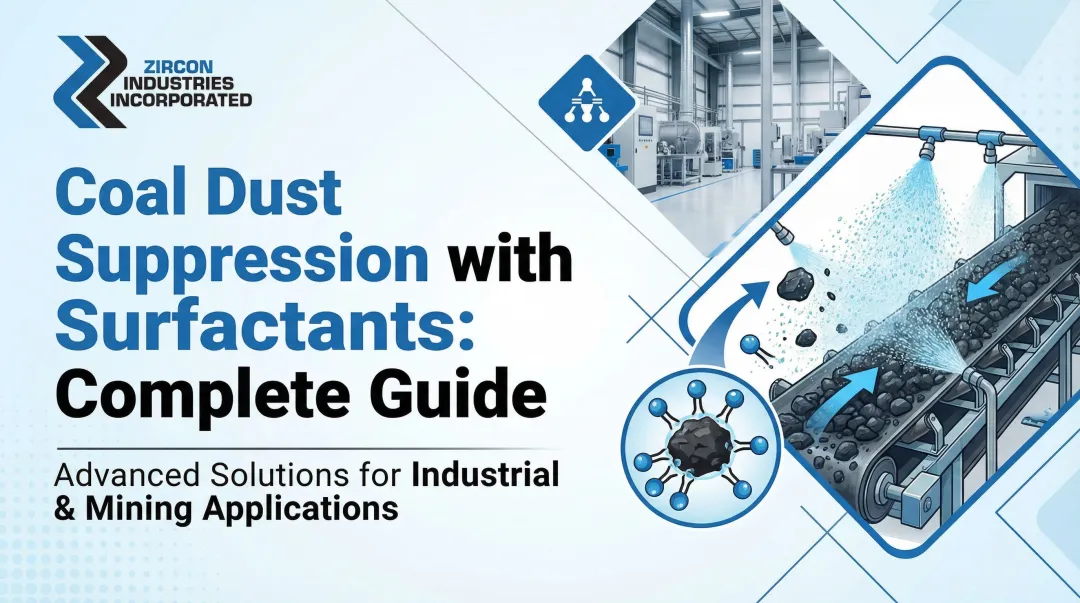
Surfactants reduce water's surface tension, converting hydrophobic coal surfaces toward hydrophilic behavior. The result: water penetrates and adheres to fine dust particles that plain water would otherwise roll off or miss entirely.
The performance gap is substantial. Research from Missouri S&T found that effective surfactants increased overall coal dust suppression by up to 93% compared to plain water, with suppression of sub-3-micron particles running 125% higher than water-only treatment. That means surfactant-dosed systems can achieve equivalent or better dust control at lower water volumes — reducing slurry formation risk and the coal quality losses that come with over-wetting.
Polymer Binders for Stockpile Dust Control
Polymer binder products applied to stockpile surfaces form a crust that helps hold fine particles in place against wind erosion. Unlike water-only surface treatments, binders can provide longer-lasting surface control when the pile or treated area remains mostly undisturbed. Performance depends on product chemistry, dilution ratio, weather, pile activity, and application rate.
For static coal, iron ore, aggregate, fly ash areas, open lots, and railcar tops, Zircon’s Latex 100 Static Dust Control Sealant forms a clear crust over undisturbed surfaces. It is designed for static piles and surfaces, not active haul roads, active mineral piles, or areas with significant traffic.
Zircon Industries Dust Control Products
Zircon Industries offers dust-control products for industrial sites that need water-enhancement, static pile sealing, road dust stabilization, or unpaved-road dust control. For coal handling plants, the strongest product fits are ZHP Water Wetter Non-Ionic Surfactant for improving water coverage, penetration, and evaporation resistance, and Latex 100 Static Dust Control Sealant for sealing static coal and other undisturbed pile surfaces.
Zircon’s dust-control lineup supports different application needs:
- Water enhancement — ZHP Water Wetter breaks the surface tension of water so it spreads, penetrates, and retards evaporation more effectively than plain water
- Static pile sealing — Latex 100 forms a clear crust on static coal, iron ore, aggregate, fly ash areas, open lots, and railcar tops that remain undisturbed
- Road dust control — RDS38 Road Dust Stabilizer is a turnkey road dust service for mining, aggregate, trucking, and lumber yard roads, with one application lasting approximately 3 to 4 months
Contact Zircon Industries for current pricing, SDS documentation, product selection guidance, application method, and availability.
Automated Dust Suppression: Moving Beyond Manual Operation
The Problem with Fixed-Schedule Sprinklers
Many legacy sprinkler installations run on fixed timers instead of actual dust-generation conditions. That can create two problems: spray during low-activity periods, which wastes water and increases over-wetting risk, and insufficient coverage during high-intensity dust events such as unloading, crusher operation, or strong wind exposure over stockpiles.
Over-sprinkling can contribute to slurry formation, excess runoff, and coal moisture problems. Under-sprinkling during peak activity leaves operators relying on cleanup, PPE, and downstream controls instead of controlling dust closer to the source.
A Spraying Systems case study from a southeastern U.S. coal-fired power plant reported a 50% reduction in water use and approximately $150,000 per year in labor savings after replacing flooding nozzles with optimized washdown nozzles for conveyors and tunnels. The case study supports the value of targeted spray design, even when the improvement is not a full sensor-triggered dust suppression system.
How Automated Systems Work
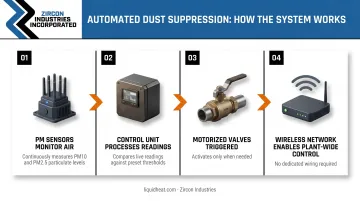
Automated dust suppression systems vary by design. Some are timer-based, some are tied to equipment operation, and more advanced systems may use particulate sensors or environmental inputs to trigger spray or fog components. A typical automated setup may include:
- Dust or activity inputs — PM sensors, belt operation, crusher activity, wind conditions, or transfer-point activity
- A monitoring and control unit — compares readings or operating conditions against preset thresholds or programmed logic
- Motorized valves or pumps — activate spray or fog systems when the system calls for treatment
- Zone-based controls — allow different conveyors, transfer points, unloading zones, or stockpile areas to run independently
Operational Benefits of Automation
- More targeted suppression cycles based on equipment activity, zone needs, or measured dust conditions
- Internal air-quality and system-status logs that can support maintenance reviews and operational documentation
- Remote monitoring capability where the control system supports it
- Reduced manual valve operation and less dependence on operator timing
- Retrofit potential in some plants, depending on existing piping, pumps, valves, electrical infrastructure, controls, and system layout
How to Choose the Right Dust Suppression System
Key Evaluation Factors
No two coal handling plants share the same dust profile. Match your system to these five variables before committing to any solution:
| Factor | What to Consider |
|---|---|
| Dust particle size | Coarse dust may respond to water sprays; respirable fine dust may require dry fog, surfactant-enhanced water, extraction, or enclosure |
| Location type | Enclosed indoor areas may need extraction or containment; outdoor stockyards may need wind mitigation, surface treatment, or pile sealing |
| Coal moisture sensitivity | If Btu value or handling quality matters, prioritize low-water, targeted, or surfactant-enhanced systems over high-volume flooding |
| Infrastructure | Water supply capacity, power access, compressed air, piping, pumps, controls, and existing spray hardware affect feasibility |
| Coverage area | Large or distributed plants may benefit from zone-based controls, automation, and remote monitoring where infrastructure supports it |
Regulatory Requirements
Two common regulatory frameworks may apply to coal dust in U.S. handling operations, depending on the site and jurisdiction:
- MSHA — under 30 CFR Part 71, surface coal mines must maintain respirable dust concentrations at or below 1.5 mg/m³ as of August 1, 2016, based on approved sampling requirements
- OSHA — OSHA’s coal dust listing for coal dust with less than 5% SiO₂, respirable fraction, identifies a 2.4 mg/m³ PEL-TWA for covered non-MSHA workplaces
Continuous PM monitoring and automated system logs can support internal trend tracking, maintenance planning, and operational documentation. Formal compliance records still need to follow the applicable OSHA or MSHA sampling methods, exposure limits, and documentation requirements for the site.
Total Cost of Ownership
Upfront cost is one line item. Plants that treat dust control as a compliance checkbox consistently pay more over time through:
- Elevated equipment maintenance from abrasive carryback and bearing contamination
- Water and power waste from inefficient fixed-schedule sprinklers
- Regulatory fines from non-compliant exposure events
- Worker health claims and associated productivity losses
Integrated systems that combine chemical suppressants, targeted spray hardware, containment, housekeeping, and automation can reduce total operating cost when they lower water use, cleanup labor, exposure risk, material loss, and unplanned downtime. ROI should be modeled site by site based on dust sources, water use, maintenance history, labor, downtime risk, and compliance requirements.
Frequently Asked Questions
What is a dust suppression system in a coal handling plant and how does it work?
Dust suppression systems prevent coal dust from becoming airborne or cause it to settle by applying water sprays, dry fog, dust extractors, or chemical agents at generation points — including transfer stations, conveyors, crushers, and stockpiles. Each method targets dust at a different stage or particle size range, which is why most effective plants combine multiple approaches.
What is the best dust suppression system?
The optimal approach combines methods based on location, dust particle size, coal moisture sensitivity, airflow, and operating conditions. Dry fog, surfactant-enhanced water, extraction systems, enclosure, and pile sealants can each outperform plain water in the right zone. No single method works universally — the right mix depends on your dust sources, plant layout, regulatory requirements, and operational constraints.
What are the main health risks of coal dust exposure for workers?
Prolonged inhalation of fine coal dust causes coal workers' pneumoconiosis (black lung disease), a progressive and irreversible condition; even short-term high-concentration exposure triggers acute respiratory irritation. Dust suppression systems are the frontline engineering control, reducing exposure at the source rather than relying solely on personal protective equipment.
How do chemical dust suppressants differ from plain water sprinklers?
Chemical suppressants work in different ways. Surfactants lower water’s surface tension to improve particle wetting and penetration, while film-forming agents bind surface fines to reduce wind erosion and re-suspension. Missouri S&T research found that effective surfactants improved coal dust suppression compared with plain water, but performance still depends on formulation, concentration, coal type, particle size, and application method.
What regulations govern dust control in coal handling plants in the US?
MSHA sets a respirable coal mine dust standard of 1.5 mg/m³ for covered surface coal mines under 30 CFR Part 71. OSHA lists a 2.4 mg/m³ PEL-TWA for coal dust with less than 5% SiO₂, respirable fraction, in covered non-MSHA workplaces. Automated monitoring can support internal tracking and system management, but official compliance documentation must follow the applicable OSHA or MSHA sampling requirements.