Solvent degreasers are often grouped by chemistry. This article compares three common groups: chlorinated solvents, aliphatic petroleum-based hydrocarbons, and aromatic hydrocarbons. Aromatic solvents are part of the broader hydrocarbon family, but they are discussed separately because their solvency, volatility, compatibility, and exposure profiles differ from mineral spirits and similar aliphatic products.
These are not the only solvent chemistries available. Ketones, alcohols, esters, glycol ethers, terpenes, and blended or emulsifiable cleaners also appear in industrial degreasing. The right choice depends on the contaminant, substrate, cleaning process, required residue level, and controls available at the facility.
TL;DR
- Solvent degreasers dissolve grease, oil, wax, tar, and other organic soils; some are used neat, while others emulsify or rinse with water.
- Chlorinated solvents can provide strong, fast cleaning and are often nonflammable, but TCE and PCE are subject to major federal restrictions and workplace-control requirements.
- Aliphatic petroleum solvents such as mineral spirits suit many maintenance jobs, but flash point, evaporation rate, odor, and exposure hazards vary by formulation.
- Aromatic solvents such as toluene and xylene are strong hydrocarbon solvents, not a universally safer or weaker middle category.
- Zircon Industries' Z99 Safety Solvent Degreaser is non-flammable and non-conductive with no flash point, no petroleum distillates, no ozone-depleting chemicals, a Level-1 storage rating, and 36,000-volt dielectric strength under ASTM D-877 — a modern formulation suited to electrical and industrial cleaning where safety ratings matter.
What Is a Solvent Degreaser and Why Does It Matter?
A solvent degreaser uses an organic solvent or solvent blend to dissolve water-insoluble contaminants. The EPA defines solvent degreasing as the physical process of using organic solvents to remove grease, fats, oils, wax, or soil from metal, glass, or plastic items.
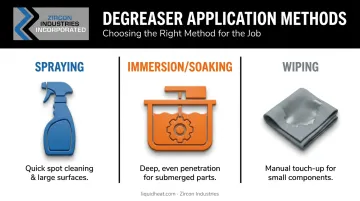
Application methods vary by product and process:
- Spraying: Applies cleaner to large components, machinery, or localized buildup.
- Immersion or soaking: Submerges compatible parts for uniform contact with the solvent.
- Wiping: Controls application on smaller areas, finished surfaces, or maintenance work.
- Vapor or enclosed-system cleaning: Uses purpose-built equipment for production or precision-cleaning processes.
Mining, aggregate, manufacturing, automotive, rail maintenance, equipment service, metal finishing, and other industrial operations use degreasing before inspection, repair, assembly, painting, plating, or coating. The cleaner must remove the target soil without compromising the component or the next process step.
The Cost of Skipping It
Degreasing is functional surface preparation. Grease can hold abrasive dust against moving parts, conceal cracks or leaks during inspection, interfere with fastener work, and prevent coatings or adhesives from bonding to the substrate. Residue from the cleaner can create its own problems if the next step requires a clean, dry surface.
The cleaning method therefore needs a defined endpoint. Maintenance cleaning may only require removal of heavy soil before service, while painting, plating, bonding, or precision assembly may require tighter residue and cleanliness limits. Choosing by brand familiarity or solvent strength alone can lead to recleaning, damaged finishes, excess waste, or an unsuitable surface for the next operation.
Types of Solvent Degreasers
The three groups below differ in solvency, evaporation rate, flash point, residue, substrate compatibility, worker exposure controls, and regulatory status. Those properties vary within each group, so the current label, SDS, and technical data for the exact product control the final decision.
Chlorinated Solvent Degreasers
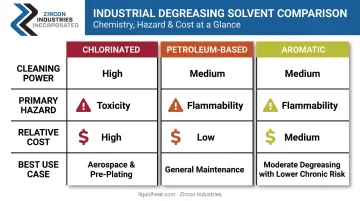
Chlorinated solvents include trichloroethylene (TCE), perchloroethylene (PCE), and methylene chloride. They have been used in cold cleaning, vapor degreasing, and precision-cleaning systems because many formulations provide strong oil and grease solvency, rapid drying, and low flammability.
Typical use profile:
- Purpose-built vapor or enclosed degreasing equipment
- Precision cleaning where the approved process requires low residue
- Specialized industrial applications operating under chemical-specific controls
The regulatory picture has changed substantially. EPA's current TCE risk-management rule prohibits most uses and phases out a limited number of continuing uses over longer timeframes with workplace protections. EPA's PCE rule prohibits or phases out many uses while allowing certain industrial uses, including vapor degreasing, to continue under specified workplace controls. Facilities using either chemical need to confirm the rule, use, deadline, and protection program that apply to their operation.
Compatibility also depends on the stabilized formulation, substrate, temperature, and equipment. Aluminum, magnesium, plastics, elastomers, coatings, and mixed-metal assemblies require confirmation against the manufacturer's technical data and the applicable process specification.
Spent-solvent classification is use- and composition-specific. Under 40 CFR 261.31, certain spent halogenated solvents used in degreasing are listed as F001 when the regulatory conditions are met. Other listings or hazardous-waste characteristics may also apply, so the generator must make and document the waste determination.
Petroleum-Based (Hydrocarbon) Solvent Degreasers
Aliphatic petroleum solvents include mineral spirits, Stoddard solvent, kerosene, naphtha, and related hydrocarbon blends. They dissolve lubricating oils, grease, wax, and some tar-like soils and are common in maintenance cleaning, parts washers, spray applications, and controlled wipe-down work.
Best suited for:
- Routine cleaning of compatible metal parts and equipment
- Parts-washer or soak processes designed for the selected solvent
- Maintenance work that benefits from a slower evaporation rate and working time
The category covers a wide range of flash points and evaporation rates. NIOSH lists a flash point of 102 to 110 degrees F for Stoddard solvent, while lighter petroleum naphthas may ignite at lower temperatures. The exact SDS determines whether a product is classified as flammable or combustible and which storage, bonding, grounding, ventilation, and ignition controls apply.
Fire is not the only consideration. Hydrocarbon vapors can affect the central nervous system, repeated skin contact can cause dermatitis, and aspiration is a serious ingestion hazard for some products. Odor, VOC content, residue, drying time, and compatibility with rubber, plastics, paint, and seals must also be checked for the specific cleaner.
Aromatic Solvent Degreasers
Aromatic solvents such as toluene and xylene are hydrocarbons with strong solvency for many oils, resins, adhesives, coatings, and heavy organic residues. They are often more aggressive toward paints, plastics, elastomers, and adhesives than aliphatic mineral spirits, which makes compatibility testing especially important.
Best suited for:
- Approved processes involving resins, adhesive residue, or difficult organic soil
- Controlled industrial cleaning where strong solvency is required
- Applications with established ventilation, exposure monitoring, and fire controls
Aromatic solvents should not be treated as a low-hazard middle option. NIOSH lists a 40 degrees F flash point and a 100 ppm recommended time-weighted exposure limit for toluene. For o-xylene, NIOSH lists a 90 degrees F flash point and a 100 ppm recommended time-weighted exposure limit. Both can enter the body through inhalation and skin contact and can affect the central nervous system.
Waste codes again depend on how the solvent was used and the composition before use. Section 261.31 lists xylene in F003 and toluene in F005 under defined spent-solvent conditions. A facility should classify the actual waste stream instead of assigning a code from the product name alone.
How to Choose the Right Type of Solvent Degreaser
The right degreaser is the product that removes the defined contaminant, leaves the required surface condition, and fits the facility's process and controls.
Key Factors to Weigh
- Type of contaminant: Lubricating grease, hydraulic oil, asphalt, tar, adhesive residue, wax, and carbon deposits do not respond identically. Rust is metal oxide and generally requires a rust remover, conversion treatment, abrasion, or another process rather than a grease solvent alone.
- Surface and component compatibility: Check bare and coated metals, plastics, elastomers, seals, gaskets, wiring, labels, and adhesives. Test a small area or representative part when compatibility is not already established.
- Cleaning process and finish requirement: Decide whether the job requires spray, wipe, soak, parts-washer, or vapor cleaning and whether the surface must be rinsed, residue-free, dry quickly, or ready for coating.
- Worker and fire controls: Compare flash point, vapor pressure, exposure limits, ventilation needs, compatible PPE, ignition control, and the facility's ability to operate the process safely.
- Regulatory, waste, and supply requirements: Review current chemical restrictions, VOC rules, hazardous-waste determinations, package size, storage capacity, freight, and supply continuity.
Mistakes That Cost Time and Money
- Choosing the most aggressive solvent without checking whether a less aggressive cleaner meets the cleanliness requirement
- Using a degreaser as a rust remover or paint stripper when the job requires different chemistry
- Checking the base metal but overlooking paint, plastics, seals, gaskets, labels, or adhesives
- Ignoring rinse requirements or cleaner residue before coating, bonding, inspection, or assembly
- Applying a new product throughout the plant before confirming results on a representative surface or part
Safety Best Practices and Safer Degreaser Alternatives
Solvent safety starts with the process, not with PPE alone. OSHA's hierarchy of controls prioritizes elimination or substitution, followed by engineering and work-practice controls, with PPE used as an additional layer.
PPE and handling:
- Use the glove material, eye or face protection, protective clothing, and respiratory controls specified for the product and exposure level.
- Provide the ventilation or enclosed equipment required for the solvent and application method.
- Train workers on dispensing, spill response, first aid, and the hazards identified in the current SDS.
- Keep food, drink, and smoking out of chemical handling and cleaning areas.
Storage and disposal:
- Store containers closed and segregated from heat, ignition sources, oxidizers, and other incompatible materials as directed by the SDS.
- Use bonding, grounding, approved electrical equipment, and fire protection where the product or process requires them.
- Prevent releases to drains and manage used cleaner, absorbents, sludge, and contaminated rinse water through the facility's waste-determination process.
- Use a qualified waste vendor when the waste stream is regulated or the facility procedure requires it.
Electrical cleaning is a separate selection problem. Zircon's ZL98 and Z99 products are purpose-formulated for electrical cleaning and should be matched to dielectric, plastic-compatibility, flammability, evaporation, and equipment-procedure requirements.
Where Newer Formulations Fit In
Zircon Industries' Z99 Safety Solvent Degreaser is a synthetic solvent rather than a chlorinated or mineral-spirit cleaner. It is non-flammable, non-conductive, and self-evaporating — with no flash point, no petroleum distillates, no ozone-depleting chemicals, and a Level-1 storage rating.
Z99 is dielectric to 36,000 volts under ASTM D-877, which means it can be used around energized electrical components within the limits of the product label, facility electrical-safety procedures, and applicable lockout/tagout requirements. It dries quickly without leaving residue, making it suited to applications where surface cleanliness after drying is a process requirement.
- No flash point — non-flammable formulation
- 36,000-volt dielectric strength under ASTM D-877
- No petroleum distillates, no ozone-depleting chemicals
- Level-1 storage rating
- Self-evaporating; no residue after drying
Z99 is available in 5-gallon pails, 55-gallon drums, and cases of 12 20-ounce aerosol cans. Supported applications include engine parts, motors, windings, bearings, gears, relays, generators, starters, production machinery, electrical assemblies, meters, and printing equipment. For current pricing, freight information, packaging availability, and application guidance, contact Zircon Industries at staff@liquidheat.com.
Conclusion
Chlorinated, aliphatic petroleum, and aromatic solvent degreasers have different strengths, hazards, and process requirements. Aromatics are a hydrocarbon subgroup, chlorinated solvents now face significant use restrictions, and no family can be ranked accurately without considering the exact formulation and job.
Start with the contaminant and required surface condition, then check compatibility, flash point, exposure controls, residue, cleaning method, waste classification, and current regulations. For electrical and industrial cleaning where a non-flammable, non-conductive, residue-free formula is required, Z99 Safety Solvent Degreaser provides a modern solvent option without petroleum distillates or ozone-depleting chemicals.
Frequently Asked Questions
What is a solvent-based degreaser?
A solvent-based degreaser uses an organic solvent or solvent blend to dissolve grease, oil, wax, tar, or similar water-insoluble soil. Products may be nonaqueous, emulsifiable, or formulated with surfactants so the dissolved soil can be rinsed away.
What is a solvent degreaser used for?
Solvent degreasers clean compatible parts, machinery, tools, and industrial surfaces. They are also used to prepare surfaces for inspection, repair, painting, plating, bonding, assembly, or coating when the process requires removal of oil and grease.
What is a good solvent degreaser?
A good solvent degreaser removes the target contaminant without damaging the substrate or disrupting the next process step. Z99 Safety Solvent Degreaser is suited to supported applications involving electrical and industrial equipment where a non-flammable, non-conductive, self-evaporating, residue-free formula without petroleum distillates is required.
Which type of solvent degreaser is safest to use?
The safest practical choice is the cleaner that meets the job's performance requirement with the lowest workable hazard and effective controls. Compare the exact product's SDS, flash point, exposure limits, substrate compatibility, ventilation, PPE, waste requirements, and application method. A chemical family name alone is not enough to determine safety.
Can solvent degreasers damage metal surfaces?
Yes. Damage depends on the solvent, additives, metal, finish, concentration, temperature, and contact time. Plastics, paints, elastomers, seals, labels, and adhesives may be more sensitive than the base metal. Follow the product's compatibility guidance and test an inconspicuous area or representative part when needed.
How should used solvent degreasers be disposed of?
The facility must determine whether the used cleaner is a listed or characteristic hazardous waste and account for the contaminants introduced during cleaning. Keep it out of drains, label and store it under the applicable facility procedure, and send it through an authorized waste-management channel when required.