Introduction
Rock salt is cheap, widely available, and works — until it doesn't. The real cost shows up later: in cracked concrete, dead grass, and corroded infrastructure.
According to the EPA, road salt contributes to $5 billion in annual repairs across U.S. roads, bridges, and vehicles. It penetrates concrete, accelerates freeze-thaw cracking, kills lawn borders, and washes into local waterways where it harms aquatic life. It also stops working reliably below 15°F — right when temperatures drop hardest.
Seven alternatives have proven more effective for specific conditions — some act faster, some work at lower temperatures, and some protect surfaces and pets that salt would damage. This guide breaks down each option so you can match the right product to your situation.
Key Takeaways
- Rock salt damages concrete, pollutes waterways, and fails below 15°F
- Calcium chloride is the strongest chemical deicer, effective to -25°F
- CMA offers one of the strongest eco-friendly profiles: chloride-free, low-corrosion, and better suited near plants, pets, and sensitive surfaces
- Urea is often gentler than chloride-based deicers, but it still needs careful application around pets and waterways
- Sand provides instant traction without melting ice — best used where grip matters more than ice removal
- No single product is ideal for every situation; match your choice to pavement temperature, surface type, and proximity to pets, plants, and runoff areas
Why Rock Salt Does More Harm Than Good
Rock salt (sodium chloride) works by dissolving into brine that lowers the freezing point of water. The problem is what happens after.
Concrete, Steel, and Costly Repairs
Sodium chloride can penetrate porous concrete and brick, worsening freeze-thaw cycles that lead to surface scaling and cracking. Over time, chloride exposure can also corrode reinforcing steel — a particular concern for concrete driveways with rebar or wire mesh. Minnesota Stormwater Manual data puts the infrastructure cost of a single ton of salt at $800 to $3,300, including $1,460 per ton for bridge corrosion alone.

Runoff, Wildlife, and Your Dog
Salt runoff doesn't stay on your driveway. USGS research found that chloride levels increased in 84% of urban streams studied, with numerous streams reaching levels that can be toxic to aquatic life. What seems like a modest driveway application adds up fast when thousands of properties drain into the same waterways.
The damage isn't limited to waterways. For pets that walk across treated surfaces — and then lick their paws — the risks are immediate:
- Ingestion toxicity: Veterinary references list the acute oral lethal dose of salt in dogs at approximately 4 g/kg, with clinical signs possible at lower doses
- Paw irritation: Prolonged contact with salt crystals can irritate paw pads, causing dryness, cracking, and discomfort
It Stops Working When You Need It Most
Rock salt stops being reliably effective when pavement temperatures fall below 15°F — a threshold FHWA guidance flags as the point where sodium chloride action becomes too slow for many snow and ice control operations. In severe cold snaps, you're spreading a product that works poorly while still carrying the same runoff, corrosion, and surface-damage risks.
7 Best Alternatives to Salt for Deicing Driveways
These seven alternatives span a full spectrum: chemical deicers for serious cold, gentler compounds for pet-heavy households, abrasives for instant traction, and natural options for eco-conscious homeowners.
1. Calcium Chloride
Calcium chloride is the most effective chemical deicer available to consumers. It absorbs moisture from the air and releases heat as it dissolves — an exothermic reaction — starting to melt ice almost on contact, even in extreme cold.
| Factor | Details |
|---|---|
| Effective Temperature | Down to -25°F (MPCA practical limit: -20°F) |
| Pet & Plant Safety | Use with caution — heat can irritate paws; harmful to vegetation if over-applied |
| Surface Damage Risk | Low-to-moderate; not recommended on concrete less than one year old |
| Best Use | Extreme cold; driveways and walkways where speed matters most |
One important caveat: calcium chloride keeps surfaces wet longer than rock salt, which can increase corrosion risk on metal fixtures and edges. Apply sparingly and sweep up residue after ice clears.
2. Magnesium Chloride
Magnesium chloride works similarly to calcium chloride but at lower heat output. It's widely marketed as a gentler option. While it does have a lower practical melting temperature than rock salt — around -10°F per MPCA data — it's still a chloride compound with real limitations.
| Factor | Details |
|---|---|
| Effective Temperature | Practical limit around -10°F; eutectic at -28°F |
| Pet & Plant Safety | Often marketed as gentler than rock salt, but still a chloride compound; use cautiously around paws and landscaping |
| Surface Damage Risk | MPCA notes that magnesium chloride can contribute to concrete degradation by replacing calcium in cement paste |
| Best Use | Moderate winter conditions; asphalt or older, well-maintained concrete where chloride use is acceptable |
It's a reasonable middle-ground option, but don't assume "pet-friendly" labeling tells the whole story.
3. Calcium Magnesium Acetate (CMA)
CMA is made from dolomitic limestone and acetic acid, the same acid found in vinegar. Unlike chloride deicers, it does not rely on chloride-based brine chemistry. Instead, it disrupts ice bonding to pavement, making mechanical removal easier with far less corrosion risk than traditional chloride products.
| Factor | Details |
|---|---|
| Effective Temperature | Works best above 20°F; loses effectiveness in hard freezes |
| Pet & Plant Safety | Biodegradable and generally lower-risk near plants, animals, and waterways when applied correctly |
| Surface Damage Risk | Low-corrosion; generally much less corrosive to steel and concrete than chloride-based deicers |
| Best Use | Eco-sensitive areas; near gardens, storm drains, or pet areas; use as a preventive treatment before ice forms |
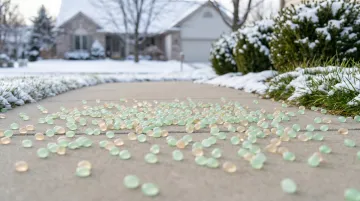
CMA costs more than chloride options. For driveways near landscaping, apply it before ice forms rather than after — it prevents bonding more effectively than it breaks it.
4. Urea (Carbonyl Diamide)
Urea is a nitrogen-based compound that lowers ice's melting point without chloride chemistry. The same ingredient is used in fertilizers, and it has been used on airport and airfield pavements. Its main drawback is runoff: in high-volume applications, excess nitrogen can contribute to water-quality problems.
| Factor | Details |
|---|---|
| Effective Temperature | Practical working temperature around 25°F; eutectic at ~12°F |
| Pet & Plant Safety | Often gentler than chloride-based deicers, but ingestion can still cause gastrointestinal irritation; avoid over-application |
| Surface Damage Risk | Low corrosion risk; usually gentler on concrete than chloride-based products when applied correctly |
| Best Use | Homes with dogs and cats; mild-to-moderate winters; areas near lawns |
Apply at the manufacturer's recommended rate. A thin, even layer is enough — excess urea doesn't improve melting and increases the chance of nitrogen reaching nearby waterways.
5. Sand and Abrasives
Sand does not melt ice. That's worth stating clearly. What it does is provide immediate friction on a frozen surface, which can be the difference between a safe walkway and a liability.
| Factor | Details |
|---|---|
| Effective Temperature | N/A — traction only, no melting at any temperature |
| Pet & Plant Safety | Completely safe; no chemical runoff |
| Surface Damage Risk | None; can be swept up and reused |
| Best Use | Steep driveways, steps, and high-traffic areas; pair with a deicer for both traction and ice removal |
Coarse sand and fine gravel both work for traction. Non-clumping kitty litter can help in a pinch, but it often turns messy when wet. The University of Minnesota Extension notes that sand can block drainage systems if overused, so sweep it up once conditions improve.
6. Rubbing Alcohol (Isopropyl Alcohol) Spray
Pure isopropyl alcohol freezes at around -128°F, making it far more cold-resistant than water. Mixed with water in a 1:2 ratio, it creates an effective spray for thin ice on targeted surfaces, particularly car windshields and doorstep areas.
| Factor | Details |
|---|---|
| Effective Temperature | Best for thin ice; effective in moderate cold; not practical for large surfaces |
| Pet & Plant Safety | Avoid direct contact with paws, plants, and treated surfaces; use only in small targeted areas |
| Surface Damage Risk | Low; safe on most paved surfaces and vehicle glass |
| Best Use | Car windshields; doorsteps; small-area quick fixes |
AAA recommends the 1-part alcohol to 2-parts water formula for windshields. This isn't a driveway solution — it won't scale — but it's an inexpensive, accessible fix for targeted spots.
7. Sugar Beet Juice and Natural Organic Options
Sugar beet juice and beet-derived additives are usually blended with salt brine to improve adhesion, lower application rates, and help the brine perform better in cold conditions. The catch: most real-world beet products are not chloride-free when used this way — they reduce salt use rather than eliminate it entirely.
| Factor | Details |
|---|---|
| Effective Temperature | Moderate; most effective when blended with salt brine |
| Pet & Plant Safety | Generally lower-risk than straight salt when used properly, but blended products may still contain chlorides |
| Surface Damage Risk | Lower corrosion risk than straight salt brine; may cause temporary staining on light concrete |
| Best Use | Eco-conscious homeowners; areas near pets and gardens; municipalities reducing road salt use |
Several municipalities and state DOTs use beet-derived additives to improve brine adhesion and reduce total salt application rates. Treat beet juice as a salt-reduction tool, not a standalone replacement for engineered deicing chemistry.
Wood ash and coffee grounds are sometimes suggested as natural alternatives. Neither melts ice in any meaningful way — use them only for added traction, and expect to sweep up the residue.
Quick Comparison: Salt Alternatives at a Glance
| Alternative | Effective Temp | Pet-Safe? | Plant-Safe? | Surface Damage Risk | Cost Level | Best Use Case |
|---|---|---|---|---|---|---|
| Calcium Chloride | To -20°F practical; often sold as effective to -25°F | Caution | Caution | Low-medium | Moderate | Extreme cold; fast action needed |
| Magnesium Chloride | To -10°F practical | Caution | Caution | Medium | Moderate | Moderate cold; asphalt or older concrete |
| CMA | Best above 20°F | Lower-risk | Lower-risk | Very low | High | Eco-sensitive areas; preventive use |
| Urea | Around 25°F practical | Use caution | Mostly | Very low | Moderate | Pet-sensitive areas in mild cold |
| Sand/Abrasives | Any temp | Yes | Yes | None | Low | Immediate traction; no melting |
| Isopropyl Alcohol | Moderate cold | Caution | Caution | Low | Low | Windshields; doorsteps; thin ice |
| Beet Juice/Organic | Moderate | Use caution | Use caution | Low | Variable | Salt-reduction blends; anti-icing support |
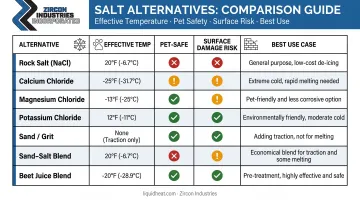
Your best pick depends on a few key factors:
- Temperature range — how cold it gets at your location
- Surface type — concrete, asphalt, pavers, or wood
- Pet and plant exposure — whether animals or landscaping are at risk
- Goal — immediate traction versus chemical melting of ice
How to Choose the Right Salt Alternative
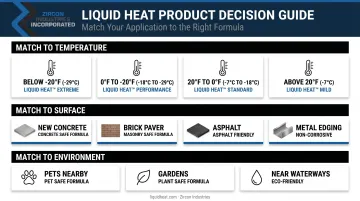
Match Your Deicer to the Temperature
- Below -10°F: Calcium chloride is usually the most reliable consumer chemical option
- 0°F to 20°F: Magnesium chloride, calcium chloride, or a properly specified blend
- Above 20°F: CMA, urea, or organic blends can work well, especially as preventive treatments
- Immediate traction regardless of temperature: Sand or fine gravel
Match Your Deicer to the Surface
- New concrete (under 1 year): Avoid chloride compounds — use CMA, urea, sand, or fine gravel
- Brick and pavers: CMA or abrasives first; use chloride products cautiously
- Asphalt: Most options are compatible when applied at the recommended rate
- Metal edging or fixtures: Avoid chloride-heavy products; use CMA or abrasives
Match Your Deicer to Your Environment
- Dogs and cats nearby: CMA, urea, sand, or fine gravel first; avoid heavy chloride use and rinse paws after exposure
- Gardens and lawn edges: CMA or carefully applied organic blends; avoid overusing chlorides
- Near storm drains or waterways: Use the lowest effective amount, sweep up residue, and prioritize non-chloride or traction-only options where practical
Application Best Practices
- Shovel first — deicers work faster and more efficiently on cleared surfaces
- Apply sparingly — more product doesn't mean faster melting; it means more runoff
- Target problem areas — steps, slopes, and entry points, not entire driveways
- Sweep up residue — once ice clears, remove excess product to minimize runoff and surface exposure
- Store properly — keep deicers in sealed, waterproof containers between uses
These tips apply whether you're treating a single walkway or managing a commercial lot. For road maintenance contractors, municipal operators, and industrial sites handling large surface areas, liquid deicer formulations often deliver better coverage control and application efficiency than bagged product. Zircon Industries has spent over 55 years developing freeze-control formulations for demanding winter operations, including conveyor systems, grounds, walkways, and industrial surfaces where downtime is expensive.
Conclusion
Rock salt earns its popularity — it's cheap and it works in moderate cold. But the real costs show up later: cracked concrete, dead grass borders, irritated pet paws, and salt-saturated drainage ditches. Every situation on the list above has a better-suited option.
For most residential driveways, calcium chloride handles serious cold, CMA or urea handles pet and plant concerns, and sand bridges the gap when you need instant traction. Several of these alternatives outperform rock salt on corrosion, environmental impact, and effective temperature range — the main tradeoff is cost per bag.
Bagged consumer products work for a driveway. They don't scale to a quarry access road, a rail yard, a conveyor system, or a municipal facility. For contractors, townships, and heavy industry needing high-volume freeze control, Zircon Industries offers purpose-built liquid solutions: Liquid Heat for conveyor belt deicing and ice prevention, and Ice Breaker Green for grounds, walkways, and surface deicing. Contact our team to find the right chemistry for your operation.
Frequently Asked Questions
What is the best non-salt deicer?
If by “non-salt” you mean “not rock salt,” calcium chloride is the strongest alternative for extreme cold, with practical performance around -20°F and many products marketed to -25°F. If you mean chloride-free, Calcium Magnesium Acetate (CMA) is the better fit for eco-sensitive areas because it is low-corrosion and better suited near plants, pets, and sensitive surfaces. Your best choice depends on pavement temperature, surface type, and what is nearby.
What melts ice the fastest without using salt?
If you mean “without rock salt,” calcium chloride is usually the fastest option on large surfaces because it releases heat as it dissolves. If you mean no chloride salt at all, a 1:2 isopropyl alcohol-to-water spray can work quickly on windshields or small patches of thin ice, but it is not practical for full driveways.
Is calcium chloride better than rock salt for driveways?
Yes, in many cases. Calcium chloride works at much lower temperatures than rock salt and acts faster because it releases heat as it dissolves. That said, it is still a chloride deicer, so it requires caution around pets, plants, metal fixtures, and concrete poured within the past year.
Are salt alternatives safe for pets and plants?
Urea and CMA are generally gentler options for pets and vegetation than chloride-heavy deicers, but no ice melt should be treated as completely risk-free. Magnesium chloride is often marketed as gentler than rock salt, but it is still a chloride compound, so avoid heavy use near plants. Sand has no chemical melting action, and beet-derived products often reduce salt use rather than eliminate it entirely.
What is the most environmentally friendly deicer?
CMA (Calcium Magnesium Acetate). It's chloride-free, biodegradable, and one of the least corrosive deicers available. Applied before ice forms, it works as a preventive treatment and reduces the total quantity needed.
Can I use sand instead of salt on an icy driveway?
Sand provides immediate traction but does not melt ice. It avoids chemical deicing runoff, but excess sand can still wash into drains and waterways, so sweep it up once conditions improve. For best results, use sand where traction matters most and pair it with a properly chosen deicer when ice removal is also needed.