The numbers justify a closer look. FRA/TTCI testing on locomotive-based TOR friction control documented lateral curving-force reductions of 20–30% when the tested system was properly operated and maintained, while Canadian Pacific's network monitoring indicated average fuel savings exceeding 5% after TOR friction management was added to its broader program. Those aren't incidental gains — they show why friction management deserves to be treated as an engineered maintenance program rather than a routine supply order.
This guide covers the fundamentals MOW teams need: what top of rail (TOR) lubrication actually is, how friction modifiers differ from conventional lubricants, how the physics and application systems work, what operational benefits are documented, and how to select the right product regime for specific conditions.
Key Takeaways
- TOR friction modifiers target the wheel tread/rail running surface, a separate contact zone from gauge face grease with a distinct performance goal
- TOR friction management targets controlled intermediate friction, not the lowest possible friction; one FRA/TTCI program targeted 0.30–0.35
- Documented programs have reported 20–30% lateral force reductions, measurable fuel savings, and substantial curve-noise reductions, but results depend on the product, application rate, track geometry, traffic, and maintenance program
- Wayside and onboard systems serve different operational needs; neither is universally superior
- Effective programs combine product types by contact zone rather than applying one product everywhere
What Is Top of Rail Lubrication?
"Top of rail" refers specifically to the running surface of the rail head—the flat area where the wheel tread contacts the rail during normal travel. This is distinct from the gauge face, the inner side of the rail head where the wheel flange rides around curves.
TOR treatment applies friction-modifying materials directly to this running surface—a separate discipline from gauge face greasing, which has existed for decades. FRA and AAR research into TOR friction control was actively underway by the late 1990s and accelerated into the early 2000s as the industry recognized that the wheel-tread/rail-top interface needed its own targeted approach.
Why "Friction Modification" Rather Than "Lubrication"
Traditional lubrication aims to minimize friction at a contact point. TOR treatment has a different goal: delivering an optimized, intermediate friction level rather than eliminating friction entirely.
The difference comes down to the performance goal:
- Lubrication reduces friction and wear between surfaces that are meant to slide against each other
- Friction modification targets a controlled intermediate friction range where traction and braking must remain reliable
A train still needs dependable adhesion for acceleration and braking. TOR products are engineered to control friction at the wheel-tread/rail interface, not minimize it indiscriminately, which is why their formulation and application differ significantly from conventional lubricants.
TOR Friction Modifiers vs. Traditional Rail Lubricants
The Friction Target
Dry-rail friction varies widely with contamination, weather, rail condition, and measurement method. In one FRA/TTCI locomotive-based program, the friction-control product reduced dry-rail friction from 0.5 or higher into a target range of 0.30–0.35.
That range should not be treated as a universal specification for every railroad, product, or operating condition. The key principle is controlled intermediate friction: low enough to reduce excessive curving forces, wear, and noise while maintaining the adhesion required for traction and braking.
Why Grease on the Top of Rail Is Counterproductive
Conventional gauge-face lubricant should not be treated as interchangeable with a purpose-designed TOR friction modifier. In an FRA top-of-rail lubrication test, the particular lubricant and application regime being evaluated built up over repeated passes and produced locomotive wheel slip during dynamic braking and, at times, traction.
The lesson is not that every TOR product creates the same result. It is that product chemistry, dosage, application location, and carry-down must be engineered and verified rather than assuming that any low-friction lubricant belongs on the running surface.
The Four Rail Lubrication Categories
RS Clare's industry taxonomy identifies four distinct categories, each targeting a different contact zone:
| Category | Contact Zone | Performance Goal |
|---|---|---|
| Curve rail lubricant | Gauge face / wheel flange | Minimize friction to reduce flange wear |
| Fishplate lubricant | Rail joint bars | Prevent fretting corrosion at joints |
| Switch plate lubricant | Switch plate sliding surface | Reduce plate wear and stock rail movement |
| TOR friction control material | Rail running surface / wheel tread | Optimize friction at 0.3–0.4 CoF |
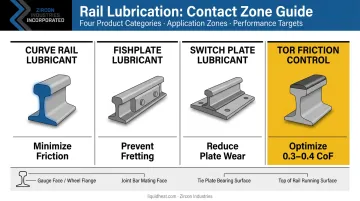
Each category uses chemistry matched to its contact zone. Gauge-face grease should not be deliberately applied as a substitute for a purpose-designed TOR friction modifier on the running surface. Uncontrolled lubricant migration can reduce adhesion, contribute to wheel slip, and compromise traction or braking performance.
How Top of Rail Friction Management Works
The Contact Patch Problem
A loaded freight wheel contacts the rail through an extremely small, highly stressed contact patch. The exact patch size and pressure vary with wheel load, wheel and rail profiles, material properties, and track conditions. Within that concentrated zone, repeated rolling and tangential forces drive wear and can contribute to rolling contact fatigue (RCF): surface and near-surface cracks that may develop into more serious defects if left unmanaged.
Stick-Slip and Curve Squeal
When a train navigates a curve, the two wheels on a fixed axle must accommodate different travel paths while remaining mechanically connected. Wheelset steering limits, contact geometry, and creepage can create stick-slip behavior at the wheel-rail interface. That rapid adhesion-slip cycle is a major source of curve squeal and contributes to accelerated wear on wheel treads and rail heads.
TOR friction modifiers interrupt this cycle. Research by Eadie and Santoro describes the mechanism as converting "negative friction" behavior, where friction drops as slip speed increases and makes oscillations self-sustaining, into "positive friction" behavior that damps the oscillations before squeal develops.
Carry-Down: One Application, Extended Coverage
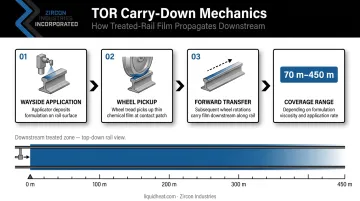
TOR modifier applied at a wayside point can transfer from the rail to the wheel tread and then back onto the rail farther along the route. This carry-down effect extends treatment beyond the applicator itself.
The actual distance varies significantly with product formulation, dosage, axle passes, speed, weather, rail condition, and traffic. Applicator spacing should therefore be based on measured friction performance and system-specific guidance rather than assuming a fixed carry distance.
Product Formulation and Verification
Many TOR friction modifiers are water-based formulations that dry or condition into a thin film on the rail surface. Their defining purpose is controlled friction behavior at the wheel-tread/rail interface, not simply leaving a dry film. Product approval, application rate, carry-down, adhesion performance, and compatibility with the railroad's friction-management program all matter.
Zircon Industries' Dry Graphite Lubricant serves a different application zone. It is an AAR Certified M971-93 Lubricant for railroad switches, couplings, autotrack chains and tracks, and other metal-to-metal wear surfaces. It should not be positioned as a TOR friction modifier or as a product for routine application to the rail running surface.
Verification confirms the program is actually delivering target friction levels, not relying on guesswork. Common methods include:
- Hand-held tribometers for spot checks at individual treated locations
- High-speed tribometer runs across treated sections in managed programs
- Periodic retesting after rain or traffic events to confirm film durability
Key Benefits of Top of Rail Friction Management
Fuel and Energy Savings
Controlling excessive friction and curving forces can reduce train resistance and the tractive effort required to move a consist through suitable territory. Canadian Pacific's total friction management program, documented in NRC research, projected fuel savings of 1.4–3.3% across eight mainline subdivisions and later reported monitored average savings exceeding 5%.
These figures are site-dependent. Curve density, grades, traffic mix, vehicle design, braking zones, product coverage, and applicator performance all affect the result, so savings from one network should not be presented as a guaranteed outcome for another.
Rail and Wheel Life Extension
Canadian Pacific's business case projected roughly 50% lower curve rail replacement under its combined gauge-face and TOR friction-management strategy. The program also estimated wheel-replacement savings for high-flange and shelled-tread conditions.
These figures were part of a network-specific business case and should be presented as projected or estimated benefits, not guaranteed service-life improvements for every railroad.
One caution comes from MxV Rail's 2026 FAST testing. Researchers observed RCF deterioration at and near TOR friction-modifier applicator bars, but the analysis suggested that the RCF initiated first and was later exacerbated by the friction modifier product. The study also noted that FAST's applicators were spaced more closely than typical revenue-service installations.
MxV Rail identified grinding as potentially beneficial and suggested that fine-tuning output rates may reduce interaction between TOR friction modifier and existing RCF. The takeaway is not that TOR friction modifier inherently causes RCF, but that friction management must be coordinated with rail condition, grinding, applicator spacing, and output calibration.
Noise Reduction
Published field studies have reported substantial reductions in curve squeal after correctly applied TOR friction modification. Results vary widely with curve geometry, vehicle type, baseline rail condition, product formulation, application rate, and measurement location.
For urban and commuter operators facing recurring curve-noise complaints, TOR friction management can be evaluated as one part of a broader noise-control strategy rather than assuming a fixed decibel reduction at every location.
Reduced Lateral Forces and Track Geometry Benefits
Field testing and CP program data show consistent lateral force reductions across curve types:
- FRA/TTCI: 20–30% average lateral curving-force reduction in sharp curves
- CP high rail: up to 50% reduction; low rail: up to 57% reduction
- CP gauge change: 49–52% reduction in progressive gauge change in curves under 7 degrees
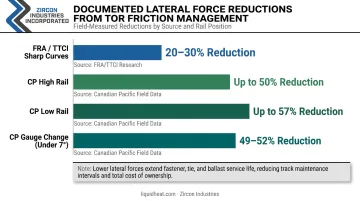
Lower lateral forces can reduce loading on fasteners, ties, and ballast and may slow some forms of track-geometry degradation. The actual maintenance benefit depends on track structure, traffic, curvature, drainage, and the consistency of the friction-management program.
Switch Blade Protection
Applying TOR friction modifier ahead of selected switch approaches has been evaluated as a way to alter wheel-rail forces before the switch point. An L.B. Foster case study at Cemetery Junction reported improvements in blade service intervals after TOR treatment was positioned ahead of the approach.
This is a supplier-reported, site-specific application rather than a general rule for switch maintenance. Any similar program should be evaluated against the railroad's track geometry, approved friction-management procedures, and switch-specific failure mode before implementation.
Wayside vs. Onboard Application Systems
Wayside Systems
Trackside applicators are installed at fixed locations—typically before known problem curves or at tangent track where wheel pickup is reliable. Modern units use wheel-sensing technology to trigger metered dispensing only when a train is present, minimizing waste and environmental exposure. Systems are available in AC-powered or solar/DC configurations and typically include remote sensors for product level, rainfall, temperature, and battery status.
Best suited for:
- Fixed curves with documented wear or noise problems
- Yards and known high-wear locations
- Operations where trackside access for maintenance is feasible
Onboard Systems
Vehicle-mounted systems deliver friction modifier from the train itself, with the exact application point depending on system design. Modern systems may use location and vehicle-speed inputs to control where and how much product is applied, and some can inhibit application during operating conditions such as braking or sanding.
Best suited for:
- Distributed route coverage across large territories
- Short lines or regional railroads where fixed wayside installation across an entire network is impractical
- Operations where depot-based filling is easier than trackside access windows
Choosing Between Them
The right choice depends on network geography, traffic density, access, refill logistics, maintenance capacity, and whether the problem is concentrated or distributed. Wayside systems suit fixed locations where targeted treatment can be maintained reliably. Onboard systems can support broader route coverage where installing and servicing multiple fixed applicators would be impractical.
Many operations use a combination rather than treating the decision as strictly either/or.
Key decision factors:
- Choose onboard for distributed territory coverage; choose wayside for precision targeting of known problem zones
- Service onboard systems at the depot; budget for field access windows when maintaining wayside units
- Expect fixed, predictable application points from wayside; onboard adapts dynamically based on GPS and speed inputs
- Factor traffic density into the cost justification, along with curve severity, wear rate, noise exposure, product consumption, maintenance access, and the value of avoided rail or wheel work
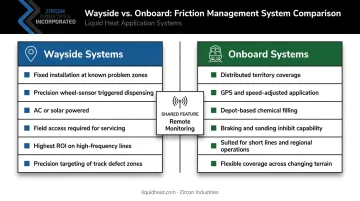
Remote monitoring is available on many modern friction-management systems. Alerts for product levels, application counts, power status, and equipment health can help maintenance teams respond to actual conditions rather than relying only on fixed inspection intervals.
Choosing the Right Lubricant for Your Operation
Product Types to Know
| Product Type | Primary Application | Notes |
|---|---|---|
| Water-based liquid TOR modifier | Rail running surface | Most common; cures to dry film; preserves traction |
| Dry graphite lubricant | Switches, couplings, chains, and metal-to-metal maintenance surfaces | Dry film; stays at the application point; not interchangeable with TOR friction modifier |
| Bio-based / biodegradable rail lubricant | Approved gauge-face or component applications | Evaluate product approval, environmental requirements, application zone, and railroad specifications |
| Switch plate lubricant | Switch plate sliding surface | Reduces plate wear and stock rail movement |
Zircon Industries' Dry Graphite Lubricant is an AAR Certified M971-93 Lubricant designed for railroad switches, couplings, autotrack chains and tracks, and other metal-to-metal wear surfaces. Its quick-dry formula leaves a graphite film that does not run or migrate after application.
It should not be presented as a TOR friction modifier for the wheel-tread/rail running surface. For product selection, application-zone guidance, and available aerosol or bulk formats, contact Zircon Industries before finalizing a lubrication program.
Key Selection Factors
Before selecting any product, evaluate:
- Operating environment: Temperature extremes affect product viscosity and film stability; tunnel and urban environments may have additional requirements
- Traffic mix: Heavy haul freight, passenger, and mixed operations have different friction targets and wear profiles
- Environmental requirements: Review site-specific railroad, state, federal, and local requirements before selecting lubricants near waterways or sensitive areas. Do not assume that a general “biodegradable” or “environmentally acceptable” label automatically makes a product suitable for a specific rail application
- Curve density and grade profile: High curve density amplifies both the problem and the return on investment from a well-managed TOR program
The Multi-Zone Approach
No single product handles every friction challenge in a rail corridor. Effective programs may pair an approved TOR friction modifier on the running surface with appropriate gauge-face lubricant on curves and specialized lubrication for switches and other metal-to-metal maintenance points.
Each contact zone has a different performance goal. A TOR friction modifier should not be used as gauge-face grease, and Zircon Industries' AAR Certified M971-93 Dry Graphite Lubricant should be positioned for switches, couplings, chains, and other approved metal-to-metal wear surfaces — not as a substitute for TOR friction-control material.
Site-specific conditions — track geometry, traffic volume, environmental context, product approvals, and maintenance capacity — all shape the right product mix. Working with a qualified supplier and the railroad's engineering team before finalizing the regime produces better results than selecting one lubricant for every application zone.
Frequently Asked Questions
Which lubricant is used in railway tracks?
Railway tracks use different lubricants depending on the contact zone:
- Gauge face grease — inner rail head, where the wheel flange rides
- TOR friction modifiers — rail running surface, to optimize wheel-tread friction
- Fishplate lubricant — rail joints
- Switch plate lubricants — movable rail elements
Dry graphite formulations and bio-based lubricants serve specific applications within these zones. Zircon Industries' Dry Graphite Lubricant is intended for switches, couplings, autotrack components, and other metal-to-metal wear surfaces — not for routine TOR friction modification.
What is a top of rail friction modifier?
A TOR friction modifier is a specialized material applied to the rail running surface to create controlled intermediate friction at the wheel-tread contact zone. Many products are water-based and leave a thin conditioned film. In one FRA/TTCI program, the tested product moved friction from 0.5 or higher into a target range of 0.30–0.35. The exact target and performance requirements depend on the approved product, railway, equipment, and operating conditions.
What is the ideal friction coefficient for top of rail?
There is no single universal coefficient of friction target for every railroad and TOR product. In one FRA/TTCI program, the tested friction-control product targeted 0.30–0.35. The broader goal is stable intermediate friction that reduces excessive curving forces and wear without sacrificing the adhesion required for traction and braking.
What is the difference between TOR friction modifiers and gauge face lubricants?
Gauge face lubricants (greases) are applied to the inner side of the rail head to minimize friction between the wheel flange and rail gauge corner—primarily reducing flange and gauge face wear on curves. TOR friction modifiers are applied to the top running surface to optimize friction at the wheel-tread contact point, serving a different zone with a different performance target.
How is top of rail lubrication applied?
TOR friction modifiers are commonly delivered by wayside systems or vehicle-mounted systems. Wayside units dispense product at fixed track locations when triggered by passing equipment. Onboard systems apply from the moving vehicle, with the exact application point and control method varying by system design. Wheel-rail transfer then helps distribute the product beyond the initial application point.
Why is friction management important for fuel efficiency?
Controlling excessive wheel-rail friction and curving forces can reduce train resistance and the tractive effort required in suitable operating territory. Canadian Pacific's friction management program reported monitored average fuel savings exceeding 5% after implementation. Results remain network-specific, but even modest percentage improvements can create substantial operating value across high-tonnage routes.