Introduction
Dust on private industrial surfaces can reduce visibility, increase housekeeping demands, accelerate filter loading, and move beyond a facility boundary. Quarries, aggregate plants, trucking yards, lumberyards, rail yards, and material-handling areas therefore need a dust-control program matched to their traffic, surface material, drainage, and operating conditions.
Oil-based dust suppressants are one option. Purpose-formulated oils and emulsions coat or bind fine particles so they are less likely to become airborne. Their performance, handling requirements, and environmental profile depend on the formulation; used motor oil and other waste oils are not acceptable substitutes.
This guide explains how commercial oil-based dust suppressants work, the main formulation categories, their benefits and limitations, and how they compare with chloride, polymer, lignosulfonate, and water-based dust-control programs.
Key Takeaways
- Purpose-formulated oil suppressants coat and bind fine particles instead of drawing moisture from the air.
- Petroleum-based emulsions, refined or synthetic hydrocarbon products, and bio-derived formulations have different application and handling requirements.
- Federal rules prohibit using used oil as a dust suppressant unless EPA approves a qualifying state program; the current federal list of approved states is reserved.
- Surface composition, traffic, climate, drainage, application rate, and facility requirements determine product fit.
- RDS38 is a calcium chloride-based dust-control treatment, not an oil-based suppressant.
How Oil Works as a Dust Suppressant
Commercial oil-based dust suppressants control dust mainly through coating, agglomeration, and binding. The product wets fine soil or aggregate particles and helps hold them within the surface. Some formulations remain flexible, while emulsified asphalt, petroleum resin, or polymer-modified products can form a firmer treated layer as they cure.
This mechanism differs from calcium chloride and magnesium chloride. Chlorides are hygroscopic, which means they attract and retain moisture within the treated material. Oil-based products do not rely on that moisture-attracting mechanism, although surface moisture, temperature, weather, and drainage can still affect application and curing.
Application and Curing
A typical application follows four stages:
- Evaluate and prepare the surface. Check aggregate gradation, fines, drainage, traffic patterns, and the manufacturer's preparation requirements. Grade or lightly condition the surface when specified.
- Apply the approved formulation. Use the dilution, coverage rate, spray equipment, and number of passes listed for the product and site.
- Allow the product to penetrate or the emulsion to break. The required dwell period depends on the chemistry, concentration, weather, and surface condition.
- Restrict traffic until the surface is ready. Follow the manufacturer's cure and reopening guidance to prevent tracking, displacement, or a slick surface.
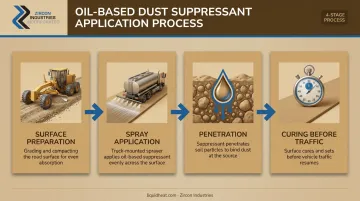
There is no standard cure time for every oil-based suppressant. A light, nonhardening formulation may remain workable, while an asphalt or resin emulsion may need a defined period to set. Product instructions, weather conditions, and a controlled site trial provide the appropriate reopening time.
Oil-based suppressants primarily manage dust at or near the treated surface. A surface that has poor drainage, inadequate load-bearing capacity, or unsuitable aggregate may still require grading, aggregate correction, drainage work, or a separate stabilization program.
Types of Oil Used for Dust Suppression
The phrase "oil used for dust suppression" covers several distinct products. Industrial buyers should distinguish a purpose-formulated dust-control product from waste oil or an improvised blend.
Petroleum-Based Oils and Emulsions
This category includes approved petroleum resin products, asphalt or bitumen emulsions, and other refined petroleum formulations made for dust control. These products can bind fines and reduce rapid evaporation compared with plain water. Asphalt and resin emulsions may produce a firmer surface, which can suit some operating areas but may make later grading or surface reworking more difficult.
Used motor oil is different. Under 40 CFR 279.82, its use as a dust suppressant is prohibited unless EPA approves a qualifying state program. The regulation's current list of approved states is reserved, so facilities should not treat used oil as an available dust-control material.
Storage of a commercial oil product may also fall within EPA's Spill Prevention, Control, and Countermeasure requirements when all applicability conditions are met. These include a non-transportation-related facility, a reasonable potential for an oil discharge to navigable waters or adjoining shorelines, and aggregate aboveground oil-storage capacity greater than 1,320 gallons, subject to the exclusions in EPA's SPCC applicability guidance.
Synthetic and Refined Hydrocarbon Oils
Synthetic and highly refined hydrocarbon suppressants are purpose-formulated to coat and bind dust while providing more consistent composition than waste or minimally processed oils. Products in this group may use isoalkanes, paraffinic components, or proprietary blends, and may be supplied neat or as an emulsion.
Selection should be based on the exact formulation. Review the product label and SDS for application rates, surface compatibility, flash point, storage, runoff controls, and disposal requirements. A trial area can confirm penetration, traction, tracking, and compatibility with the site's aggregate.
Vegetable-Based and Recycled Oils
Bio-derived dust-control products can use vegetable-oil derivatives, glycerin, or other materials produced through food or biodiesel processing. These formulations are distinct from pouring raw or recovered cooking oil onto an industrial surface. Commercial products include controlled chemistry, application instructions, packaging, and safety documentation.
Glycerin DC-100 fits this broader bio-derived category. It is a glycerin-based dust-control product made from a biodiesel byproduct derived from soy oil. Zircon supplies it in 330-gallon totes for self-application at a 50/50 mix with water. It provides a shorter treatment cycle than RDS38 and can suit private gravel and unpaved industrial areas where a self-applied program is preferred.
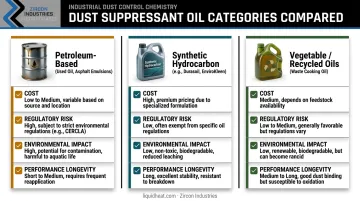
Benefits and Drawbacks of Oil-Based Dust Control
Where Oil Performs Well
- Particle binding without repeated wetting: Purpose-formulated oils and emulsions can hold fines in the surface after free water has evaporated.
- Longer treatment intervals than plain water: A suitable formulation can reduce the frequency of water-truck passes, depending on traffic, weather, and surface condition.
- Fast surface-dust control: Properly applied products can reduce dust soon after penetration or curing.
- Formulation choices: Flexible oils, emulsions, and firmer-binding products allow facilities to match the treatment to the surface and operating pattern.
Where Oil Falls Short
Oil-based products require careful control of storage, application, runoff, and curing. Overapplication can cause tracking or reduced traction, while poor surface preparation can lead to uneven penetration and performance. Products that form a firm crust may also complicate grading or repairs after the treated layer is damaged.
The treatment interval is site-specific. Heavy truck traffic, abrasive aggregate, drainage, heat, rainfall, and maintenance activity all affect how long the treated surface remains effective. Facilities also need to confirm that the selected formulation is acceptable under applicable environmental requirements and their own spill-prevention procedures.
Oil-Based Dust Suppressants vs. Other Options
Oil-based products are one of several dust-control technologies used on private industrial surfaces.
| Category | Mechanism | Strength | Trade-off |
|---|---|---|---|
| Chloride salts, including calcium and magnesium chloride | Attract and retain moisture within the treated material | Residual moisture control for high-traffic gravel and unpaved industrial surfaces | Performance depends on formulation, application rate, surface conditions, and available moisture |
| Synthetic polymers | Form a binding film or crust | Can provide durable control on compatible surfaces or static areas | Rigid films may crack or require repair when traffic or surface movement is heavy |
| Lignosulfonate | Binds fine particles within the surface | Renewable byproduct used in suitable aggregate and climate conditions | Water solubility and wet-weather behavior must be considered |
| Oil-based products | Coat and agglomerate fine particles | Binding action does not depend on atmospheric humidity | Storage, runoff, curing, tracking, and regulatory requirements vary by formulation |
No category is the best choice for every site. EPA's AP-42 background documentation identifies dilution, application rate, time between applications, traffic, vehicle characteristics, and surface characteristics as important variables in chemical dust-control performance.
The selection process should account for:
- Traffic volume, vehicle weight, and operating speed
- Aggregate gradation, fines, clay content, and bearing strength
- Temperature, rainfall, humidity, drainage, and nearby receiving areas
- The need to regrade, repair, or disturb the treated surface
- Site permits, dust-management plans, spill controls, and product documentation
Best Practices for Applying Oil-Based Dust Suppressants
Effective dust control begins with matching the product to the surface and operating conditions.
- Evaluate the material before treatment. Aggregate gradation, fines, clay, drainage, and bearing strength influence penetration, binding, traction, and durability.
- Use only a purpose-formulated product. Confirm that the material is sold and documented for dust control. Do not substitute used motor oil or an improvised waste-oil blend.
- Follow the product's application instructions. Use the stated dilution, coverage rate, equipment, surface preparation, cure time, PPE, and runoff controls.
- Start with a controlled test area when needed. A trial helps confirm application rate, penetration, traction, tracking, and compatibility before full-site treatment.
- Monitor the treated area. Inspect high-turning zones, grades, drainage paths, and heavy-traffic areas so maintenance or reapplication can be scheduled before dust returns.
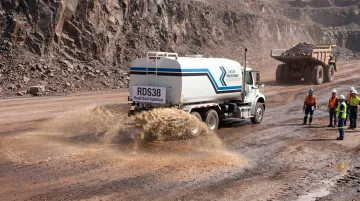
For facilities comparing oil-based products with a longer-cycle, non-oil treatment, RDS38 Road Dust Stabilizer is Zircon Industries' calcium chloride-based option for demanding private industrial surfaces. RDS38 draws and retains moisture in the treated material, and Zircon delivers and applies it as a turnkey service with application included in the product price.
Zircon has manufactured industrial specialty chemicals since 1970. RDS38 treatment intervals are typically 3 to 4 months, depending on site conditions, and moisture helps reactivate the treatment. The turnkey program is designed for high-traffic areas at quarries, aggregate operations, trucking yards, lumberyards, and other industrial facilities.
Zircon's published customer results include:
- Vulcan Materials in Virginia reported that RDS38 allowed the operation to move its water truck to another quarry.
- Lafarge in Pennsylvania reported more than $20,000 in annual savings and the ability to redirect the water-truck driver's time to other work.
Facilities can contact Zircon Industries at staff@liquidheat.com for product selection, site evaluation, application guidance, and current service availability.
Frequently Asked Questions
What oil is used for dust suppression?
Commercial dust-control formulations may use refined petroleum components, petroleum resins, asphalt emulsions, synthetic hydrocarbons, vegetable-oil derivatives, or glycerin-based materials. Use a purpose-formulated product with an SDS and application instructions; used motor oil is prohibited as a dust suppressant under federal rules unless EPA approves a qualifying state program.
What is a good dust suppressant?
A good dust suppressant matches the surface material, traffic, climate, drainage, maintenance plan, and facility requirements. Oil-based binders, calcium chloride treatments, polymers, lignosulfonates, and water additives solve different problems. Zircon Industries can help facilities compare RDS38, Glycerin DC-100, ZHP Water Wetter, and Latex 100 for the intended industrial application.
Can used motor oil be used for dust control?
No approved state exception is currently listed under 40 CFR 279.82. Facilities should use a commercial dust-control product that is permitted for the intended application and supported by current product documentation.
Is oil-based dust suppression harmful to the environment?
Environmental performance depends on the formulation, application rate, site drainage, and handling practices. Product selection should include review of the SDS, spill controls, runoff pathways, disposal requirements, and applicable permits. Bio-derived, synthetic, and petroleum-based products should each be evaluated on their own documentation.
How long does an oil-based dust suppressant last compared to water?
A purpose-formulated oil treatment generally remains effective longer than a single plain-water application, but there is no universal treatment interval. Traffic, surface material, weather, product type, application rate, and maintenance activity determine duration. For comparison, Zircon's non-oil RDS38 program typically uses 3- to 4-month treatment intervals, while Glycerin DC-100 is designed for shorter self-applied cycles.
Are oil-based dust suppressants regulated?
Yes. Used oil is regulated under 40 CFR Part 279, and commercial oil storage may be subject to SPCC requirements when the facility meets EPA's applicability conditions. State and local air-quality, stormwater, wastewater, spill-control, and site-permit requirements may also apply. The product label, SDS, facility plans, and applicable regulations should guide selection and use.