Oil, grease, cutting fluid, marking compounds, and fabrication residue can interfere with later cleaning, pickling, or chemical passivation. They can also contaminate the process fluid when the pipe enters service. Degreasing removes these organic soils; it is a separate operation from descaling, pickling, and passivation.
Results depend on the cleaner, soil, stainless grade, surface finish, dwell time, temperature, agitation, rinse-water quality, and acceptance criteria. This guide explains how to control those variables without treating every stainless-steel pipe as the same cleaning job.
Key Takeaways
- Degreasing removes oil and fabrication residue before any specified pickling or passivation treatment
- The core process is to inspect, identify the grade and service requirements, clean, rinse, dry, and then perform any specified surface treatment and verification
- Sodium hypochlorite, uncontrolled chloride exposure, and carbon-steel contamination can increase the risk of pitting or rust staining
- Cleaner selection depends on the soil, stainless grade, surface finish, seals, and end use; sanitary and high-purity systems require their own approved procedures
- Zircon Industries' Z99 Safety Solvent Degreaser is a solvent for general industrial degreasing that dissolves oil and grease and evaporates without leaving residue; its current SDS classifies it as a flammable liquid and a suspected carcinogen, so plan ventilation and ignition control accordingly
- Cleaning frequency should be based on contamination, service conditions, inspection results, and the facility's maintenance plan
How to Degrease and Clean Stainless Steel Pipes (Step-by-Step)
Step 1: Inspect and Prepare the Pipe Surface
Begin with a visual inspection of the interior and exterior surfaces. Look for oil, grease, shop dirt, marking compounds, adhesive, weld spatter, heat tint, oxide scale, rust staining, and embedded iron. These conditions do not all require the same treatment.
A clean white-cloth wipe can reveal transferable oil or dirt. For critical work, ASTM A380/A380M-25 includes additional cleanliness checks such as water-break, residual-pattern, black-light, atomizer, solvent-ring, and ferroxyl methods. Black-light inspection is useful when the oil or chemical film fluoresces; the acceptance method should match the project specification and the contamination being evaluated.
Confirm the exact stainless grade before selecting the cleaning and surface-treatment procedure. Common nominal chromium ranges include:
- Type 304 austenitic stainless steel: approximately 18-20% chromium
- Type 316 austenitic stainless steel: approximately 16-18% chromium
- Type 430 ferritic stainless steel: approximately 16-18% chromium
- Duplex 2205 stainless steel: approximately 21-23% chromium
Use mill certificates, material records, or positive material identification when required. Grade, surface finish, fabrication history, soil, and service conditions all affect the appropriate cleaning, pickling, and passivation procedure.
Step 2: Apply a Suitable Degreasing Agent
Match the cleaner to the soil and end use. A cleaner that removes light shop oil may not remove heavy grease, tar, adhesive, or baked-on residue. The procedure must also account for polished surfaces, elastomer seals, coatings, instruments, and other materials attached to the piping system.
Food, beverage, pharmaceutical, and high-purity systems require a cleaner and rinse procedure accepted by the facility's governing specification and validation program. Z99 carries no food-contact or sanitary approval, so those systems should follow their own validated procedure rather than a general industrial recommendation. Product approval, residue limits, rinse verification, and process-contact requirements should be established before cleaning begins.
For general industrial cleaning, Zircon Industries' Z99 Safety Solvent Degreaser is a solvent that dissolves grease, oil, tar, and other soils. Zircon documents it for metal parts, production machinery, and general industrial and automotive equipment degreasing. Because it self-evaporates and leaves no residue, it suits pipe exteriors, spools, fittings, and removable parts where a residue-free surface is needed ahead of a specified pickling or passivation step. Zircon's technical data lists its pH and its water dilution as not applicable, so it adds no chloride, no alkalinity, and no rinse-water load to the stainless surface. Apply it according to the current label and SDS, which direct users to keep the product off plastics and to pretest painted surfaces.
One question is worth answering directly, because this guide warns elsewhere about chloride attack on stainless: Z99 is a chlorinated solvent, so does it introduce a chloride risk? No, and the distinction matters. The pitting and stress-corrosion mechanism described later in this guide is driven by chloride ions in an aqueous environment, such as bleach residue or chloride-bearing rinse water sitting on the surface. A stabilized non-aqueous chlorinated solvent does not put free chloride ions on the steel, which is why stainless is the standard material of construction for perchloroethylene degreasing and dry-cleaning equipment. Keep the two apart when writing your procedure.
Ventilation is a controlling safety requirement on pipe work, not a footnote. Zircon's current safety data sheet (V7.0, March 2026) classifies Z99 as a Category 3 flammable liquid with a flash point of 142 degrees F, a suspected carcinogen, and a skin sensitizer, and directs users to store and work in a well-ventilated area with explosion-proof equipment and non-sparking tools. The product label separately warns that in confined or poorly ventilated areas the vapors can cause unconsciousness or fatality. Pipe bores, spools, vessels, and partially enclosed assemblies are exactly that kind of space. Treat work inside a closed section as confined-space entry under your site's permit, atmospheric-monitoring, and attendant requirements. Do not circulate or swab solvent inside a pipe on the assumption that it will simply evaporate away.
Application depends on the pipe and approved procedure:
- Small-diameter pipes and removable parts: Use immersion, ultrasonic cleaning, circulation, spraying, or swabbing only when the selected cleaner and written procedure support that method. Maintain the specified temperature, contact time, and agitation, plus the concentration where the cleaner is supplied as a concentrate.
- Larger pipes and installed systems: Use swabbing, spraying, or circulation to reach the complete surface. Select lint-free cloths or fiber materials that will not shed into the system, and provide a way to drain and recover the cleaning solution.
Step 3: Rinse and Dry Thoroughly
If you degreased with Z99, this step is not about removing the cleaner, because the solvent evaporates on its own. It applies where the written procedure calls for a rinse anyway: to flush released soil out of a bore, to follow a specified pickling or passivation treatment, or to reach a documented cleanliness endpoint. Aqueous degreasers, by contrast, must always be rinsed off.
Rinse using water that meets the quality requirements for the stainless grade and intended service. ASTM A380 recognizes that rinse water and circulation practices can introduce contamination, so hoses, tanks, pumps, and rinse systems must be clean before use.
A neutral pH reading alone does not prove that oil, detergent, or solvent residue is gone. Depending on the specification, completion may be established through a water-break-free surface, visual or wipe inspection, conductivity, pH, total organic carbon, or another validated endpoint. High-purity and sanitary systems may require deionized or otherwise specified final-rinse water, while general industrial work may use a different documented water-quality limit.
Drain low points and remove rinse water promptly. Dry with clean, oil-free compressed air, filtered gas, or lint-free materials when the procedure requires a dry surface. Protect the cleaned pipe from carbon-steel dust, dirty handling equipment, contaminated gloves, and standing water before the next process step.
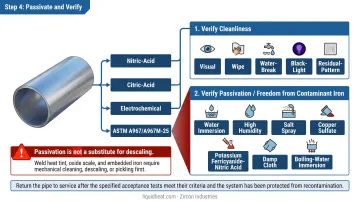
Step 4: Passivate and Verify
A thoroughly cleaned stainless-steel surface forms its passive film naturally in an oxygen-containing environment. Chemical passivation is used when the project specification requires removal of contaminant iron or an accelerated passive-film treatment.
Passivation is not a substitute for descaling. Weld heat tint, oxide scale, and deeply embedded iron may require mechanical cleaning, chemical descaling, or pickling before passivation. The selected method must be appropriate for the grade, finish, weld condition, and service.
ASTM A967/A967M-25 covers nitric-acid, citric-acid, and electrochemical passivation treatments. Treatment selection, concentration, temperature, dwell time, rinsing, neutralization, and acceptance testing should follow the edition and procedure named in the purchase or project specification.
Confirm the result in two stages:
- Verify cleanliness using the specified visual, wipe, water-break, black-light, residual-pattern, or other applicable test
- Verify passivation or freedom from contaminant iron using the test required by the governing specification, such as water immersion, high humidity, salt spray, copper sulfate, potassium ferricyanide-nitric acid, damp cloth, boiling-water immersion, or another approved method
Return the pipe to service after the specified acceptance tests meet their criteria and the system has been protected from recontamination.
When and What You Need Before Degreasing Stainless Steel Pipes
When Should You Degrease and Clean Stainless Steel Pipes?
Light dust, fingerprints, and water-soluble residue may be removed with a mild cleaner suited to the surface and service. Cleaning intervals should come from inspection, process requirements, environmental exposure, contamination rate, and the facility's maintenance plan rather than a universal calendar interval.
Full degreasing is appropriate:
- After fabrication when oil, cutting fluid, polishing compound, adhesive, or other organic residue is present
- Before a specified pickling or passivation treatment
- When heavy grease or oil contamination is present
- Before high-purity, sanitary, or process service when the governing procedure requires validated removal of organic residue
- After maintenance that introduces lubricant, sealant, marking compound, or other contamination
Acid passivation does not replace precleaning. Oil and grease can prevent the treatment solution from contacting the stainless surface uniformly.
What You'll Need Before Starting
Materials:
- A degreaser matched to the soil, stainless finish, attached materials, and end-use requirements, such as Z99 for general industrial grease and oil removal
- Clean, lint-free cloths or approved swabs
- Dedicated nylon or stainless-steel brushes that have not contacted carbon steel
- Rinse water that meets the written procedure
- Pumps, hoses, tanks, plugs, and recovery equipment suited to the cleaner and pipe geometry
- PPE and ventilation specified by the cleaner's current label, SDS, and site hazard assessment
Before you start, confirm:
- The stainless grade, surface finish, fabrication condition, and service requirements
- The cleaner's current label and SDS have been reviewed
- The application method, concentration, temperature, dwell time, and rinse endpoint are documented
- The workspace has the ventilation and spill controls required for the product and process
- Any sanitary, food-contact, pharmaceutical, or high-purity requirements have been incorporated into the approved procedure
Key Parameters That Affect Degreasing and Cleaning Results
Cleaning quality depends on controlling the variables that affect soil removal and the stainless surface.
| Variable | Why It Matters | Impact on Quality |
|---|---|---|
| Degreaser chemistry | The formulation must dissolve, loosen, or emulsify the actual soil without damaging the stainless finish, seals, coatings, or connected components | A compatible cleaner removes the contamination while keeping the complete assembly within its material and process requirements |
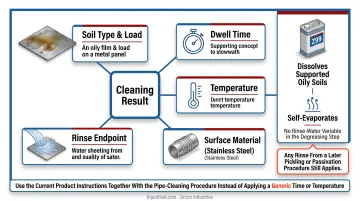
| Dwell time and temperature | Contact time and temperature affect solvency, emulsification, and rinsing; limits vary by formulation | Follow the cleaner's documented operating range. An aqueous cleaner must be kept from drying on the surface, while a self-evaporating solvent instead needs the released soil wiped away before it flashes off |
| Rinse-water quality | Rinse water, tanks, hoses, and pumps can redeposit chlorides, iron, oil, or other contaminants | Use the water quality and final-rinse endpoint required for the grade and service |
| Tool and material contact | Carbon-steel tools can transfer contaminant iron, while unsuitable cloths can leave fibers or residue | Use clean, dedicated tools and lint-free materials compatible with the specified cleanliness level |
There is no universal dwell time or rinse endpoint for every degreaser. Z99 relies on solvency alone to dissolve supported oily soils and then self-evaporates, which takes the rinse-water variable out of the degreasing step itself, though any rinse specified by a later pickling or passivation procedure still applies. Use the current product instructions together with the pipe-cleaning procedure instead of applying a generic time or temperature.
Common Mistakes and Troubleshooting Tips
Common Mistakes to Avoid
- Skipping degreasing before passivation can prevent the passivating solution from reaching the stainless surface uniformly
- Using sodium hypochlorite or cleaners with uncontrolled chloride content can create pitting risk under the wrong concentration, temperature, pH, exposure time, and stagnant conditions. An NIH investigation of repeated 316L trap failures identified chloride attack associated with frequent bleach use as the most likely cause
- Allowing carbon-steel contact from brushes, wire wheels, handling equipment, grinding debris, or nearby fabrication can transfer iron that later rusts on the stainless surface
- Treating passivation as a heat-tint or scale remover leaves fabrication oxide in place. Heat tint and scale require an appropriate descaling, pickling, or mechanical-cleaning step before passivation
- Using unverified household or all-purpose cleaners can introduce residue, abrasives, or chemicals that are incompatible with the grade, finish, or process service
Zircon Industries' Z99 Safety Solvent Degreaser dissolves grease, oil, and tar on metal parts and industrial equipment. Use it for general industrial cleaning under the current SDS, the product label, and the facility's stainless-steel cleaning procedure.
Troubleshooting Common Issues
| Problem | Likely Cause | What to Check |
|---|---|---|
| Oil film remains after degreasing | Incomplete coverage, insufficient contact or agitation, incorrect concentration, or cleaner mismatched to the soil | Reinspect the surface, confirm the product instructions, and repeat the approved process with corrected coverage, concentration, time, temperature, or agitation |
| Rust spots appear after cleaning | Contaminant iron, chloride exposure, dirty rinse equipment, residual heat tint, incomplete surface treatment, or recontamination during handling | Identify the source, clean or descale as required, perform the specified contaminant-iron test, and repeat passivation when the governing procedure calls for it |
Alternatives to Chemical Degreasing (and Choosing the Right Product)
Chemical degreasing is one of several cleaning methods recognized for stainless systems. Pipe geometry, soil, surface finish, connected components, wastewater handling, and acceptance criteria determine the best method.
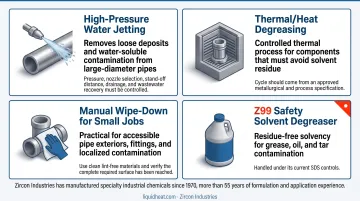
High-Pressure Water Jetting: This method can remove loose deposits and water-soluble contamination from large-diameter pipes. Oil and baked-on grease may require heat or a compatible detergent. Pressure, nozzle selection, stand-off distance, drainage, and wastewater recovery must be controlled to protect the surface and connected equipment.
Thermal/Heat Degreasing: A controlled thermal process may be used for components that can tolerate the cycle and must avoid solvent residue. The allowable temperature and exposure time depend on the alloy, weld condition, dimensions, and required properties, so the cycle should come from an approved metallurgical and process specification.
Manual Wipe-Down for Small Jobs: Wiping is practical for accessible pipe exteriors, fittings, and localized contamination. Use clean lint-free materials, replace them before they redistribute soil, and verify that the complete required surface has been reached.
For general industrial stainless-steel cleaning, Z99 Safety Solvent Degreaser provides residue-free solvency for grease, oil, and tar contamination, handled under the controls its current SDS specifies. Zircon Industries has manufactured specialty industrial chemicals since 1970, giving customers more than 55 years of formulation and application experience.
Frequently Asked Questions
Will degreaser damage stainless steel?
A compatible degreaser used within its specified concentration, temperature, dwell time, and rinse procedure should clean stainless steel without unacceptable surface change. Damage can occur when the chemistry is incompatible with the grade or finish, the cleaner dries on the surface, exposure exceeds the approved limits, or contaminated tools and rinse water are used.
What is the best degreaser for stainless steel pipes?
The best cleaner matches the soil, stainless finish, connected materials, and end use. For general industrial grease, oil, and tar contamination, Z99 Safety Solvent Degreaser is a solvent formulated for metal-parts cleaning that evaporates without leaving residue, used under the ventilation and ignition controls its SDS requires. Food-contact, pharmaceutical, sanitary, and high-purity systems require cleaners and verification procedures approved for those specific services.
Can I use vinegar or household cleaners on stainless steel pipes?
Diluted vinegar may remove light mineral deposits from some stainless surfaces, but it is not an effective heavy-oil degreaser. Household products may contain sodium hypochlorite, chlorides, abrasives, fragrances, or other residues that do not fit an industrial pipe-cleaning specification. Use a documented cleaner and procedure matched to the grade, finish, and service.
How often should stainless steel pipes be degreased and cleaned?
There is no universal six-month interval. Clean when inspection finds contamination, after work that introduces oil or fabrication residue, before specified surface treatment, and at the frequency required by the process, environment, hygiene program, or preventive-maintenance plan.
Does degreasing remove the passive layer on stainless steel?
Proper degreasing is intended to remove organic contamination, not strip the stainless substrate. The passive film reforms naturally on a clean surface exposed to oxygen or moisture. Aggressive or incompatible chemicals can affect the surface, which is why cleaner selection and exposure limits matter.
Is passivation necessary after degreasing stainless steel pipes?
Not after every routine degreasing job. Chemical passivation is appropriate when the project specification requires it, when contaminant iron must be removed, or after fabrication and surface treatment under an approved procedure. If welding has left heat tint or oxide scale, complete the required descaling or pickling step before passivation.