Dust control is therefore more than housekeeping. A sound program identifies the material, measures exposure where required, controls dust where it is generated, prevents it from spreading, and removes settled material without putting it back into the air.
This guide explains why dust control matters, how to build a layered program, which site conditions affect performance, and where Zircon Industries' dust-control products fit within a broader engineered system.
Key Takeaways
- Dust must be characterized before the facility selects ventilation, suppression, filtration, housekeeping, or explosion controls.
- Effective programs reduce generation, capture dust at the source, suppress compatible materials, contain migration, and clean settled dust safely.
- Combustible-dust hazards require attention to all five elements of the dust explosion pentagon: fuel, oxygen, ignition, dispersion, and confinement.
- Indoor process dust and exterior surface dust need different controls; one chemical or collection system cannot cover every use case.
- Inspection, exposure monitoring, pressure readings, airflow checks, and preventive maintenance keep the program effective over time.
Why Dust Control Matters in Manufacturing Facilities
Visible haze and settled material are signs that dust has escaped the process. The health, equipment, fire, and quality implications depend on the material and the way it is handled.
Health and Safety Risks to Employees
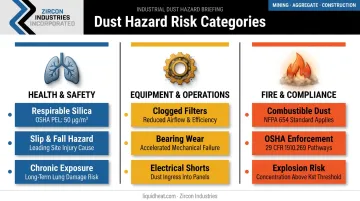
Respirable particles can reach deep into the lungs, while larger particles may irritate the eyes, skin, nose, and throat. The specific health risk varies. Crystalline silica can cause silicosis and other serious disease; wood dust, metal dust, pharmaceutical powders, and process chemicals have their own exposure profiles.
For respirable crystalline silica, OSHA's general industry standard sets an action level of 25 micrograms per cubic meter and a permissible exposure limit of 50 micrograms per cubic meter, each measured as an eight-hour time-weighted average. Other dusts may fall under different OSHA limits or substance-specific requirements.
Settled dust can also reduce traction or obscure steps, floor markings, leaks, and other walking-surface hazards. A housekeeping program should address the actual material and accumulation pattern without using a cleaning method that creates another airborne exposure.
Equipment and Operational Risks
Dust affects equipment differently according to particle size, hardness, conductivity, moisture, and chemical composition.
- Loaded filters and restricted airflow can reduce ventilation or cooling performance and increase fan load.
- Abrasive particles in bearings, seals, and moving assemblies can accelerate wear when they enter lubricated components.
- Conductive or combustible material in electrical enclosures can create electrical and fire hazards when the enclosure and equipment are not designed for the environment.
- Deposits on sensors, optical devices, heat exchangers, and product-contact barriers can interfere with readings, heat transfer, inspection, or quality controls.
Rising pressure drop, declining airflow, dust leakage, recurring deposits, and visible emissions are useful warning signs. They should trigger inspection against the equipment manufacturer's operating range and the facility's control plan.
Fire, Explosion, and Compliance Risks
A combustible-dust explosion requires five elements: combustible dust as fuel, oxygen, an ignition source, dispersion at a sufficient concentration, and confinement. OSHA refers to these elements as the dust explosion pentagon. Removing or controlling one or more elements is central to prevention and mitigation.
Settled combustible dust matters because a small primary event can suspend deposits from beams, equipment, floors, or ductwork and fuel a larger secondary explosion. The Chemical Safety Board identified 281 combustible-dust incidents, 119 deaths, and 718 injuries in U.S. industry from 1980 through 2005, and the agency continues to investigate serious dust incidents.
OSHA does not rely on one general-industry combustible-dust standard. Applicable obligations can arise through the General Duty Clause, hazard communication, housekeeping, ventilation, electrical classification, substance-specific standards, and other requirements. OSHA also uses its revised Combustible Dust National Emphasis Program to guide inspections of facilities that generate or handle combustible dust.
A dust-control product can support a facility program, but compliance depends on the hazard assessment, exposure data, engineered controls, written procedures, training, maintenance, documentation, and regulations that apply to the site.
How to Control Dust in Your Manufacturing Facility: Step-by-Step
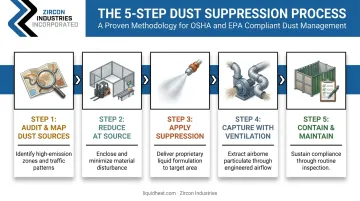
Dust control works best as a layered system. The sequence begins with knowing the dust and controlling its release at the source.
Step 1: Audit and Map Dust Sources
Walk the process from raw-material receiving through production, packaging, storage, and shipping. Mark cutting and grinding stations, crushers, screens, mixers, bag dumps, conveyor transfers, loading points, vehicle routes, open doors, collection-system discharge points, and recurring areas of settled dust.
For each source, record:
- Material composition and available SDS information
- Particle size and whether a respirable fraction is present
- Employee tasks, duration, and proximity to the source
- Normal operation, startup, shutdown, cleaning, and upset conditions
- Possible combustibility, toxicity, conductivity, and reactivity
- Existing enclosure, ventilation, suppression, and housekeeping controls
Use personal or area sampling when required to assess exposure. If a dust may be combustible and its properties are not established, obtain representative testing through a qualified laboratory and have a competent specialist evaluate the process. A generic label such as “metal dust” or “organic powder” is not enough because explosibility changes with composition, particle size, and moisture.
Step 2: Reduce Dust Generation at the Source
Preventing release is more reliable than collecting dust after it spreads through the building.
- Enclose transfer and discharge points with enough access for inspection and maintenance.
- Reduce drop height and material velocity at chutes, conveyors, bins, and loading points.
- Use covered containers and closed transfer methods for powders and fine granular material.
- Maintain seals, skirts, flexible connections, and process equipment so dust does not leak from the system.
- Adjust traffic flow and vehicle speed in exterior material-handling and staging areas where movement lifts surface dust.
Changes must remain compatible with fire protection, process safety, maintenance access, and material flow. An enclosure that traps combustible dust without suitable protection can exchange an exposure problem for an explosion hazard.
Step 3: Apply Suppression Methods
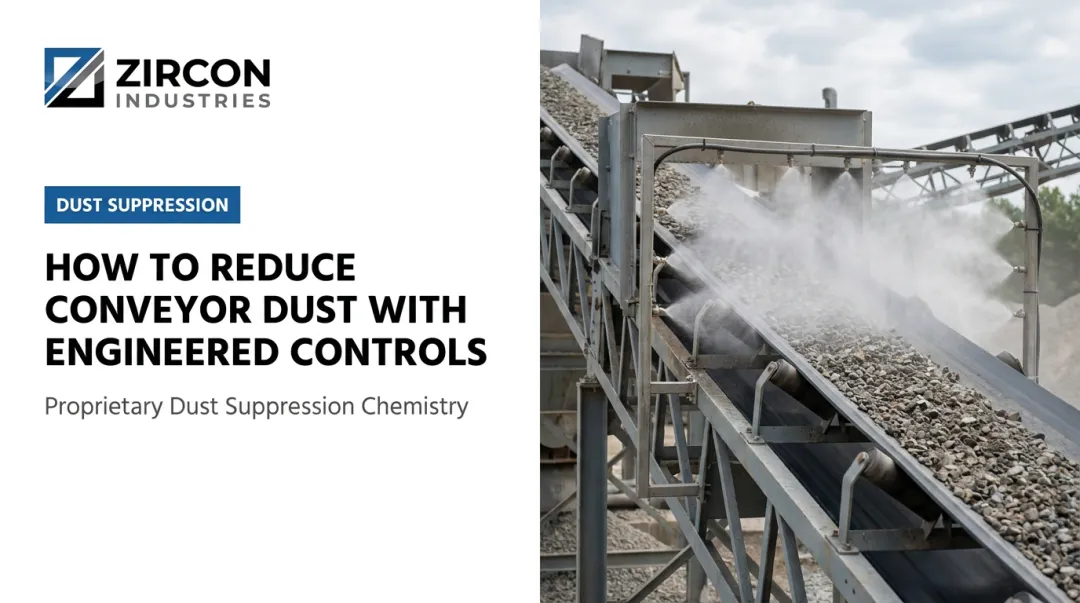
Wet suppression applies water or an approved mixture at the point of generation or to a compatible surface so particles are less likely to become airborne. Droplet size, spray placement, coverage, water quality, flow rate, and contact time determine performance. The method must also fit the process: water can damage product, create slip or corrosion concerns, react with some materials, or be unacceptable near electrical equipment.
ZHP Water Wetter is Zircon Industries' non-ionic surfactant and resin extender for approved water-based dust-suppression programs. It reduces water's surface tension to improve spreading and penetration. Product guidance lists a ratio of 1 part ZHP to 1,500 to 3,000 parts water. The ZHP Transfer System transfers or injects ZHP into a water truck; the truck's spray bar, nozzles, hoses, or other application equipment distribute the treated water.
Different Zircon products serve different exterior applications:
- RDS38 is a calcium chloride-based, turnkey treatment for demanding private gravel and unpaved industrial surfaces at quarries, aggregate operations, trucking yards, lumberyards, and similar facilities. Zircon delivers and applies it, with treatment cycles typically lasting three to four months depending on site conditions.
- Latex 100 forms a clear, brittle crust over static coal, ore, aggregate, fly ash areas, unused lots, and open railcar tops. It is intended for undisturbed surfaces, not active piles or traffic areas.
These surface treatments do not replace local exhaust ventilation, combustible-dust safeguards, or exposure controls for indoor cutting, grinding, conveying, or production equipment.
Step 4: Capture Airborne Particles with Ventilation and Collection Systems
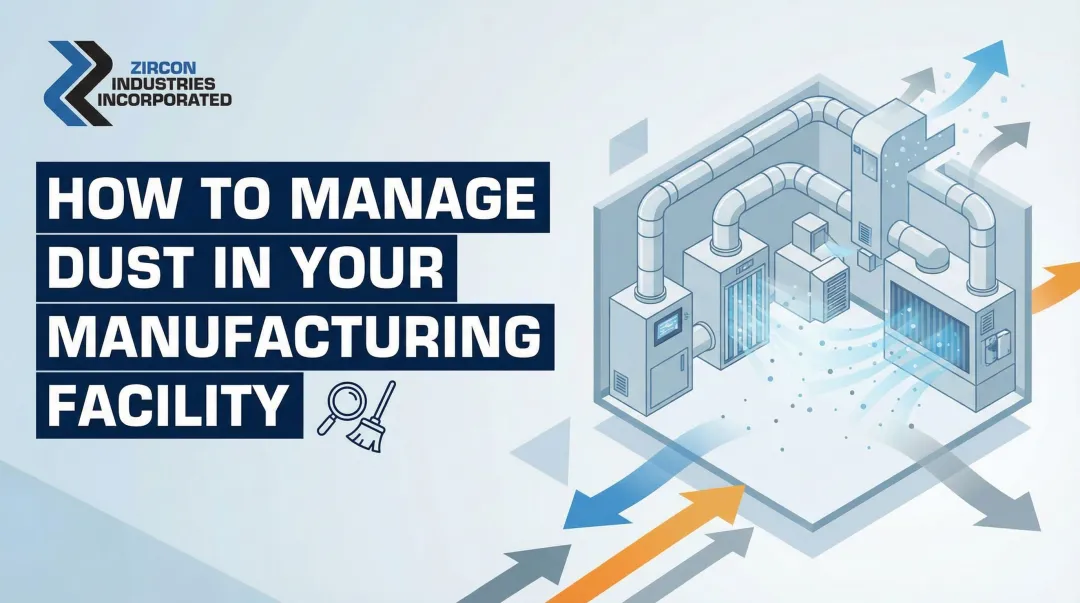
Local exhaust ventilation captures dust close to the point of release before it reaches the employee breathing zone or general plant air. A typical system includes a hood or enclosure, ductwork, an air cleaner or collector, a fan, and a safe exhaust or return-air arrangement. NIOSH identifies local exhaust ventilation as an engineering control that removes airborne emissions at the source.
Collection performance depends on more than filter efficiency:
- Hood location and capture velocity must draw the dust away from the process and worker.
- Duct velocity and layout must transport the material without excessive settling or pressure loss.
- Filter media and collector design must match particle size, loading, temperature, moisture, and chemical properties.
- Makeup air and building pressure must support the designed airflow without spreading contamination.
- Combustible-dust systems may require explosion prevention or protection, isolation, grounding, bonding, and appropriately classified electrical equipment designed by qualified professionals.
Maintain the system using measured performance. Track pressure drop, airflow, fan condition, visible leakage, hopper levels, pulse-cleaning performance, and filter condition against the manufacturer's limits. A filter change schedule should reflect these readings and the documented maintenance plan, not an arbitrary calendar date.
Step 5: Contain and Maintain with Barriers and Routine Cleaning
Partitions, curtains, booths, and process enclosures can keep dusty work separated from cleaner zones. The containment design should work with ventilation so openings and employee movement do not carry dust into adjacent areas.
Housekeeping must reach the surfaces where dust actually settles:
- Overhead beams, joists, rafters, and cable trays
- Ledges, duct exteriors, equipment tops, and light fixtures
- Behind and beneath machinery
- Floors, stairs, platforms, and traffic paths
- Inside approved collectors, hoppers, and enclosures during controlled maintenance
Use cleaning methods suited to the hazard. For silica, 29 CFR 1910.1053 restricts dry sweeping, dry brushing, and compressed-air cleaning where they can contribute to exposure, subject to the standard's stated exceptions. Combustible dust should not be dispersed with compressed air or unsuitable cleaning equipment. Use wet methods or vacuum systems selected and approved for the material, location classification, and facility procedure.
Key Factors That Affect Dust Control Results
A control method can work well in one area and fail in another because dust and operating conditions change across the facility.
Dust Type and Combustibility
Mineral, organic, polymer, carbonaceous, and metal dusts have different health, fire, conductivity, and reactivity profiles. Even dusts from the same material can behave differently as particle size or moisture changes. Use representative data for the actual process, and do not assume that a wet method, filter, vacuum, or collector is suitable until compatibility and combustibility are established.
Facility Layout and Traffic Patterns
Open doors, cross-drafts, forklift movement, transfer routes, and pressure differences can pull dust away from capture hoods and move it into cleaner zones. Layout affects hood placement, enclosure openings, cleaning zones, exterior surface treatment, and the separation of people from dusty processes.
Environmental Conditions
Temperature, humidity, rainfall, wind, and freeze conditions influence exterior suppression and material handling. Indoors, process heat, makeup air, seasonal ventilation changes, and moisture restrictions can affect both dust generation and collector performance. The control plan should cover normal seasonal and production changes instead of being tuned to a single operating condition.
Consistency and Quality of Suppression Products or Application
Suppression performance depends on using the specified product, dilution, application rate, equipment, surface preparation, and treatment interval. Uneven coverage or an unsuitable product leaves gaps even when the overall volume appears adequate.
Zircon's published RDS38 customer results illustrate the value of a correctly matched exterior program. Vulcan Materials in Virginia reported moving its water truck to another quarry after adopting RDS38. Lafarge in Pennsylvania reported more than $20,000 in annual savings and redirected the water-truck driver's time to other work. These are attributed customer results for RDS38 applications, not universal savings promises.
Common Mistakes to Avoid When Controlling Dust
Even a well-funded program can underperform when the controls are mismatched or poorly maintained.
- Treating dust control as a one-time cleanup instead of a continuing program tied to inspection, monitoring, and maintenance
- Selecting controls before characterizing the dust, including its health, combustibility, conductivity, and reactivity hazards
- Using plain water or a chemical suppressant where moisture is incompatible with the material, process, walking surface, or electrical equipment
- Using compressed air, dry sweeping, or an unsuitable vacuum and putting settled dust back into the air
- Ignoring overhead and concealed accumulation on beams, ledges, ducts, equipment tops, and cable trays
- Using exterior surface treatments as a substitute for indoor source capture at cutting, grinding, conveying, or transfer operations
- Waiting for visible haze or equipment failure instead of tracking airflow, pressure drop, leakage, exposure data, and deposit patterns
Conclusion
An effective manufacturing dust-control program starts with the material and process. Reduce dust generation, capture it close to the source, apply wet suppression only where it is compatible, contain migration, and remove settled material with methods designed for the hazard.
Zircon Industries has manufactured specialty chemicals since 1970 and provides distinct products for water-based suppression programs, private exterior gravel areas, and static undisturbed piles. Contact staff@liquidheat.com for current product availability and application guidance. Facility-specific engineering, exposure, fire, and compliance decisions should remain with the site's qualified safety, industrial hygiene, and engineering professionals.
Frequently Asked Questions
How do I handle excessive dust in a factory?
Identify the material and source, assess employee exposure and combustibility where applicable, and then apply the hierarchy of controls. Enclose or modify the process, capture dust with local exhaust ventilation, use compatible suppression, contain migration, and establish safe housekeeping and maintenance procedures.
What is the OSHA standard for dust control?
OSHA does not use one standard for every type of dust. Requirements may come from substance-specific standards such as 29 CFR 1910.1053 for respirable crystalline silica, the General Duty Clause, hazard communication, respiratory protection, ventilation, electrical, walking-working surfaces, and other rules. Combustible-dust inspections may also follow OSHA's National Emphasis Program.
What is the most effective method for controlling dust in a manufacturing facility?
Control at the source is generally the strongest starting point. Process changes, enclosure, and local exhaust ventilation prevent dust from reaching the worker or spreading through the building. Suppression, containment, housekeeping, and PPE support those controls according to the material and task.
How often should dust control systems be cleaned or maintained?
Use a documented frequency based on the hazard assessment, dust loading, operating hours, exposure data, inspection results, collector readings, and manufacturer instructions. High-loading or combustible-dust areas may require much more frequent attention than low-dust areas. Adjust the schedule when deposits, leakage, pressure drop, or airflow show that the current interval is inadequate.
Can dust control chemicals be used safely around food or pharmaceutical manufacturing?
Use only products approved by the facility's quality, safety, and regulatory teams for the exact area and exposure pathway. Enclosure, local exhaust ventilation, and validated housekeeping are often preferred where adding moisture or chemistry could affect product quality. Glycerin DC-100 is intended for exterior unpaved industrial dust control and should not be positioned as a treatment for food or pharmaceutical production areas.
What's the difference between dust suppression and dust collection?
Suppression wets or binds compatible dust so it is less likely to become airborne. Collection uses a hood, ductwork, airflow, and an air-cleaning device to capture dust released by the process. Many facilities use both, but each must be designed for the material and application.