Introduction
A dirty stator winding doesn't fail overnight. It fails slowly, one layer of oil, dust, and carbon at a time, while mechanical, thermal, and electrical stresses quietly compound underneath the grime.
Many maintenance teams don't realize that the cleaning product they grab off the shelf can do more damage than the contamination itself.
Legacy varnish and shellac systems tolerate certain solvents; modern Class F polyimide and epoxy systems do not. Grab the wrong bottle, and you can strip the insulation you meant to protect.
This guide covers why winding cleanliness matters, how to choose a solvent that won't attack your insulation, how the main cleaning methods compare, a step-by-step procedure, and the safety precautions your crew needs before opening any container.
Key Takeaways
- Citrus-based (d-limonene) degreasers cut oil on stator windings without the aggressive chemistry of chlorinated solvents.
- Solvent choice must match your insulation system's age and construction, not just its thermal class rating.
- Run a megohmmeter test before and after cleaning, and never skip lockout/tagout.
- Pair a citrus-based presoak with dry ice blasting for hard-to-reach end-windings and air vents.
Why a Clean Generator Winding Matters
Generator insulation ages through four recognized stress categories: mechanical, thermal, electrical, and environmental. A dirty winding doesn't just look bad. It accelerates all four at once.
Here's how contamination compounds each stress type:
- Oil acts as a lubricant and a mild solvent simultaneously. It loosens wedges, side packing, and lacing while slowly breaking down varnish and epoxy binders.
- Water is the most dangerous contaminant. It conducts electricity, and it combines with dust and oil to form an abrasive, insulating sludge that traps heat against the winding.
- Dust and carbon buildup insulate the winding thermally, blocking the cooling airflow the machine depends on to shed heat.
The reliability numbers back this up. EPRI's long-term reliability study tracked 20 stator-winding failures and 458 outage days in a 1990-2001 dataset, working out to a 0.0160 failures-per-year rate across the fleet studied, with average forced-outage events running close to 234 hours apiece.
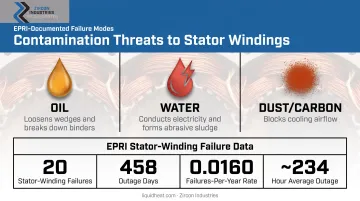
Dust, greasing, surface tracking, and moisture ingress all appear on EPRI's list of documented aging mechanisms behind those numbers.
The payoff for staying ahead of it is straightforward: a clean winding runs cooler, resists flashover, and simply lasts longer, mechanically and dielectrically.
Common Contamination Sources to Watch For
Not all contamination looks the same, and where it comes from often tells you what to expect on the next inspection. Common sources include:
- Bearing oil from thrust and guide bearing releases or high-pressure lift system leaks
- Carbon and brake dust from slip-ring brushes and generator braking systems
- Fly ash and heavy dust, especially common in mining, aggregate, and coal-adjacent operations
- Environmental debris such as humidity, pollen, sand, and insects working their way into open enclosures
- Maintenance leftovers like rags, blast media, or insulation scraps from prior service work
Heavy industrial environments see this buildup faster than most. If your operation runs in a quarry, mine, or aggregate plant, plan for shorter cleaning intervals than a climate-controlled facility would need.
Choosing the Right Solvent for Generator Winding Cleaning
So what solvent is actually safe for generator windings? Citrus-based, d-limonene degreasers are generally the preferred starting point for routine cleaning across Class F, Class B, and Class H insulation systems. They cut through oil and grease effectively without the harsh chlorinated chemistry that damaged older winding insulation for decades.
That said, one caveat matters: NEMA's Class B and Class F ratings describe thermal endurance, not solvent compatibility. A "Class F" label tells you how much heat the insulation tolerates, not which chemicals it can safely absorb. Coatings, corona-suppression layers, adhesives, and slot fillers all vary by OEM, so a coupon test or manufacturer approval remains the responsible step before treating an entire winding.
Here's how the main solvent families compare:
| Solvent Type | Best For | Key Limitation |
|---|---|---|
| Citrus-based (d-limonene) | Routine cleaning, broad insulation compatibility | Flammable; case data shows it can still soften some epoxy paints with prolonged contact |
| Petroleum distillates | Heavy oil and grease loads | Can degrade polyimide films; not universally safe |
| Chlorinated (methylene chloride) | Stubborn legacy contamination | Highly toxic; heavily restricted under EPA's 2024 TSCA rule; last-resort only |
| Aqueous/detergent | Light surface cleaning | Requires thorough, monitored drying; can carry carbon dust deeper into the machine |
Matching solvent to insulation age matters just as much as matching it to contamination type:
- Modern Class F polyimide/epoxy systems generally tolerate citrus-based and, in some cases, petroleum distillate cleaners.
- Class B mica/asphaltic systems do better with milder, non-chlorinated products.
- Legacy pre-1980s varnish, shellac, or paper systems should get mild aqueous cleaning only, or a very light citrus wipe with immediate removal.
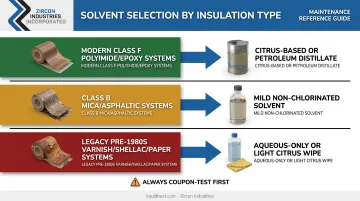
Most winding-cleaning solvents are classified as hazardous materials regardless of how "natural" the base ingredient sounds. Choose the least aggressive product that still gets the contamination off.
DirectChem's Citrus-Based Solvents: Super Orange and Z99 Safety Solvent
DirectChem manufactures two citrus-based products relevant here, and they're not interchangeable.
Super Orange Degreaser is built around DirectChem's micro-micellular technology, a blend of dextro-limonene, citrus extracts, and mixed ionic emulsifiers. It uses 100% natural citrus terpene oil and zero petroleum distillates.
The formula lifts oil, grease, and tar off metal surfaces fast. It's biodegradable, non-corrosive, and safe on all metals, so it fits bearing housings, brackets, and external generator surfaces where heavy oil builds up before it reaches the winding.
For the winding itself, DirectChem's Z99 Safety Solvent Degreaser is the product specifically documented for motors, windings, generators, and starters, carrying a 36,000-volt dielectric strength rating under ASTM D-877. That dielectric spec is exactly the kind of data point you want on record before a solvent touches live-adjacent insulation.
If you're unsure which product fits your specific insulation system, DirectChem's team can walk through it: 800-547-4328 or sales@directchem.com.
Comparing Generator Winding Cleaning Methods
No single method handles every contamination scenario. Most experienced crews combine two or three depending on access and soil type.
| Method | Best for | Key caution |
|---|---|---|
| Solvent wipe/spray | Light to moderate oil; tight spaces | Apply sparingly, agitate gently, then non-solvent rewash—slow but high control |
| Dry ice (CO2) blasting | Energized-adjacent work; no secondary residue | Needs specialized gear; aggressive settings can strip insulation paint |
| Dry media blasting | Reusable corn cob or walnut shell media | Low air pressure only—overpowered or stationary nozzles abrade coil coating fast |
| Steam cleaning | External housings only | Not for open-frame stators; moisture ingress and long dry-out risk |
A Real-World Combination: NB Power's Mactaquac Case Study
One of the better-documented examples of combining methods comes from NB Power's Mactaquac hydro station. Crews cleaned a 110-MW generator (Unit 2) contaminated with thrust-bearing oil mixed with brake and slip-ring brush dust.
The process:
- Hand-sprayed d-limonene degreaser directly ahead of the dry ice nozzle
- Lightly presoaked the core face, circuit rings, supports, and lower end winding
- Blasted while continuously moving the nozzle to avoid dwelling in one spot
The combined approach successfully cleared contamination from the stator's air vents, though it took two continuous 12-hour shifts across two passes. About 0.5% of the epoxy paint was stripped and required touch-up repair.
The unit returned to service in September 2000. Treat it as a reference point—every stator's coating and access will differ.
Step-by-Step Safe Cleaning Procedure
Follow this sequence regardless of which solvent or method you choose:
- De-energize and lock out/tag out the unit, then verify a zero-energy state before anyone touches the winding.
- Record a baseline insulation resistance reading with a megohmmeter, following IEEE 43 test procedures, before any solvent contacts the winding.
- Inspect the contamination to distinguish loose dust from oily deposits or retained blast media, since this determines your method.
- Apply the chosen solvent by hand or low-pressure spray. Allow a brief dwell time to break up contaminants, then agitate gently with a soft-bristle nylon or natural-fiber brush.
- Wipe with a lint-free cloth. If oil residue remains, follow with a non-solvent rewash.
- Allow complete evaporation before re-testing or reassembly. Drying time varies with ambient humidity, so don't rush this step in a damp shop.
- Re-test insulation resistance and confirm the reading meets or exceeds your baseline before returning the generator to service.
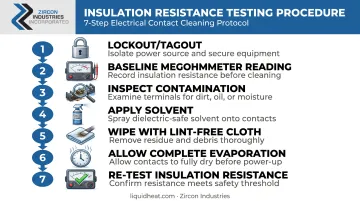
Skipping step 7 is the most common shortcut crews take, and it's the one that catches problems too late.
Safety Precautions When Handling Winding Cleaning Solvents
Citrus-based solvents feel low-risk because they smell like oranges, but they're still flammable liquids that demand real precautions.
Required PPE:
- NIOSH-approved organic vapor respirator
- Nitrile or SDS-specified chemical-resistant gloves
- Chemical-resistant apron for extended handling
Ventilation and fire safety:
- Confirm adequate air changes for the enclosed space you're working in
- Remove ignition sources (open flames, welding, hot surfaces, static discharge) from the work area
- Keep a rated fire extinguisher within reach
- Treat d-limonene solvents as flammable liquids and confirm flash point on the SDS
Before you start:
- Verify a confirmed zero-energy state through lockout/tagout
- Pull the current SDS for your specific solvent—PPE and ventilation requirements vary by formulation
DirectChem includes SDS documentation with product orders. For product-specific PPE or ventilation guidance on Super Orange or Z99, contact the technical team directly.
Frequently Asked Questions
What solvent is safe and effective for cleaning generator windings?
Citrus-based (d-limonene) solvents are the safest effective starting point for most modern epoxy and polyimide insulation. Confirm compatibility against your OEM insulation spec before use.
Can I use brake cleaner on generator windings?
Most brake cleaners contain acetone, petroleum distillates, or chlorinated solvents like tetrachloroethylene—none with documented epoxy or polyimide compatibility. Skip them and use a purpose-built winding solvent.
How long should I wait after solvent cleaning before energizing the generator?
Wait until the winding is completely dry and your megohmmeter readings match or exceed baseline, typically a minimum of two hours at room temperature. Humid environments require longer drying windows.
What insulation class is most vulnerable to solvent damage?
Legacy systems built before the 1980s, using varnish, shellac, and paper construction, are the most susceptible to solvent absorption and degradation. Treat these with extreme caution and minimal solvent contact.
Is WD-40 safe for cleaning generator windings?
No. WD-40’s petroleum distillate base makes it a poor winding cleaner, especially with heavy oil contamination. It is a lubricant and moisture displacer, not a purpose-built solvent.
What should I do if insulation resistance drops after cleaning?
Residual moisture is the most common cause. Run a supervised bake-out cycle within the manufacturer's temperature limits, then re-test before assuming the insulation itself has been damaged.