Introduction
Unplanned downtime is expensive — far more than most operations budget for. According to Siemens, the world's 500 largest companies lose $1.4 trillion per year to unplanned downtime, equal to roughly 11% of annual revenues. While no single factor accounts for all of that, corroded and contaminated electrical contacts are a common maintenance trigger behind intermittent failures, false fault codes, control-panel issues, and shutdowns that take hours to diagnose and fix.
The fix is often straightforward: regular, deliberate contact inspection and cleaning. Yet many maintenance teams skip it, rush it, or grab whatever solvent is nearby — which can leave residue, damage plastics, or create a safety hazard around energized equipment.
This guide covers five practical tips for cleaning electrical contacts correctly. It's written for industrial maintenance crews in mining, aggregate, railroad, construction, and heavy equipment operations — servicing everything from control panels and wire terminals to relays, switches, connectors, starters, and circuit breakers. These steps will help you clean contacts safely, protect sensitive components, and reduce repeat electrical faults.
Key Takeaways
- De-energize equipment and follow lockout/tagout procedures before touching electrical contacts
- Use a purpose-formulated electrical contact cleaner — not general lubricants, penetrating oils, or all-purpose degreasers
- Match the cleaner to the component, plastic/rubber compatibility needs, dielectric requirements, flammability risk, and residue requirements
- Use soft tools only; abrasives can permanently damage protective contact plating
- Never restore power until the cleaner has fully evaporated and the contact area is dry
What Makes Electrical Contacts Dirty — and Why It Matters
Common Contaminants in Industrial Environments
Electrical contacts in heavy industrial settings are exposed to a range of damaging contaminants:
- Dust and airborne particles, especially in aggregate plants, quarries, and mines
- Oxidation and corrosion, accelerated by moisture, industrial chemicals, and corrosive atmospheres
- Oil and grease transferred from nearby machinery or handling
- Carbon deposits left behind by electrical arcing at switching contacts
- Moisture infiltration from condensation, wash-down, or humidity fluctuations
Each of these contaminants can increase electrical resistance at the contact surface. A 2025 review of electrical connection component failures confirms that excessive contact resistance can lead to overheating at connection points — a failure mode that can escalate quickly in high-current industrial applications.
Why It Gets Worse Over Time
Contamination rarely stays static. A 2017 peer-reviewed study found that fretting — micro-motion between contact surfaces — combined with pollutant particles significantly increases contact resistance and degrades connector reliability. In mining equipment, rail cars, and construction machinery, this process runs continuously during operation, which is why contacts in high-vibration environments typically need more frequent inspection than standard maintenance schedules assume.
Warning Signs Your Contacts Need Cleaning
- Intermittent power or signal loss that clears temporarily on its own
- Connections that only work when wiggled or re-seated
- Visible greenish corrosion, black carbon deposits, or discoloration on terminals
- Overheating detected at connector points during thermographic inspection
Tip 1: Disconnect the Power Source Before You Start
De-energizing equipment before contact cleaning protects workers, prevents unexpected start-up, and reduces ignition risk around cleaning solvents. Skipping this step turns a routine maintenance task into an electrical-safety hazard.
The governing general-industry standard is OSHA 29 CFR 1910.147 — the Lockout/Tagout regulation covering the control of hazardous energy during servicing and maintenance. OSHA estimates that compliance with this standard prevents approximately 120 fatalities and 50,000 injuries annually.
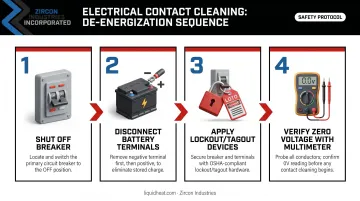
De-Energization Steps
- Shut off the circuit breaker, disconnect switch, or energy-isolating device for the equipment being serviced
- Disconnect stored-energy sources where applicable, including battery terminals, capacitors, or auxiliary power supplies
- Apply lockout/tagout devices according to the site's energy-control procedure
- Verify zero voltage with a properly rated and verified meter before touching any contacts
- Confirm the equipment cannot restart unexpectedly before cleaning begins
These steps align with federal LOTO requirements, but mining operations carry additional regulatory weight. For coal mines, 30 CFR 75.509 requires power circuits and electric equipment to be de-energized before work is done, except when necessary for troubleshooting or testing. For metal and nonmetal mines, 30 CFR 56/57.12016 requires electrically powered equipment to be de-energized before mechanical work, with power switches locked out or other measures taken to prevent unexpected energization. Always follow the mine's approved electrical safety and lockout procedure before contact cleaning.
The One Exception — and Why It Stays Rare
If cleaning near energized electrical components is genuinely unavoidable, treat it as a controlled exception — not a routine shortcut. The work should be performed only by qualified personnel under an approved energized-work procedure, with the correct PPE, area classification review, ventilation, ignition-source control, and product approval.
The cleaner must be appropriate for the electrical exposure, including dielectric rating, flammability profile, evaporation behavior, and material compatibility. Zircon Industries' ZL98 High Purity Plastic Safe Contact Cleaner, for example, is non-flammable, non-conductive, self-evaporating, plastic-safe, and dielectric to 18,000 volts. Zircon's contact-cleaner line also includes higher dielectric options for heavier industrial requirements. Even with a dielectric-rated cleaner, de-energized cleaning remains the safer default.
Tips 2 & 3: Choose the Right Cleaner — and Apply It Correctly
Selecting the Right Contact Cleaner for Your Environment
Contact cleaners are not interchangeable. Using the wrong product can leave residue, damage plastic housings, swell rubber seals, attack coatings, or create a safety hazard.
| Cleaner Type | Best For | Watch Out For |
|---|---|---|
| Fast-drying electrical contact cleaner | Relays, switches, wire terminals, connectors, circuit breakers, and control-panel components | Confirm dielectric rating, residue profile, and plastic/rubber compatibility |
| Plastic-safe contact cleaner | Sensitive electronics, circuit boards, plastic-heavy connectors, and sealed assemblies | Still test compatibility where possible and follow drying guidance |
| Non-flammable contact cleaner | Higher-risk maintenance environments where flammability must be minimized | Non-flammable does not automatically mean safe for energized work or classified areas |
| IPA-based cleaner | Light contamination and electronics where IPA is approved by the component manufacturer | May not remove heavy grease, oil, carbon, or industrial grime |
| General degreaser or lubricant | Not recommended for electrical contacts | Can leave residue, damage components, or attract new contamination |
Key selection criteria before you buy:
- Flammability — Check the SDS and product label. In combustible dust or flammable atmospheres, product selection must follow the site's electrical classification, hot-work rules, ignition-source controls, and safety program
- Dielectric strength — Relevant where electrical exposure is possible; choose a cleaner with a dielectric rating appropriate for the equipment and maintenance procedure
- Material compatibility — Test on a small, inconspicuous area before full application where practical; some solvents can craze plastics, swell rubber, or attack coatings
- Residue profile — Use no-residue or low-residue contact cleaners where residue could interfere with signal quality or attract dust
- Solvent toxicity — Avoid legacy high-risk solvents where safer alternatives are available. EPA has issued or proposed TSCA risk-management actions for solvents including methylene chloride, TCE, PCE, and 1-bromopropane
When surrounding equipment is coated in thick grease or oil — common on mining, aggregate, rail, and construction equipment — clean the surrounding non-energized area first so contamination does not migrate back into the connector. Use only a cleaner that is compatible with the component and approved for the surface being treated.
For actual electrical contacts, use a purpose-formulated contact cleaner such as Zircon Industries' ZL98 High Purity Plastic Safe Contact Cleaner for sensitive, plastic-heavy components or another approved Zircon contact cleaner matched to the application.
Always verify material compatibility and confirm full evaporation before applying contact cleaner, reassembling the component, or restoring power.
Applying the Cleaner Correctly
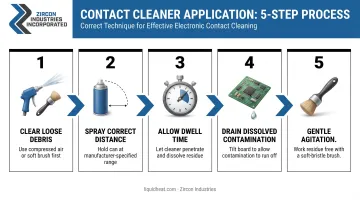
Application technique matters as much as product selection. Follow this sequence:
- Clear loose debris first — use clean, dry, low-pressure air or a soft brush to remove surface dust and particles before applying any liquid. Avoid driving debris deeper into connector cavities
- Spray from the correct distance — typically 2–6 inches from the contact surface; follow the product label
- Allow the recommended contact time — give the cleaner enough time to penetrate and lift contamination before agitating, following the product label
- Drain contamination away — tilt or orient the component so loosened residue flows away from the contact surface, not deeper into the connector cavity
- Agitate gently if needed — use a soft-bristled brush, cotton swab, or lint-free cloth
Avoid sandpaper, steel wool, and abrasive pads. Contact surfaces are often plated with gold, tin, nickel, or other protective finishes. Abrasives can remove that plating permanently, exposing base metal that corrodes faster and performs worse over time. If a contact is badly pitted, burned, or mechanically damaged, replacement is usually safer than aggressive cleaning.
Tip 4 and Tip 5: Let It Dry — Then Keep It Clean
Tip 4 — Allow Complete Drying Before Reconnecting Power
Residual cleaner in a live connector can contribute to shorts, surface tracking, arcing, residue problems, or corrosion depending on the product and circuit. Full evaporation is required. Do not treat drying time as an optional waiting period.
Evaporation time varies by product type, ambient temperature, humidity, and connector geometry. Fast-drying formulas may clear quickly under good conditions, but enclosed connectors, low temperatures, and trapped cavities can extend drying time. Check the product label and SDS for evaporation guidance and follow the manufacturer's instructions before re-energizing.
What not to do:
- Do not use a heat gun to speed up drying — it can damage plastic housings and push moisture deeper into connector cavities
- Do not use hot compressed air — clean, dry, low-pressure room-temperature air may be used if the component and site procedure allow it
- Do not reconnect power based on visual inspection alone; allow the manufacturer-recommended drying time and verify the contact area is dry before reassembly and re-energization
Tip 5 — Establish a Regular Maintenance Schedule
Reactive cleaning — done only after a failure — costs far more time than scheduled maintenance. Build contact inspection and cleaning into your existing preventive maintenance routine so it happens consistently, not only after a false fault code, intermittent shutdown, or failed connector forces the issue.
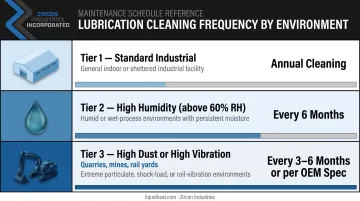
General inspection frequency by environment:
- Standard industrial setting: At least annually during scheduled shutdowns or preventive maintenance windows
- High-humidity environments: Inspect more often and clean when corrosion, condensation, or residue is present
- High-dust or high-vibration sites — quarries, aggregate plants, rail yards, underground mines: Inspect every 3–6 months, or per OEM specification
- Critical control panels, starters, relays, and safety-related circuits: Follow OEM and site electrical-maintenance requirements rather than relying on a generic calendar
Cleaning schedules address the contacts you can reach; thermographic surveys can help identify overheating connections, overloaded components, and resistance problems that are not visible during a basic inspection. In heavy industrial operations, pairing thermography with hands-on contact inspection gives maintenance teams a more complete picture of connection health than either method alone.
Common Mistakes That Undermine Electrical Contact Cleaning
Avoid these three mistakes that compromise cleaning results — or turn a maintenance task into a hazard.
- Using general lubricants, penetrating oils, or moisture displacers as contact cleaners. Standard lubricants and penetrating oils can leave oily residue that attracts dust, degrades over time, and becomes the contamination you were trying to remove. Use only purpose-formulated electrical contact cleaners designed for the job. If referencing the WD-40 brand, distinguish between general WD-40 Multi-Use Product and WD-40's dedicated Specialist Contact Cleaner.
- Reconnecting power before full evaporation. Even fast-drying formulas need to fully clear before the circuit is live. Residual cleaner or trapped moisture can contribute to shorts, arcing, tracking, or residue problems, especially in sensitive control systems, sensor circuits, and relay logic panels common in mining and rail applications.
- Skipping visual inspection before and after cleaning. Cleaning is not a substitute for inspection. Contacts with visible pitting, scoring, or severely degraded plating may need replacement, not just cleaning. Continuing to service a mechanically damaged contact delays an inevitable failure and, in high-current applications, creates a safety hazard.
Always inspect before you spray and again after the cleaner has evaporated.
Frequently Asked Questions
Can I clean electrical contacts without disconnecting power?
No — not as a routine practice. De-energize the equipment and follow lockout/tagout procedures before cleaning. If energized work is genuinely unavoidable, it should be handled only by qualified personnel under an approved energized-work procedure, with the correct PPE, area classification review, and product selection. Nonflammable and dielectric-rated cleaners reduce certain risks, but they do not make energized cleaning automatically safe.
What is the best type of contact cleaner for industrial equipment?
Match the cleaner to your component and environment. For sensitive or plastic-heavy electrical parts, use a plastic-safe, no-residue, self-evaporating contact cleaner such as Zircon Industries' ZL98 High Purity Plastic Safe Contact Cleaner. For heavier industrial electrical applications, select an approved contact cleaner with the dielectric rating, evaporation behavior, and material compatibility required for the job.
Also verify:
- Plastic and rubber compatibility
- Dielectric strength rating
- Flammability profile
- Residue behavior
- SDS and site chemical-approval requirements
Can I use isopropyl alcohol to clean electrical contacts?
IPA can work for light contamination when approved by the component manufacturer and site procedure. In industrial settings with heavy dust, grease, oil, moisture, or carbon buildup — common on mining, aggregate, rail, and construction equipment — it may lack the cleaning power, evaporation profile, or dielectric performance needed. A purpose-formulated electrical contact cleaner is usually the better choice.
How often should electrical contacts be cleaned in industrial environments?
At minimum, inspect electrical contacts during scheduled maintenance. Increase inspection frequency in high-humidity, high-dust, high-vibration, or corrosive environments such as quarries, underground mines, rail yards, aggregate plants, and heavy equipment fleets. Clean only when inspection, OEM guidance, or operating symptoms indicate contamination.
What are the signs that electrical contacts need cleaning?
Look for intermittent power or signal loss, visible corrosion or carbon deposits on terminals, connections that only work when wiggled, or overheating detected at connector points during inspection or thermographic surveys.
Is it safe to use a degreaser on electrical contacts?
Use caution. A degreaser may be appropriate for surrounding equipment surfaces or heavy grease near a connector, but actual electrical contacts should be cleaned with a purpose-formulated electrical contact cleaner. Before proceeding, confirm material compatibility with connector housings, avoid driving cleaner deeper into sealed cavities, allow full evaporation, and keep the circuit de-energized throughout.