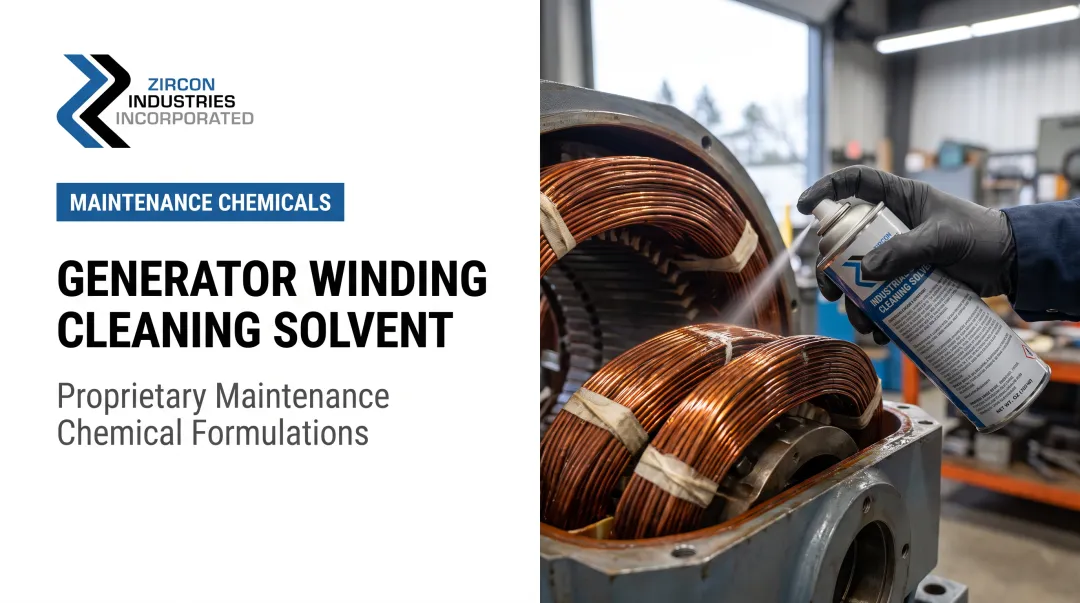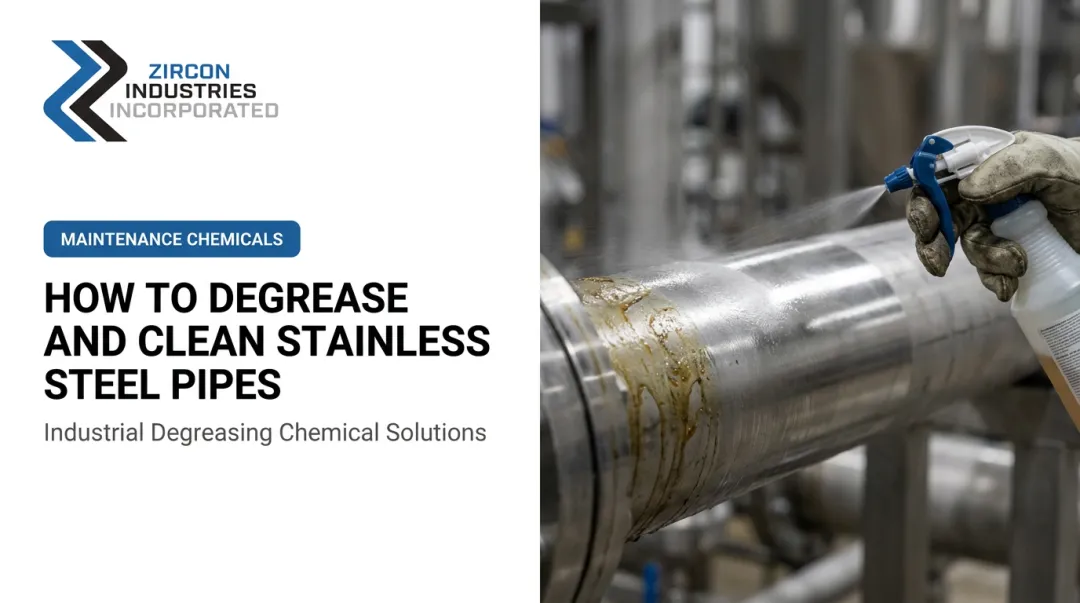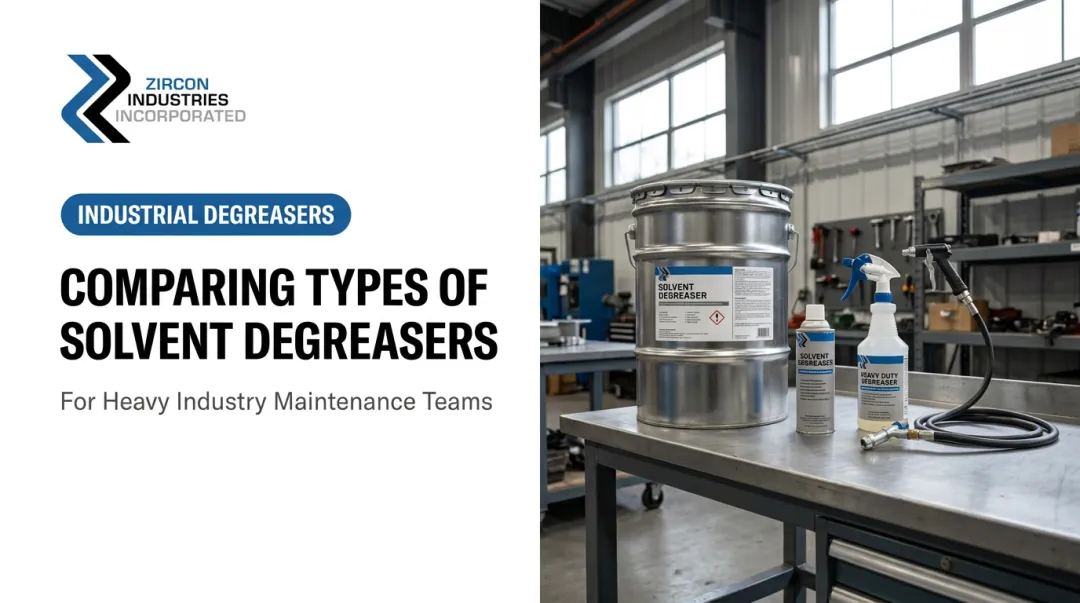
General-purpose cleaners may handle light soil but struggle with heavy grease, tar, asphalt, and cutting-fluid residue. Degreaser chemicals are formulated to dissolve, loosen, emulsify, or suspend these oil-based contaminants so they can be removed from compatible surfaces.
This guide explains how degreasers work, compares the main formula types, covers key safety considerations, and shows how to match a cleaner to a specific industrial application.
Key Takeaways
- Industrial degreasers use solvent action, surfactants, alkaline builders, emulsifiers, or a combination of these mechanisms to remove oily soils.
- Solvent-based, water-based, and bio-based formulas differ in evaporation rate, residue, flammability, material compatibility, and application method, not simply cleaning strength.
- Flash point, dielectric strength, surface compatibility, worker exposure controls, VOC requirements, and disposal procedures should be evaluated alongside purchase price.
- Zircon Industries offers Z99 Safety Solvent Degreaser for fast-drying, nonflammable cleaning of listed mechanical and electrical equipment.
What Is a Degreaser and How Does It Work?
A degreaser is a cleaning formulation designed to remove grease, oil, fats, tar, asphalt, cutting fluids, and other oily contamination from compatible surfaces. Unlike a general-purpose cleaner intended for routine soil, an industrial degreaser is selected around the type and amount of oily residue, the surface being cleaned, and the facility's application requirements.
Different formulas use different cleaning mechanisms. Solvents dissolve oily soils so they can be wiped or flushed away. In water-based formulas, surfactants reduce surface tension, help the solution wet the contaminated surface, and suspend or emulsify loosened oil in the wash solution. Alkaline builders can also help break down saponifiable fats and improve the removal of certain greasy soils. Dwell time, temperature, agitation, concentration, and rinsing all affect the final result.
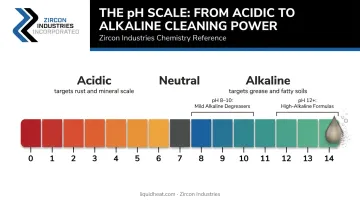
The EPA identifies mild alkaline aqueous cleaners in the pH 8-10 range and high-alkaline cleaners at pH 12 or higher. Higher alkalinity can improve cleaning on certain heavy oils and greases, but it also increases the importance of checking compatibility with metals, coatings, plastics, and elastomers. Acidic cleaners are generally selected for mineral scale, oxidation, and related deposits rather than oily soil.
Degreaser vs. All-Purpose Cleaner
An all-purpose cleaner is typically formulated for routine cleaning across a broad range of washable surfaces. A degreaser uses more specialized solvency, surfactant chemistry, alkalinity, or concentration to handle heavier oil-based contamination. The correct choice depends on the soil and surface; a stronger or more concentrated product is not automatically the better option for every job.
Industrial degreasers are commonly selected to tackle:
- Heavy grease and motor oil
- Tar and asphalt residue
- Cutting fluids and coolants
- Oily protective films and corrosion-inhibitor residue
- Handling contamination on heavy equipment and machinery parts
Types of Degreaser Chemicals: Solvent-Based, Water-Based, and Bio-Based Formulas
Degreaser categories differ in how they remove soil and how they must be applied. Selecting the right category helps maintenance teams achieve the required cleaning result while protecting the surface, controlling exposure, and meeting site procedures.
Solvent-Based Degreasers
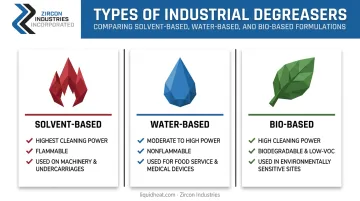
Solvent-based degreasers dissolve grease, oil, tar, and similar soils. Depending on the formulation, they may use hydrocarbons, oxygenated solvents, halogenated solvents, or other specialty solvent systems. They are often chosen when fast penetration, low residue, or rapid evaporation is important, including spot cleaning and the maintenance of mechanical or electrical components.
Flammability varies by formulation. Some solvent degreasers have low flash points, while others are specifically formulated to be nonflammable. Before use near heat, sparks, welding, or electrical equipment, verify the exact product's flash point, dielectric properties, ventilation requirements, and material compatibility.
Zircon Industries' Z99 Safety Solvent Degreaser is nonconductive, nonflammable, self-evaporating, and formulated without petroleum distillates. It has no flash point, dries quickly without residue, and provides 36,000-volt dielectric strength under ASTM D-877. Supported applications include engine parts, motors, windings, bearings, gears, relays, generators, starters, production machinery, electrical assemblies, meters, and printing equipment. Electrical cleaning should follow the product label and SDS, equipment-manufacturer instructions, and the facility's electrical-safety and lockout/tagout procedures.
Water-Based Degreasers
Water-based degreasers use water as the primary carrier and may combine surfactants with alkaline builders, emulsifiers, chelating agents, and corrosion-control additives. Depending on the formula, they can be supplied ready to use or as concentrates that are diluted for the required soil level.
These products often rely on dwell time, agitation, temperature, and rinsing to remove heavy contamination. They are well suited to washable equipment surfaces, floors, and parts-cleaning systems when the materials can tolerate water and the product's pH. Food-contact, medical-device, and other controlled applications require a product and cleaning procedure specifically approved for that use; being water-based alone does not establish suitability.
Bio-Based and Eco-Friendly Degreasers
Bio-based degreasers use solvents or other ingredients derived from renewable sources. Citrus-terpene formulas, for example, can provide strong solvency for grease, oil, tar, and asphalt and may incorporate emulsifiers to help the loosened soil rinse away. VOC content, flash point, material compatibility, worker controls, and disposal requirements still depend on the complete formulation.
For buyers evaluating environmental claims, the EPA's Safer Choice label is product-specific. Products carrying the label undergo ingredient, performance, pH, packaging, and VOC review under the program's criteria.
Zircon Industries' Floating Lift Station Degreaser is a 100% d'Limonene formula that is petroleum-free and USDA Authorized C1. It floats on water for continuous grease-dissolving action on wet walls in municipal wastewater lift stations, helps control odors, and is formulated not to disrupt bacterial action in raw sewage treatment operations. It is not intended for equipment cleaning, vehicle washing, or general-purpose degreasing.
| Type | How It Cleans | Key Selection Factors | Best-Fit Applications |
|---|---|---|---|
| Solvent-based | Dissolves oily soil and may evaporate rapidly | Flash point, dielectric strength, vapor controls, residue, and material compatibility | Electrical and electromechanical cleaning, metal parts, spot cleaning, and equipment maintenance, depending on the formula |
| Water-based | Uses surfactants and builders to loosen, emulsify, and suspend soil | pH, dilution, dwell time, rinsing, corrosion control, and water compatibility | Washable equipment surfaces, plant floors, and parts-washing systems |
| Bio-based | Uses plant-derived solvency, often combined with emulsifiers | Concentration, flash point, VOC content, compatibility, rinsing, and disposal | Grease, oil, tar, and asphalt on compatible industrial equipment and hard surfaces |
Key Factors to Consider When Choosing an Industrial Degreaser
Cleaning performance is only one part of product selection. Four factors determine whether a degreaser fits the surface, process, work area, and facility requirements.
Flammability and Fire Safety
A liquid's flash point is the lowest temperature at which it releases enough vapor to form an ignitable mixture near its surface. OSHA divides flammable liquids into four categories based on flash point and boiling point. Category 1 liquids have a flash point below 73.4 degrees F and a boiling point at or below 95 degrees F.
Where heat, sparks, welding, or other ignition sources are present, confirm the product classification and the controls required by its label, SDS, and facility procedures. A nonflammable product can be an important selection criterion for these work areas, but the complete hazard and application profile still needs to match the task.
Toxicity and Health Hazards
Hazards vary with the specific ingredients, concentration, application method, and exposure route. Several solvents historically used in cleaning operations now carry significant regulatory or occupational-health considerations:
- Perchloroethylene (PCE) and trichloroethylene (TCE) are subject to EPA risk-management rules addressing unreasonable risks. Facilities should confirm whether the proposed use is permitted and which workplace controls apply.
- 1-Bromopropane, also called n-propyl bromide or nPB, has been associated with neurological illness in occupational exposure cases, and NIOSH recommends engineering controls, work practices, and appropriate PPE to reduce exposure.
Review the SDS before purchasing and using a degreaser. Sections 2, 8, and 9 identify the product's hazard classification, exposure controls, PPE, and relevant physical properties.
Material Compatibility
Solvents and high-alkaline cleaners can affect plastics, elastomers, rubber seals, coatings, adhesives, and some metals. A formula that performs well on a steel part may soften a gasket or dull a finished surface on the same assembly.
Check the product's compatibility guidance and the equipment manufacturer's cleaning instructions before broad application. When a material or finish is not explicitly covered, test the correct use concentration on a small, inconspicuous area and inspect it after the recommended contact time.
Environmental and Regulatory Compliance
VOC requirements vary by product category, form, jurisdiction, and intended use. California's Consumer Products Regulation, for example, assigns requirements by defined product category rather than applying one universal limit to every degreaser. Facilities should confirm how the exact product and use are classified and account for wastewater, air-quality, storage, and waste-disposal rules that apply at the site.
Direct and Bulk Ordering: Purchase directly from Zircon Industries in the case, pail, or drum formats available for the selected product. Contact the team for current pricing, freight information, packaging availability, and application guidance.
Industries and Applications That Depend on Heavy-Duty Degreasers
Heavy-duty degreasing supports routine inspection, maintenance, repair, and housekeeping across demanding industrial operations.
- Mining, aggregate, and quarry operations: Crushers, conveyors, haul equipment, and support machinery accumulate grease, oil, and dust. Degreasers help clean compatible equipment exteriors, housings, and removed parts so maintenance teams can inspect and service them. Lubricated bearings, chains, and wear points should be restored according to the equipment manufacturer's procedures after cleaning.
- Trucking, railroad, and construction equipment maintenance: Engines, components, truck bodies, equipment frames, and undercarriages collect oil, grease, grime, tar, and asphalt. The selected formula must suit the soil as well as the metal, coating, wiring, seals, and plastics present.
- Manufacturing and utility maintenance: Motors, relays, meters, electrical assemblies, production machinery, and metal parts may require fast-drying or low-residue cleaners chosen for their dielectric properties and material compatibility.
- Food service and controlled manufacturing: Food-contact surfaces, medical-device operations, and other controlled processes require products and procedures approved for the exact application. Cleaning, rinsing, sanitizing, and validation requirements should follow the product label and the facility's regulatory and quality systems.
Zircon Industries supplies industrial cleaning products to mining, aggregate, trucking, railroad, manufacturing, and related operations. Z99 Safety Solvent Degreaser provides a fast-drying, nonflammable option for its listed mechanical and electrical uses.
Safety Best Practices When Handling Degreaser Chemicals
Industrial degreasers should be handled according to the exact product, application method, and work environment.
PPE and ventilation basics include:
- Chemical-resistant gloves selected for the ingredients and exposure time
- Safety glasses, goggles, or face protection where splash or spray exposure is possible
- Adequate general or local exhaust ventilation, particularly for spraying, enclosed spaces, tanks, or vapor-producing processes
- Respiratory protection selected through a hazard assessment and used under a compliant respiratory-protection program when engineering controls cannot adequately manage exposure
Before using a new degreaser, review the label and current SDS. Together, they provide the handling, ventilation, PPE, first-aid, storage, and physical-property information required for that formulation.
For electrical applications, confirm the product's dielectric rating and approved uses. Follow equipment-manufacturer instructions, facility electrical-safety procedures, and applicable lockout/tagout requirements rather than relying on dielectric strength alone.
Storage and disposal also depend on the formulation and how it was used. EPA's F001-F005 hazardous-waste listings cover specified spent solvents and mixtures under defined conditions. Identify the waste based on its ingredients, use, and contaminants, then follow the applicable federal, state, and local generator, accumulation, wastewater, and disposal requirements.
Why Choose Zircon Industries for Industrial-Grade Degreasing Solutions
Zircon Industries has manufactured specialty industrial chemicals since 1970. Its degreaser line gives maintenance teams application-specific options for heavy oily contamination and fast-drying solvent cleaning.
Z99 Safety Solvent Degreaser is a nonconductive, nonflammable, self-evaporating cleaner with no flash point, no petroleum distillates, and 36,000-volt dielectric strength under ASTM D-877 for its listed mechanical and electrical applications. Floating Lift Station Degreaser provides a 100% d'Limonene, petroleum-free, USDA Authorized C1 option for municipal wastewater and lift-station applications.
What over 55 years of manufacturing experience means for you:
- Industrial formulations developed for demanding maintenance and cleaning applications
- Distinct product options for heavy grease, oil, tar, and asphalt removal and for low-residue electrical and mechanical cleaning
- Product-specific packaging: Z99 is available in 5-gallon pails, 55-gallon drums, and cases of 12 20-ounce aerosol cans; Floating Lift Station Degreaser is available in 55-gallon drums
- Direct and bulk ordering with product-selection and application guidance from the Zircon Industries team
For help selecting the appropriate degreaser, contact Zircon Industries at 800-547-4328 or staff@liquidheat.com.
Frequently Asked Questions
What chemical is the best degreaser?
The best degreaser matches the soil, surface, process, and safety requirements. Alkaline water-based formulas are often effective on saponifiable grease and washable surfaces. Solvent-based formulas may be better suited to precision mechanical and electrical components where fast evaporation, no residue, and nonflammability are required. Z99 Safety Solvent Degreaser is designed for listed mechanical and electrical cleaning tasks that benefit from fast evaporation, no residue, and nonflammability.
Is degreaser a hazardous chemical?
Hazard classification depends on the complete formulation. Solvent-based, water-based, and bio-based degreasers can each require specific controls. Review the current SDS for hazard classification, exposure limits, ventilation, PPE, storage, spill response, and disposal instructions before use.
What is degreaser made of?
Degreasers may contain solvent blends that dissolve oily soil or water-based systems that combine surfactants, alkaline builders, emulsifiers, and other functional additives. Bio-based formulas may use plant-derived solvents such as citrus terpenes. The exact ingredients and concentrations vary by product and intended application.
Are degreasers flammable?
Some degreasers are flammable, while others are formulated to be nonflammable. Check the exact product's flash point and flammability classification rather than relying on its broad category. Zircon Industries' Z99 is a nonflammable solvent degreaser with no flash point and 36,000-volt dielectric strength under ASTM D-877.
Can degreaser damage plastic or rubber components?
Yes. Certain solvents and high-alkaline cleaners can soften, swell, crack, discolor, or embrittle plastics, elastomers, rubber seals, coatings, and adhesives. Review the product's compatibility information and equipment-manufacturer guidance, then test an inconspicuous area when the material is not explicitly covered.
How do you choose the right degreaser for your industry?
Start with the soil: grease, oil, tar, asphalt, cutting fluid, or mixed contamination. Then identify every surface and component the cleaner may contact. Compare the product's flash point, dielectric requirements, evaporation rate, residue, dilution, dwell time, rinsing needs, PPE, VOC classification, waste handling, and available packaging. For Zircon Industries products, contact the team with the equipment, soil, cleaning method, and facility requirements to confirm the appropriate option.