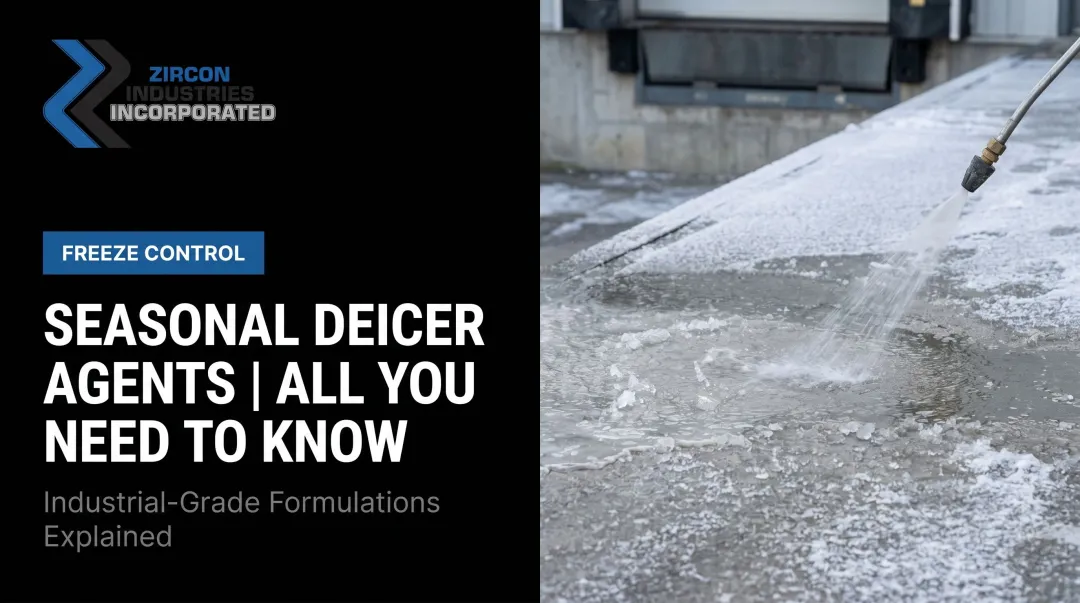
Those damp lines or white residue marks you see across a loading dock before a snowstorm are not leftover rain or random stains. They are liquid anti-icing treatments applied before snow or freezing conditions arrive so ice cannot bond tightly to the pavement.
For warehouses, distribution centers, manufacturing plants, and other industrial facilities, that matters far beyond appearance. Ice on dock approaches, trailer lanes, pedestrian routes, and loading areas can disrupt deliveries, increase slip risk, and slow equipment movement during the busiest parts of a winter shift.
This guide explains what facilities spray on loading docks before snow, how liquid anti-icing works, which chemicals are commonly used, when pre-treatment fails, and what industrial operators should consider when choosing a liquid deicer.
Key Takeaways
- Loading docks are commonly pre-treated with liquid anti-icing products that help prevent snow and ice from bonding tightly to paved surfaces
- Anti-icing is proactive; de-icing is reactive. Preventing the ice-pavement bond is usually easier than breaking it after the surface has frozen
- Liquid application gives facility teams more controlled coverage around dock approaches, trailer lanes, pedestrian routes, and recurring freeze zones
- Sodium chloride brine is a common low-cost option; calcium chloride, magnesium chloride, and blended formulations are used when lower-temperature performance is needed
- Product selection should account for pavement temperature, drainage, corrosion exposure, application equipment, and the type of traffic moving through the loading area
What Is the Liquid They Spray on Loading Docks Before Snow?
That damp sheen or white residue you notice across loading dock pavement before a winter storm isn't random. Facility teams apply liquid anti-icing treatments deliberately to help prevent ice from bonding tightly to the surface before trucks, forklifts, equipment, and employees begin moving through the area.
Salt Brine and Liquid Deicers: Common Pre-Treatments
One common pre-snow treatment is salt brine — sodium chloride dissolved in water at roughly 23–23.3% concentration by weight. According to FHWA's Manual of Practice for an Effective Anti-Icing Program, 23.3% is the eutectic concentration — the point at which sodium chloride brine reaches its lowest possible freezing temperature of -6°F (-21°C).
Industrial facilities may also use calcium chloride, magnesium chloride, or blended liquid deicers where lower-temperature performance or specific operational requirements matter.
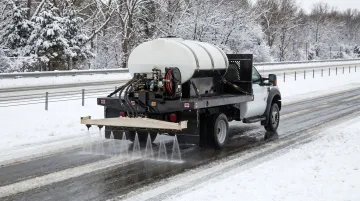
These treatments lower the freezing point of water and help prevent snow or ice from bonding tightly to pavement. The result is not an “ice-proof” loading dock, but a surface where snow and ice are easier to remove before they interfere with deliveries, pedestrian movement, or equipment operations.
Why Liquid Instead of Solid Salt?
Granular rock salt scattered across a dry loading dock can bounce, scatter under vehicle traffic, collect near drains, and remain inactive until enough moisture is present.
Liquid treatment works differently:
- Adheres immediately to the pavement surface on contact
- Leaves active residue after drying, often visible as white lines or streaks
- Reactivates when moisture arrives, as long as the treatment has not been diluted or washed off
- Allows more controlled application around dock approaches, trailer lanes, pedestrian routes, and recurring freeze zones
- Reduces loose granular material that can be tracked into warehouses or displaced by truck and equipment traffic
For industrial facilities, the main advantage is control. A calibrated liquid system can treat the areas that repeatedly freeze without spreading dry product across the entire loading area.
Anti-Icing vs. De-Icing: Understanding the Difference
These terms get used interchangeably, but they describe fundamentally opposite approaches to winter loading dock management — one helps prevent ice from bonding to the surface, while the other breaks that bond after it has already formed.
Anti-Icing (Proactive)
Anti-icing means applying liquid treatment before a storm begins. The goal is creating a chemical barrier that prevents snow and ice from ever bonding to the pavement surface. Once that bond never forms, plows can clear accumulated snow far more easily.
The effective temperature range depends on the chemistry being applied. Sodium chloride brine loses practical effectiveness as pavement temperatures fall, while calcium chloride, magnesium chloride, and specialized blends may perform at lower temperatures. Always match the product and application rate to actual pavement conditions.
De-Icing (Reactive)
De-icing means treating the loading dock during or after a storm to break an existing ice-pavement bond. It usually requires more material and more active removal than a successful pre-treatment. For facilities that cannot afford blocked dock doors, delayed trailers, or unsafe pedestrian routes, preventing the bond is usually easier than breaking it after it forms.
The Cost Difference
The operational case favors prevention. Anti-icing helps stop bonded snow and ice from forming in the first place, which can reduce repeated scraping, heavy granular applications, and emergency treatment during active loading hours.
Actual savings depend on storm timing, pavement temperature, application rates, labor costs, equipment calibration, and how much downtime the facility avoids.
How They Work Together
In practice, most facilities use all three steps:
- Anti-icing treatment applied before the storm
- Mechanical snow removal during or after accumulation
- Targeted de-icing treatment on remaining ice and recurring refreeze zones
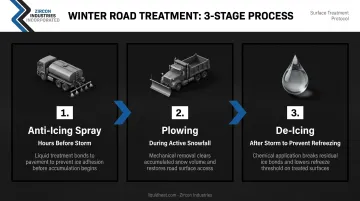
One important caveat to this sequence: anti-icing loses effectiveness when a storm opens with above-freezing rain. Rainfall can dilute or wash away the brine before snow or ice arrives, which is why operators monitor precipitation type and timing closely before committing to pre-treatment.
Types of Pre-Snow Loading Dock Treatment Chemicals
Not all liquid deicers are created equal. The right choice depends on pavement temperature, storm type, loading activity, corrosion exposure, drainage, application equipment, and budget.
Common Liquid Anti-Icing Chemicals
| Chemical | Eutectic Freeze Point | Best Use Case |
|---|---|---|
| Sodium chloride (NaCl) brine | -6°F (-21°C) eutectic | Standard anti-icing; most cost-effective |
| Magnesium chloride (MgCl₂) | -28°F (-33°C) eutectic | Lower-temperature blends and pre-wetting applications |
| Calcium chloride (CaCl₂) | -60°F (-51°C) eutectic | Very cold conditions; often used in blends or pre-wetting programs |
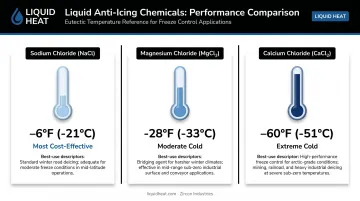
Source: FHWA Anti-Icing Program Manual. Eutectic temperatures are chemical limits, not guaranteed field performance temperatures.
A note on corrosion: the relationship between these chemicals and metal isn't simple. Research indexed by TRID found magnesium chloride was more corrosive than sodium chloride in humid environments, while sodium chloride caused more corrosion under immersion and arid conditions. There's no universal ranking, as corrosion behavior shifts with the exposure environment.
Organic Additives and Blended Formulations
Some liquid deicers blend chloride chemistry with organic or agricultural byproducts — including beet-derived additives, corn-based liquids, molasses-style blends, and glycerin-based materials. These additives are usually used to improve chloride performance, not eliminate chloride entirely.
Potential advantages include:
- Better adhesion to paved surfaces
- Reduced corrosion compared with some straight chloride formulations
- Improved performance under certain temperature and residue conditions
- More controlled liquid application with less loose material displaced by truck traffic
Facilities should compare actual product specifications rather than assuming every organic blend performs the same way.
Supplemental Treatments (Not Pre-Sprays)
Rock salt, sand, and pre-mixed calcium chloride/rock salt combinations are primarily de-icing or traction tools, applied during or after storms rather than as liquid pre-treatments. Sand provides traction but does not melt ice, and excess material can be tracked indoors, collect near drains, or interfere with housekeeping around active dock areas.
Loading dock managers, contractors, and industrial facilities sourcing liquid deicers should prioritize formulations matched to the actual application: pavement anti-icing, surface deicing, conveyor freeze prevention, truck-bed freeze release, or facility access control. For recurring treatment schedules, compatibility with automated spray systems is just as important as the chemistry itself.
How and When Loading Docks Are Treated Before a Storm
Timing a pre-treatment application correctly depends on more than the weather forecast. Facility teams should consider:
- Actual pavement temperature, not just air temperature
- Weather forecast data including storm timing, intensity, and duration
- Dew point and relative humidity to assess surface moisture conditions
- Precipitation type — whether the storm will start as rain, snow, sleet, or freezing rain
- Loading schedules — when trailers, forklifts, yard equipment, and employees will be moving through the area
- Drainage and refreeze patterns around dock aprons, ramps, doors, and shaded surfaces
The target window is before frozen precipitation starts and before the loading area becomes too active for controlled application.
Priority Treatment Locations
Not every part of a facility carries the same freeze risk. Prioritize:
- Loading dock aprons and trailer approaches
- Inclines, ramps, and dock access lanes
- Pedestrian doors, walkways, and employee crossing points
- Shaded areas and pavement near exterior walls
- Drainage zones and low spots where meltwater repeatedly refreezes
- High-traffic surfaces that must remain open throughout the storm
Application Rates
Liquid application rates vary by product chemistry, pavement temperature, storm timing, expected precipitation, and surface conditions. Follow the product manufacturer's application guidance rather than copying a fixed rate from another facility or application.
For recurring loading dock treatment, calibrated spray systems help maintain consistent coverage and reduce over-application. The goal is to treat the pavement evenly without creating unnecessary runoff, pooling near drains, or excess residue around dock doors and equipment routes.
Limitations and When Pre-Spraying Doesn't Work
Pre-treatment isn't a universal solution. Three conditions undermine its effectiveness:
1. Rain at storm onset If a winter storm begins as above-freezing rain before transitioning to snow, rainfall can dilute or wash the brine away before it can act. Even modest rainfall can reduce anti-icing effectiveness, so crews avoid pre-treatment when rain is expected before snow or freezing conditions.
2. Temperatures below sodium chloride’s practical range Sodium chloride brine reaches its theoretical eutectic point at -6°F (-21°C), but field performance weakens well before that because brine becomes diluted, traffic spreads it, and storms keep adding moisture. Many agencies use more conservative operating thresholds for straight salt brine and switch to magnesium chloride, calcium chloride, or blended products when pavement temperatures are too low for standard brine to perform efficiently.
3. Heavy residue from a prior treatment When significant chemical residue remains on the pavement, automatic re-application can waste material and increase tracking, runoff, or corrosion exposure. Facility teams should inspect the surface before each treatment rather than following a fixed schedule regardless of actual conditions.
Environmental and Facility Impact of Loading Dock Deicers
The chemistry applied to a loading dock does not disappear after the storm. Meltwater can carry residue toward drains, soil, surface water, equipment, trailer underbodies, and building components.
Chloride Runoff
The EPA's freshwater aquatic life criteria set the benchmark: a chronic chloride limit of 230 mg/L — four-day average, not to be exceeded more than once every three years — and an acute limit of 860 mg/L — one-hour average. Minnesota uses the 230 mg/L figure as its impairment assessment standard.
For industrial facilities, the practical issue is where runoff goes. Loading docks often sit close to storm drains, warehouse entrances, trailer staging areas, and landscaped edges. Over-application can move chloride residue beyond the treatment zone, which is why precise application and drainage awareness matter.
Equipment and Facility Corrosion
Repeated chloride exposure can accelerate corrosion on:
- Trailer and truck underbodies
- Dock levelers and metal dock components
- Forklifts and yard equipment
- Door hardware, railings, and exposed steel
- Drainage components and nearby metal infrastructure
Application should be controlled around metal-heavy areas, and residue should not be allowed to build up indefinitely on equipment or facility components.
Reducing Impact Through Precision Application
Industrial facilities can reduce unnecessary chemical use through more precise treatment:
- Apply liquid only to identified loading, pedestrian, access, and recurring refreeze zones
- Use calibrated equipment instead of estimating application rates by eye
- Match the formulation to actual pavement temperatures and operating conditions
- Inspect residual treatment before automatically reapplying
- Use anti-icing before the storm to reduce reliance on repeated emergency applications after ice has bonded
Frequently Asked Questions
What do they spray on loading docks to prevent ice?
Facilities commonly spray liquid anti-icing treatments such as sodium chloride brine, calcium chloride, magnesium chloride, or blended liquid deicers. These products help reduce the bond between snow, ice, and pavement so frozen buildup is easier to remove.
What will melt ice immediately?
Calcium chloride is one of the fastest lower-temperature deicing chemistries. Dry calcium chloride releases heat as it dissolves, while liquid calcium chloride brine is already in solution and can work faster than standard salt brine in cold conditions. Still, no deicer melts ice instantly — pavement temperature, dilution, application rate, and timing all affect how quickly it works.
What do warehouses use to deice loading docks?
Warehouses and industrial facilities use a mix of liquid deicers, granular ice melt, mechanical snow removal, and traction materials. The right combination depends on pavement temperature, truck and forklift traffic, pedestrian exposure, drainage, corrosion concerns, and how quickly the loading area must return to service.
Why do I see lines on loading dock pavement before it snows?
Those lines are often dried liquid anti-icing treatment applied with spray nozzles. The visible pattern shows where the liquid was placed before the storm so moisture can reactivate the treatment when snow or freezing conditions arrive.
How long does loading dock pre-treatment last before a storm?
A liquid anti-icing treatment can remain useful on dry pavement for hours or longer, depending on the chemistry, traffic, humidity, and weather conditions. Rain, heavy vehicle movement, cleaning, or runoff can dilute or remove the treatment, so facilities should inspect the surface instead of assuming one application will remain effective indefinitely.
Can loading dock deicers damage trucks or equipment?
Repeated exposure to chloride-based deicers can contribute to corrosion on trailer underbodies, forklifts, dock levelers, door hardware, and other metal components. Facilities can reduce exposure by applying only the amount needed, avoiding unnecessary pooling, managing runoff, and removing heavy residue buildup from equipment and high-contact areas.