Fugitive conveyor dust can enter idlers and bearings, accelerate abrasive wear, obscure walkways and guards, increase cleanup work, and contribute to airborne exposure. The visible dust around a transfer point is also a practical sign that material and dust-laden air are escaping the system.
This article focuses on engineered controls, including chute design, containment, sealing, local exhaust ventilation, and wet suppression. These controls work best as a coordinated system built around the material, conveyor, and measured exposure conditions.
Key Takeaways
- Each load zone, transfer point, and discharge can generate or release dust
- Reducing free-fall distance, controlling material trajectory, and managing entrained air limits dust generation at the source
- Enclosures, skirting, belt support, local exhaust ventilation, and wet suppression address different parts of the same problem
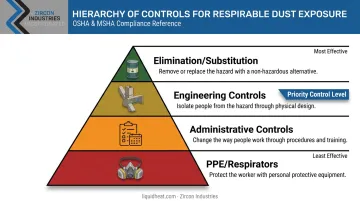
- OSHA and MSHA require engineering controls as the primary means of controlling respirable crystalline silica exposure, with respiratory protection used where required
How Conveyor Dust Builds Up
A moving conveyor belt pulls air along its surface even when it is empty. When material falls through a transfer chute, the moving stream entrains additional air. That air enters the receiving enclosure with the material and can pressurize an enclosure that is too small or poorly vented.
When the material strikes the receiving belt, impact and turbulence separate fine particles from the material stream. The displaced air then moves toward openings at the skirtboards, belt entry and exit points, inspection doors, worn seals, and other gaps. If the enclosure cannot slow, contain, or exhaust that air, it carries dust into the surrounding work area.
This process can occur at load zones, transfer chutes, crusher discharges, and conveyor head and tail sections. The amount of dust released depends on the material, transfer geometry, production rate, belt condition, enclosure design, and control system.
Nuisance Dust vs. Respirable Dust
Not all airborne particles behave the same way:
- Larger, settleable particles are more visible and tend to fall out of the air sooner, contributing to spillage, housekeeping, and visibility problems
- Respirable dust is defined by aerodynamic behavior and its ability to reach the gas-exchange region of the lungs, not by a simple maximum particle diameter
- Respirable sampling conventions use a size-selective curve with a 50% cut point near 4 micrometers aerodynamic diameter
- When the respirable fraction contains crystalline silica, it presents the occupational health hazard addressed by OSHA and MSHA silica standards (NIOSH Dust Control Handbook)
The respirable fraction may not be visible to the naked eye. Air sampling is therefore necessary to determine exposure; the appearance of a dust cloud alone cannot establish the respirable dust or silica concentration.
Key Drivers of Conveyor Dust Generation
Several factors interact to determine how much dust a transfer point produces and how much of it escapes.
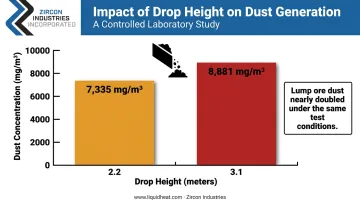
Drop height and impact energy. A longer free-fall distance increases material velocity, impact energy, and air entrainment. In a controlled chute study, increasing chute height from 2.2 meters to 3.1 meters raised the measured concentration for one limestone material from 7,335.1 mg/m3 to 8,881.1 mg/m3 (MDPI experimental study). The result is specific to that test material and apparatus, but it demonstrates why transfer design should minimize unnecessary free fall.
Uncontrolled air movement compounds the problem. NIOSH guidance recommends keeping air velocity inside a transfer enclosure below about 200 feet per minute so the enclosure can act as a settling plenum. Where local exhaust ventilation is used, unavoidable openings are designed for inward air velocity of approximately 200 feet per minute to prevent dust leakage.
Production increases can overload an enclosure or chute designed for a lower material rate or belt speed. Higher throughput changes material depth, impact, induced airflow, and the amount of settling volume required.
Material characteristics also affect dust generation:
- Drier material generally releases more dust than the same material at a controlled higher moisture content
- A larger percentage of fines increases the amount of material available to become airborne
- Friable material can break during handling and create additional fines
- Particle size, shape, surface condition, and moisture all influence how readily the material can be wetted
Finally, belt sag and misalignment open gaps along the skirting seal. An unsupported or off-center belt allows dust and spillage to escape below the containment line.
Engineered Controls for Reducing Conveyor Dust
Effective conveyor dust control addresses three areas: the transfer itself, the containment and ventilation system, and the condition of the material. Each control should be selected around the source and verified under operating conditions.
Controls That Change Transfer Point Design
Reducing the energy and turbulence of the transfer limits the amount of dust generated:
- Minimize free-fall distance with rock ladders, telescoping chutes, spiral chutes, bin-lowering chutes, or intermediate impact points suited to the material
- Control material trajectory with sloped impact surfaces, rockboxes, impact beds, or engineered curved chute geometry that reduces abrupt changes in direction
- Load in the direction of belt travel and center the material on the receiving belt to reduce impact, side loading, and turbulence
- Provide sufficient settling volume by making the enclosure and skirtboard section long and high enough to slow the air and allow dust to return to the material stream
Controls That Improve Containment and Sealing
Once dust is generated, the enclosure must keep it from escaping while the material and air stabilize:
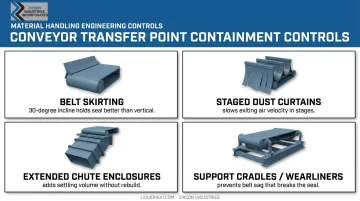
- Belt skirting closes the lateral gaps along the loading zone. NIOSH guidance notes that skirting angled approximately 30 degrees from vertical can provide wear and sealing advantages over a standard vertical arrangement
- Strip curtains and dust curtains reduce the effective opening at conveyor entry and exit points while allowing material to pass
- Extended or modular chute enclosures add settling volume and give entrained air more room to slow before it reaches an opening
- Slider-bar cradles and continuous belt support reduce sag beneath the skirting and help maintain a consistent seal
- Local exhaust ventilation captures dust-laden air from enclosed transfers. The pickup point, airflow, duct velocity, collector capacity, and replacement air must be engineered as one system
Controls That Modify Material and Environment
Wet suppression can complement transfer design and containment when the material and downstream process can tolerate added moisture. NIOSH recommends wetting the full width of the material and locating sprays near the beginning of the dust source. Multiple lower-flow nozzles positioned close to the material can improve coverage without creating unnecessary air turbulence.
Zircon Industries' ZHP Water Wetter is a non-ionic surfactant and resin extender that reduces water's surface tension so the water spreads and penetrates the treated material more effectively. It is introduced at a ratio of 1 part ZHP to 1,500-3,000 parts water. For conveyor dust suppression, the treated water is applied through the site's properly designed spray bars, nozzles, pumps, hoses, and controls.
The optimum moisture addition depends on the material, belt loading, downstream screens, product specifications, climate, and existing moisture content. Applying more water than the process can accept can increase carryback or interfere with screening and material flow, so spray output should be adjusted from operating observations and exposure-control data.
Local exhaust ventilation and dust collection are also primary engineering controls at enclosed transfer points. They can be used with or without wet suppression, depending on the material, process, climate, and air-quality target.
Regulatory Considerations for Engineered Dust Controls
OSHA and MSHA regulate different workplaces, but both require source controls for respirable crystalline silica.
For general industry and maritime workplaces covered by OSHA 29 CFR 1910.1053, the permissible exposure limit is 50 micrograms per cubic meter as an 8-hour time-weighted average, and the action level is 25 micrograms per cubic meter. Employers must use feasible engineering and work-practice controls to reduce exposure to or below the PEL. Where those controls cannot reach the PEL, they must still reduce exposure to the lowest feasible level and be supplemented with respiratory protection.
For mines, MSHA's respirable crystalline silica rule establishes a PEL of 50 micrograms per cubic meter and an action level of 25 micrograms per cubic meter over a full shift, calculated as an 8-hour time-weighted average. Mine operators must use and maintain engineering controls as the primary means of controlling exposure.
These limits apply specifically to respirable crystalline silica. The silica content of the handled material and representative personal exposure sampling determine whether workers are at or above the action level or PEL.
Documenting engineered controls supports both compliance and maintenance:
- Chute drawings, enclosure dimensions, sealing specifications, ventilation design data, and spray-system settings establish the intended control configuration
- Inspection and maintenance records show whether skirts, curtains, belt supports, nozzles, ducts, and collectors are operating as designed
- Exposure-monitoring results show whether the complete control system is reducing worker exposure
- Written exposure-control plans connect identified tasks with the engineering controls, work practices, housekeeping measures, and respiratory protection used
Conclusion
Reducing conveyor dust requires a layered system built around where dust is generated and how dust-laden air moves through each transfer point. Chute geometry limits impact and air entrainment. Belt support, skirting, curtains, and enclosures contain the source. Local exhaust ventilation or wet suppression then controls the dust that remains.
A conveyor audit should document drop height, material trajectory, enclosure volume, unavoidable openings, belt support, seal condition, airflow, production rate, material moisture, and worker exposure data. Where wet suppression is appropriate, ZHP Water Wetter can improve the coverage and penetration of water applied through the site's conveyor spray system. Inspection and exposure monitoring should then confirm that the combined controls perform as intended.
Frequently Asked Questions
What is the purpose of dust suppression?
Dust suppression prevents or limits fine particles from becoming airborne. On conveyor systems, it can reduce worker exposure, airborne material loss, equipment contamination, and housekeeping demands. Regulatory compliance still depends on exposure assessment, control performance, documentation, and the requirements that apply to the facility.
What is the best method of dust suppression?
The strongest approach controls dust as close to the source as possible. Transfer design, enclosure, belt support, sealing, local exhaust ventilation, and wet suppression each address a different cause or pathway. The right combination depends on the material, transfer point, climate, downstream process, and exposure-monitoring results.
What is the OSHA standard for dust control?
OSHA does not apply one exposure limit to every type of dust. For respirable crystalline silica in general industry and maritime, 29 CFR 1910.1053 sets a PEL of 50 micrograms per cubic meter as an 8-hour time-weighted average and an action level of 25 micrograms per cubic meter. Mines are regulated by MSHA, whose silica rule uses the same numerical PEL and action level over a full shift calculated as an 8-hour TWA.
What is the difference between nuisance dust and respirable dust?
Visible, settleable dust primarily contributes to spillage, housekeeping, visibility, and equipment contamination. Respirable dust is the size-selective fraction capable of reaching the gas-exchange region of the lungs. It is defined by aerodynamic behavior and sampling convention, and much of it may be too small to see. When respirable dust contains crystalline silica, it presents the hazard covered by silica exposure standards.
Can engineered controls fully eliminate conveyor dust without chemical suppression?
A well-designed dry system using controlled transfer geometry, enclosure, sealing, and local exhaust ventilation may achieve the required control without chemical suppression. Other operations benefit from wet suppression because of their material, process, or climate. Performance should be established through inspection, airflow measurements, and representative exposure monitoring.
How do engineered dust controls impact maintenance and operating costs?
Effective controls can reduce spillage cleanup, abrasive contamination, premature component wear, material loss, and interruptions caused by failed seals or blocked equipment. They also require inspection and maintenance of skirts, curtains, supports, nozzles, ducts, and collectors. Facilities can evaluate the operating impact by tracking cleanup hours, component replacement, water use, collector performance, downtime, and exposure results before and after the upgrade.