Introduction
Every time rock, concrete, or aggregate fractures inside a crusher, it releases fine respirable particles — including crystalline silica — that spread through the plant and surrounding area. Size reduction exposes fresh surfaces instantly, and the finest particles can reach deep into lung tissue.
Granite alone contains 10% to 50% crystalline silica by composition, according to OSHA/NIOSH data. Sandstone runs even higher, at 60% or more. When those materials fracture at high energy inside a crusher, workers don't just see dust — they may be exposed to respirable crystalline silica that requires engineered control.
Left uncontrolled, crusher dust creates compounding problems: occupational disease risks, OSHA and MSHA compliance exposure, accelerated equipment wear, and complaints from neighboring properties. The right suppression system reduces those risks at the source instead of relying on cleanup after dust has already spread.
This guide covers where crusher dust actually comes from, which suppression systems address each source, what OSHA and MSHA require, and what a practical, layered dust control program looks like in operation.
Key Takeaways
- Fines screening, fines crushing, and screening are among the highest AP-42 process emission sources in aggregate plants
- OSHA's silica standard sets a PEL of 50 µg/m³ as an 8-hour TWA; the 25 µg/m³ action level triggers exposure-assessment requirements when Table 1 is not fully implemented
- Effective programs layer water spray or mist, surfactant-enhanced suppression, enclosures, operator isolation, and site-level road and stockpile controls
- Surfactants improve water penetration and dust capture; road and stockpile suppressants extend control beyond the crusher circuit
- For covered construction work, OSHA requires a written exposure control plan, maintained controls, a competent person, and documented worker training
Health and Operational Risks of Crushing Plant Dust
What Crusher Dust Actually Contains
Crusher dust is not a single substance. It's a mixture of fine particles — PM10 (≤10 micrometers), PM2.5 (≤2.5 micrometers), and finer fractions — generated when rock fractures under high compressive force. According to the EPA, particles at the PM2.5 scale pose the greatest health risk because they can penetrate deep into lung tissue and enter the bloodstream.
The crystalline silica content of the feed material determines exposure severity:
| Rock Type | Approximate Crystalline Silica Content |
|---|---|
| Quartzite | ≥95% |
| Sandstone | ≥60% |
| Granite | 10–50% |
| Limestone | Generally <5% |
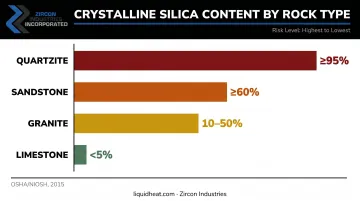
Source: OSHA/NIOSH stone silica-content ranges; actual crystalline silica content varies by material source and should be verified through material testing where exposure risk is significant.
Disease Consequences of Silica Exposure
Prolonged silica exposure causes irreversible occupational diseases. OSHA and NIOSH recognize silicosis, lung cancer, COPD, and kidney disease as documented outcomes of chronic respirable crystalline silica exposure.
These diseases often develop silently over years or decades. By the time symptoms appear, the damage may already be permanent. Quarry and stone-processing studies continue to link long-term dust exposure with elevated respiratory disease risk, but each plant still needs site-specific exposure assessment to understand actual worker risk.
Suppressing dust at the source is the most reliable way to reduce exposure before it spreads across the plant.
Operational Consequences Beyond Health
Crusher dust also degrades equipment across the plant. Documented operational impacts include:
- Dust ingress into bearings, rollers, and pulleys causes accelerated shaft wear
- Clogged air filters shorten maintenance intervals and can compromise diesel fuel systems
- Electrical switches malfunction when dust infiltrates control cabinets
- Heat and moisture buildup occurs in plugged cabinet filters
- Reduced visibility across the plant creates safety hazards
These mechanisms are well-established in industry practice. No single verified cost benchmark covers all crushing plant configurations, but any plant manager who has replaced a prematurely worn bearing understands the downstream expense.
Primary Dust Generation Points in a Crushing Plant
Effective dust suppression starts with knowing exactly where to apply controls. Spraying at random wastes water and misses the sources that matter. EPA AP-42 emission data identifies the measurable sources clearly:
| Source | Uncontrolled PM10 (kg/Mg) | Controlled PM10 (kg/Mg) |
|---|---|---|
| Fines screening | 0.036 | 0.0011 |
| Fines crushing | 0.0075 | 0.0006 |
| Screening | 0.00435 | 0.00037 |
| Tertiary crushing | 0.0012 | 0.00027 |
| Conveyor transfer point | 0.00055 | 0.000023 |
Fines screening, fines crushing, and screening are the highest AP-42 per-ton PM10 sources in this group. Transfer points are lower per ton, but they are repeated across every plant — which adds up fast when every conveyor drop creates another dust source.
Crusher Inlet and Discharge
The crusher chamber is the primary generation point. Material fractures at high energy, releasing a surge of fine particles with every cycle. NIOSH specifically notes that jaw crushers create a bellows-type effect — the mechanical action of the jaws generates air movement that pushes dust outward through both the inlet and the discharge. Suppression applied at only one end of a jaw crusher is only half a solution.
Transfer Points and Conveyor Belts
Every drop point where material falls from one conveyor to another generates airborne dust through two mechanisms:
- Impact fracturing — material breaks further on landing, releasing fresh fines
- Induced airflow — falling material pulls air downward, then displaces it outward as a dust-carrying current
For local exhaust ventilation and enclosure design, belt speed, material drop height, induced airflow, and enclosure openings all affect the capture volume needed at transfer points. Lower drop heights reduce both impact fracturing and induced airflow before suppression is even applied.
Screening Operations and Stockpile Areas
Vibrating screen decks handle the finest material in the plant and are a significant secondary dust source — the EPA data confirms this. Stockpile loading and truck loading areas are just as important but routinely under-controlled compared to the crushing circuit. Wind erosion from uncovered stockpile faces can generate substantial fugitive dust independent of any active processing operation.
Types of Dust Suppression Systems for Crushing Plants
No single method eliminates all crusher plant dust. The most effective programs layer multiple approaches, starting at the source and working outward to site perimeters.
Wet Water Spray Systems
Pressurized water delivered through nozzles at the crusher inlet, discharge, and conveyor transfer points increases particle weight so dust drops out of the air rather than staying suspended. The nozzle type matters:
- Hollow cone nozzles — produce smaller droplets (10–150 micrometers) suited for capturing airborne dust already in suspension
- Full cone nozzles — produce larger droplets (200–500 micrometers) suited for wetting material surfaces in bins and hoppers to prevent dust generation
Over-application is a real operational problem. Saturating material causes buildup inside the crusher, accelerated hammer wear, screen blinding, and sticky discharge that slows the entire plant. The target is a fine mist that suppresses dust without adding meaningful moisture to the product.
Chemical Dust Suppressants
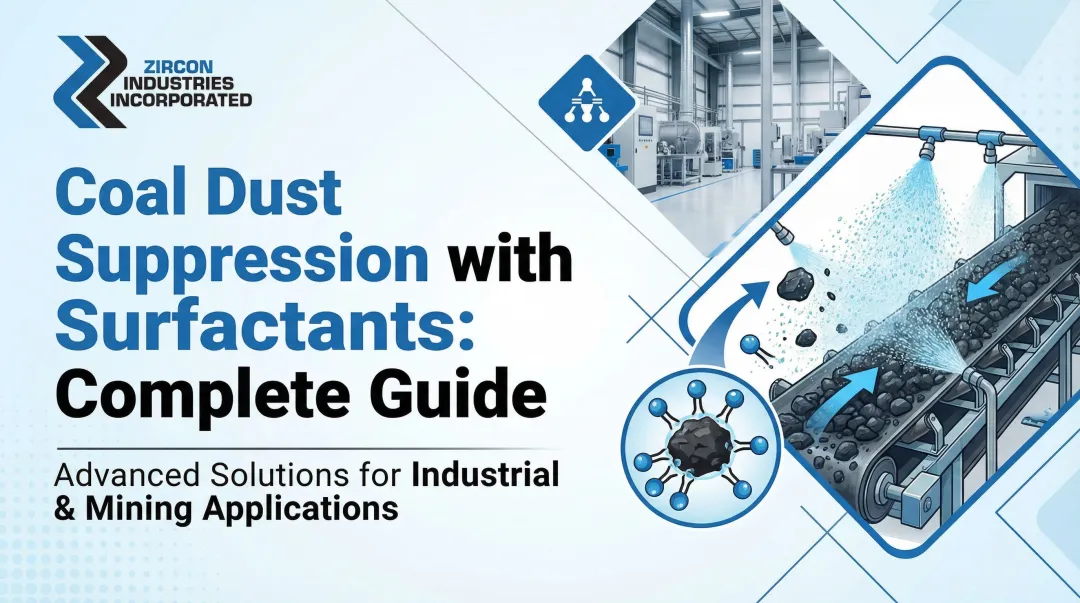
Chemical dust control is not one product category. In crusher circuits, surfactant-based water additives help reduce surface tension so water spreads, penetrates, and captures fine dust more effectively than water alone. This can reduce water demand while improving suppression at crushers, screens, hoppers, and transfer points.
For plant roads and outdoor material-handling zones, longer-duration suppressants serve a different role. RDS38 Road Dust Stabilizer is designed for active unpaved and gravel roads exposed to repeated truck traffic, helping control both existing dust and new dust stirred up daily. Latex 100 is better suited for static or undisturbed material surfaces such as aggregate, coal, fly ash areas, open unused lots, and railcar tops — not active haul roads.
These products should be matched to the source. A surfactant-enhanced spray program helps inside the crusher circuit. RDS38 supports active haul-road control. Latex 100 supports static stockpile and surface sealing. None of these replaces the need for properly maintained OSHA-required engineering controls at crushing machines.
Dry Fog and Fine Misting Systems
Dry fog systems atomize water into very fine droplets sized to interact with airborne dust particles. They can reduce total water addition compared with standard spray systems and work particularly well at transfer points and enclosed areas where airflow can be controlled. The tradeoff is higher upfront infrastructure cost, compressed-air or high-pressure requirements, and more demanding maintenance compared to basic spray nozzles.
Dust Collectors and Enclosures
Enclosing crusher housings, transfer points, and screen decks and connecting them to baghouse, cartridge, or other properly designed filtration systems is the highest-performance option available. EPA data indicates fabric filter systems achieve collection efficiency greater than 99.5% for controlled dry-process equipment. This approach is most practical for fixed crushing plants where regulatory pressure is highest — mobile and portable operations face real challenges with enclosure implementation.
Operator Isolation
OSHA's crushing-machines guidance explicitly recognizes operator isolation as an engineering control: an enclosed booth or remote-control station that physically separates the operator from the dust zone. OSHA specifies positive pressure, filtered intake air rated MERV-16 or better, climate control, and closed doors and windows for these enclosures. Operator isolation works best as a complement to wet suppression — not a substitute for it.
OSHA and MSHA Compliance Requirements for Crushing Plant Dust
The Regulatory Framework
OSHA's 29 CFR 1926.1153 governs construction operations involving respirable crystalline silica, including crushing tasks covered by Table 1. The standard sets:
- PEL: 50 µg/m³ respirable crystalline silica, 8-hour TWA
- Action Level: 25 µg/m³, 8-hour TWA — triggers exposure assessment and monitoring requirements when employers are not fully and properly implementing Table 1
For construction work, medical surveillance is not triggered by the action level alone. OSHA requires medical surveillance for employees who are required by the silica standard to use a respirator for 30 or more days per year.
MSHA published a newer silica rule with a 50 µg/m³ PEL and 25 µg/m³ action level, but current enforcement status must be handled carefully. A 2026 Federal Register notice states that conforming amendments for metal/nonmetal mines are delayed indefinitely pending judicial review, and MSHA continues to enforce the existing Parts 56 and 57 standards until the court-ordered stay is terminated.
OSHA Table 1 Compliance
OSHA Table 1 lists specific construction tasks paired with required engineering and work-practice controls. Crushing machines are explicitly listed. For crushing machines, Table 1 requires:
- Equipment designed to deliver water spray or mist for dust suppression at the crusher and other dust generation points, including hoppers, conveyors, sieves, vibrating components, and discharge points
- Operation and maintenance in accordance with manufacturer instructions to minimize dust emissions
- A ventilated booth that provides fresh, climate-controlled air to the operator, or a remote-control station
Local exhaust ventilation and enclosures can still be part of a stronger dust-control strategy, but the Table 1 crusher row itself is not written as a simple “water or LEV” choice.
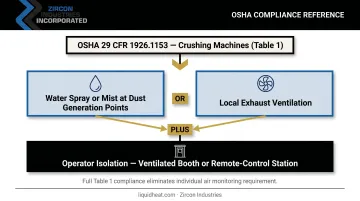
Employers who fully and properly implement Table 1 controls for a listed task can use that compliance path instead of performing individual exposure monitoring for that task. If those controls are not fully implemented, the employer must assess exposure and ensure workers are not exposed above the PEL.
Written Exposure Control Plan
Table 1 compliance doesn't stand alone — it must be backed by a written exposure control plan for covered construction work. Every covered employer must maintain a plan that:
- Identifies all silica-generating tasks
- Describes the engineering controls, work practices, and respiratory protection in use
- Designates a competent person responsible for implementation and frequent inspections
- Is reviewed and evaluated at least annually and updated as necessary
A missing or inadequate exposure control plan is a citable violation, and suppression equipment that is present but not operating properly will not protect workers or support compliance.
Medical Surveillance and Additional Requirements
Additional compliance obligations include:
- Medical surveillance offered to any worker required to wear a respirator 30 or more days per year
- Respirator fit testing — proper fit is required, not just respirator provision
- No dry sweeping in silica-exposure areas — wet vacuuming or HEPA-vacuum methods required
- Documented training on silica hazards and controls for all exposed workers
Best Practices for a More Effective Dust Suppression Program
Start with a Site-Specific Dust Assessment
Before installing any system, identify where dust is actually generated at your specific plant. A useful assessment includes:
- Rank your top 3–5 emission points by volume and worker proximity — use the EPA AP-42 emission factor table as a starting framework
- Map prevailing wind direction — it determines where dust migrates and how to orient discharge points and suppression equipment
- Establish a baseline using personal air sampling per NIOSH Method 7500 (crystalline silica by XRD, the CDC's preferred method) so you can measure suppression effectiveness after installation
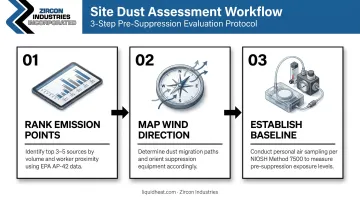
Personal sampling also satisfies the exposure-assessment component of the written control plan if you're not using Table 1.
Maintain Operational Discipline
The most common failure in crusher plant dust control is suppression systems that are physically present but switched off. Common reasons: water conservation, freeze avoidance, unfamiliar operators. None of these are acceptable reasons to leave required dust controls inactive during silica-generating work.
Practical disciplines that prevent this:
- Suppression must operate whenever crushing is generating dust, in accordance with Table 1 requirements, manufacturer instructions, and the site's written exposure control plan
- Pre-shift checks of nozzle output and water pressure, every shift
- Weekly inspection of hoses, fittings, and flow valves for wear or clogging
- Water supply pre-planned: tank capacity, hose connections, on-site source
- Moist feed material generates significantly less dust than dry feed — conditioning material upstream is a low-cost, high-value supplement
Control Haul Roads and Stockpiles as a Separate Zone
Haul roads and stockpile areas generate substantial fugitive dust completely independent of the crushing circuit. EPA background documentation reports spray systems on storage piles can reduce loading and wind-erosion emissions by 80% to 90%. Chemical dust suppressants applied to haul road surfaces provide longer-lasting control than water alone, reducing re-application frequency along with the labor and water costs that go with it.
Zircon Industries products should be matched to the surface being treated. RDS38 Road Dust Stabilizer is built for active unpaved plant roads and high-traffic industrial surfaces where trucks keep stirring up new dust. Latex 100 is better suited for static dust sealing on undisturbed aggregate, coal, fly ash areas, unused lots, and open railcar tops. A program that controls the crusher circuit but ignores haul roads, stockpiles, and loading zones is incomplete.
Frequently Asked Questions
How do you control dust in a crusher plant?
Effective crusher plant dust control layers multiple controls: source suppression at the inlet and discharge, water spray or mist at conveyor transfer points and screen decks, surfactant-enhanced water where appropriate, and site-level controls for haul roads and stockpiles. Operator isolation, exposure assessment, and respiratory protection fill remaining gaps when required. Layering these methods consistently outperforms relying on any single approach.
What is a dust suppression system for a stone crusher?
A dust suppression system for a stone crusher is a set of engineered controls positioned at key generation points — inlet, discharge, hoppers, screens, conveyors, and transfer points. These typically include water spray or mist, surfactant-enhanced spray programs, enclosures, filtration, and operator isolation, all designed to prevent fine particles from becoming airborne during crushing and material handling.
What are OSHA's requirements for silica dust in crushing operations?
OSHA's 29 CFR 1926.1153 sets a PEL of 50 µg/m³ for respirable crystalline silica as an 8-hour TWA and an action level of 25 µg/m³. Crushing machines are listed in Table 1, which requires water spray or mist at dust generation points, proper operation and maintenance, and operator isolation through a ventilated booth or remote-control station. Employers must also maintain a written exposure control plan, designate a competent person, and train exposed workers.
Can chemical dust suppressants replace water-only spray systems in crushing plants?
Chemical suppressants and surfactants enhance water-based programs rather than replace required crusher-zone engineering controls. In the crusher circuit, surfactant-enhanced water can improve droplet spread, penetration, and dust capture. Outside the crusher circuit, products like RDS38 and Latex 100 extend dust control on the surfaces they are designed for: active haul roads for RDS38, and static or undisturbed material surfaces for Latex 100.
How often should dust suppression systems be inspected and maintained?
Conduct daily pre-shift checks of nozzle output and water pressure, weekly inspection of hoses, fittings, and flow valves, and periodic reviews aligned with your written exposure control plan. A suppression system that is present but non-functional does not control exposure and will not support OSHA compliance.
Does excess water from dust suppression cause problems in a crushing plant?
Over-application causes material buildup inside the crusher, increased hammer wear, screen blinding, and sticky discharge that slows production. The goal is a fine mist that suppresses dust without saturating the material. Adjust flow valves and match water volume to the actual production rate of each machine.